
 Back
Back





IN THE HIGH COURT OF ALLAHABAD
SHEKHAR B. SARAF, J.
Bharatiya Rashtriya Rajmarg Pradhikaran – Appellant
Versus
Neeraj Sharma And Others – Respondent
Appeal under section 37 of arbitration and Conciliation act no. 8 of 2020
Decided on : 24-05-2024
ARBITRATION - NATIONAL HIGHWAYS ACT, 1956; ARBITRATION & CONCILIATION ACT, 1996 - Sections 3A, 3D, 3G(5) of NHAI Act; Sections 31(5), 34, 37 of Arbitration Act - The court discussed the significance of Section 31(5) of the Arbitration Act, emphasizing that the delivery of a signed copy of the arbitral award is not merely procedural but substantive, as it initiates various timelines for challenging the award. The court interpreted the requirement of delivery in light of the parties' actual knowledge of the award's contents, concluding that the appellant's awareness and actions negated their claim of non-receipt, thus affirming the lower court's dismissal of the application as time-barred.
Fact of the Case:
The appellant filed an application under Section 37 of the Arbitration Act against a judgment rejecting their application under Section 34, which challenged an arbitral award regarding compensation for land acquired under the NHAI Act. The appellant contended they never received a signed copy of the award, which they claimed was necessary for the limitation period to commence.
Finding of the Court:
The court found that the appellant was aware of the arbitral award and had acted upon it, thus demonstrating practical acknowledgment of the award. The court emphasized that the delivery of a signed copy is crucial but should not be interpreted so literally as to undermine the arbitration process's objectives.
Issues: Whether the learned District Judge was justified in dismissing the application under Section 34 of the Arbitration Act as time-barred due to the appellant's claim of not receiving a signed copy of the arbitral award.
Ratio Decidendi: The court held that the requirement of delivering a signed copy of the arbitral award is substantive and initiates limitation periods. However, if a party is aware of the award's contents and acts upon it, they cannot later claim non-receipt to avoid the consequences of the award. The principle of estoppel applies, preventing a party from taking inconsistent positions.
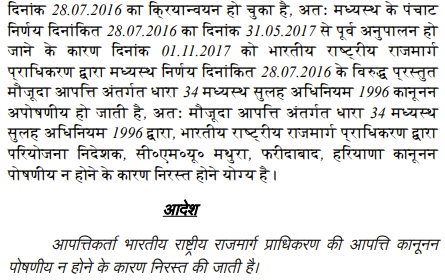
Final Decision: The court dismissed the application under Section 37, affirming the lower court's decision that the arbitral award had attained finality and could not be questioned at this stage.
JUDGMENT :
HON’BLE SHEKHAR B. SARAF, J.
1. The instant application has been filed under Section 37 of the Arbitration & Conciliation Act, 1996 (hereinafter referred to as the ‘Arbitration Act’) against the judgment and order dated November 16, 2019 passed by the District Judge, Mathura rejecting the application filed by Bharatiya Rashtriya Rajmarg Pradhikaran (hereinafter referred to as the ‘Appellant’) under Section 34 of the Arbitration Act.
FACTS
2. I have laid down the factual matrix of the instant lis below:
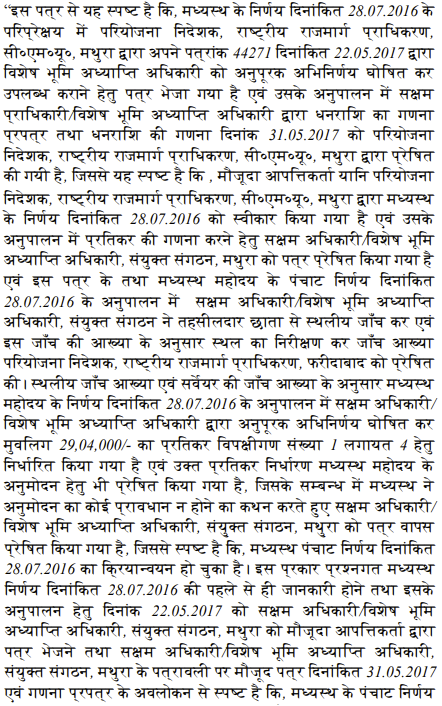
(a) A notification was issued under Section 3A of the National Highways Act, 1956 (hereinafter referred to as the ‘NHAI Act’) on December 4, 2009 followed by a declaration dated June 25, 2010 under Section 3D of the NHAI Act in respect of the land in question. Thereafter, the Competent Authority declared the award determining the amount of compensation in respect of the land in question under Section 3G of the NHAI Act.
(b) Against the award of the Competent Authority, the Respondents filed a petition under Section 3G(5) of the NHAI Act before the Arbitrator (Additional Commissioner (Administration), Agra Division, Agra). The Arbitrator published an award on July 28, 2016 and remanded the matter to the Competent Authority.
(c) The appellant filed an application under Section 34 of the Arbitration Act against the award dated July 28, 2016 which was rejected vide judgment and order dated November 16, 2019.
(d) Against the judgment and order dated November 16, 2019, the appellant has filed the instant application under Section 37 of the Arbitration Act before this Court.
CONTENTIONS OF THE APPELLANT
3. Shri Pranjal Mehrotra, learned counsel appearing for the appellant has made the following submissions before this Court:
(i) As per the provisions of Section 3G(5) of the NHAI Act, the Arbitrator ought to have determined the amount itself. As such, the Arbitrator was not justified in remitting the matter back to the Competent Authority.
(ii) Learned District Judge acted with patent illegality in passing the impugned judgment and order dated November 16, 2019.
(iii) The appellant never received a signed copy of the arbitral award dated July 28, 2016 which is a mandatory requirement under Section 31(5) of the Arbitration Act. As such, the Learned District Judge was not justified in dismissing the application filed by the appellant as time barred.
CONTENTIONS OF THE RESPONDENT
4. Learned counsel appearing for the Respondents has made the following submission before this Court: The appellant had knowledge of the arbitral award dated July 28, 2016 and was fully aware of the same. As such, it is not open for it to now argue that since the appellant did not receive a signed copy of the award dated July 28, 2016, the period of limitation for challenging an arbitral award under Section 34 of the Act never started. Learned District Judge did not err in dismissing the application filed by the appellant under Section 34 of the Act as time barred. Reliance in this regard is placed upon the judgment of the High Court of Chhattisgarh in Union of India -v- Bhola Prasad Agrawal reported in 2022 SCC OnLine Chh 1644.
ANALYSIS
5. I have heard the learned counsel appearing for the parties and perused the materials on record.
6. The primary issue raised in the instant case is that whether or not the Learned District Judge was justified in dismissing the application filed by the appellant under Section 34 of the Arbitration Act since the appellant was never served with a signed copy of the arbitral award, which is a mandatory requirement under Section 31(5) of the Arbitration Act. Relevant parts of Section 31(5) of the Arbitration Act have been extracted herein below for ease of reference:
“31. Form and contents of arbitral award. —
(1) ...
(2) ...
(3) ...
(4) ...
(5) After the arbitral award is made, a signed copy shall be delivered to each party.”
7. Section 31(5) of the Arbitration Act while seemingly procedural in nature, embodies broader objectives. The Hon’ble S
AI
The delivery of a signed copy of an arbitral award under Section 31(5) of the Arbitration Act is essential for initiating limitation periods, but actual knowledge and acknowledgment of the award by a....

The limitation period for challenging an arbitral award under Section 34 of the Arbitration & Conciliation Act, 1996, commences only from the date the aggrieved party receives a signed copy of the aw....

The court established that non-compliance with the mandatory delivery of the arbitral award affects the limitation period for filing an application to set aside the award.

The delivery of the signed copy of the arbitral award to the party is a crucial stage in the arbitral proceedings, and the limitation period for filing objections commences only from the date of such....

The necessity of delivering a signed copy of the arbitral award to each party to begin the running of the limitation period under Section 34 of the A&C Act.
Arbitral Award – Limitation – S. 34(3) specifically states that an application for setting aside may not be made after three months have lapsed from date of which party making an application had rece....

The limitation period for filing an application under the Arbitration and Conciliation Act commences upon receipt of a signed copy of the arbitral award, not an uncertified copy.
The limitation period for challenging an arbitral award under Sections 31(5) and 34(3) of the Arbitration Act begins upon receipt of a signed copy, making timely receipt crucial for valid appeals.

Compliance with Sec. 31(5) of the Act of 1996 regarding the delivery of the arbitration award to each party is crucial in commencing the period of limitation for filing objections under Sec. 34(3) of....

The court confirmed that compliance with service requirements for an arbitral award can be established through proper postal dispatch and delivery confirmation under Section 31(5) of the Arbitration ....



An indispensable Tool for Legal Professionals, Endorsed by Various High Court and Judicial Officers
Please visit our Training & Support
Center or Contact Us for assistance

Scan Me!
India’s Legal research and Law Firm App, Download now!


For Daily Legal Updates, Join us on :



 Back to top


