
 Back
Back





IN THE HIGH COURT OF ALLAHABAD
SHEKHAR B. SARAF, J.
M/s. Balaji Coal Traders – Petitioner
Versus
Commissioner, Commercial Tax, Lucknow And Others – Respondents
Writ Tax No. 1614 of 2022
Decided On : 17-05-2024
Writ Petition - UPGST Act, 2017 - Section 107, General Clauses Act, 1897, Section 9 - The court discussed the limitation period for filing appeals under Section 107 of the UPGST Act, emphasizing that the period begins the day after the communication of the order. It interpreted 'within' and 'month' in legal terms, clarifying that the appeal must be filed within three months, excluding the day of communication. The court highlighted the importance of accurate calculation of time limits and the provision for extension under Section 107(4) if sufficient cause is shown. This legal framework influenced the court's decision to quash the lower authority's order and allow the appeal to be heard on merits.
Fact of the Case:
The petitioner, whose registration under the UPGST Act was cancelled, filed an application for revocation which was rejected. An appeal against this rejection was dismissed as time-barred by the first appellate authority.
Finding of the Court:
The court found that the calculation of the limitation period by the authorities was incorrect. The appeal was filed within the permissible time frame when calculated correctly, warranting judicial intervention.
Issues: Whether the appeal filed by the Petitioner under Section 107 of the UPGST Act was within the statutory time limit.
Ratio Decidendi: The court established that the limitation period for filing an appeal starts the day after the communication of the order, and the interpretation of 'within' and 'month' in legal terms ensures that appellants have the full benefit of the specified time frame.
Final Decision: The court quashed the order dismissing the appeal as time-barred and directed the first appellate authority to allow the delay in filing the appeal and to hear it on merits within two months.
JUDGMENT :
(Shekhar B. Saraf, J.) :
1. This is a writ petition under Article 226 of the Constitution of India wherein the petitioner is aggrieved by the order dated April 19, 2022 passed by the Assistant Commissioner, State Tax, Sector -7, Agra (hereinafter referred to as the ‘Respondent No. 2’), order dated July 12, 2022 passed by the Assistant Commissioner, State Tax, Sector – 5, Agra (hereinafter referred to as the ‘Respondent No. 3’), and the order dated November 24, 2022 passed by the first appellate authority. Vide order dated November 24, 2022, the appeal filed by the Petitioner was dismissed as time barred.
2. Facts of the instant case are briefly delineated below:
(b) The aforesaid registration of the petitioner was cancelled by the Respondent No. 2 vide impugned order dated April 19, 2022.
(c) Thereafter, the Petitioner had filed an application for revocation of the cancellation of registration before the Respondent No. 3 which was rejected vide impugned order dated July 12, 2022.
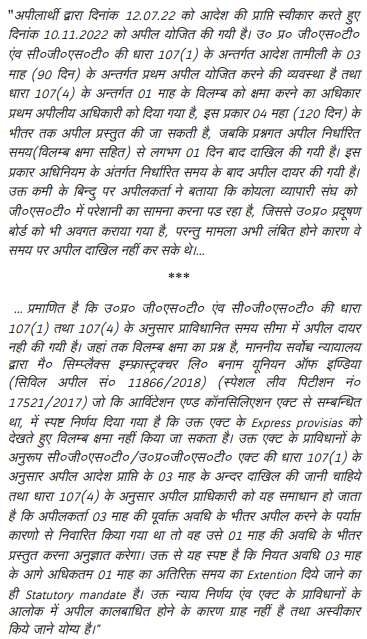
(d) Aggrieved by the impugned order dated July 12, 2022 the Petitioner had filed an appeal under Section 107 of the UPGST Act. The first appellate authority vide order dated November 24, 2022 dismissed the said appeal as time barred. Relevant portions of the impugned order dated November 24, 2022 are extracted herein below:
3. I have heard the learned counsel appearing for the parties and perused the material on record.
4. In the instant writ petition, the primary issue that lies for the consideration of this Court is that “Whether the appeal filed by the Petitioner under Section 107 of the UPGST Act was within the statutory time limit?”
5. I have reproduced the relevant sub sections of Section 107 of the UPGST Act herein for ease of reference:
***
(4) The Appellate Authority may, if he is satisfied that the appellant was prevented by sufficient cause from presenting the appeal within the aforesaid period of three months or six months, as the case may be, allow it to be presented within a further period of one month.”
6. Since the clock of limitation starts running “from the date on which the said order or decision is communicated to such person” it would be prudent to refer to Section 9 of the General Clauses Act, 1897 (hereinafter referred to as the ‘GC Act’) which provides as follows:
(1) In any [Central Act] or Regulation made after the commencement of this Act, it shall be sufficient, for the purpose of excluding the first in a series of days or any other period of time, to use the word “from”, and, for the purpose of including the last in a series of days or any other period of time, to use the word “to”.
(2) This section applies also to all [Central Acts] made after the third day of January, 1868, and to all Regulations made on or after the fourteenth day of January, 1887.”
7. The phrase “from the date on which the said decision or order is communicated to such person” is crucial as it marks the starting point of the limitation period for filling an appeal. The legislative intent behind this provision is to ensure that the aggrieved party has a clear and fair understanding of the decision or order before the clock starts ticking for the appeal period.
8. Section 9 of the GC Act provides guidance on how to compute periods of time specified in statutes. Specifically, it indicates that when calculating a time period that starts with the word “from”, the day of the event from which the period begins is
The limitation period for filing an appeal under the UPGST Act begins the day after the communication of the order, and the interpretation of statutory time limits must ensure fairness and clarity fo....

The application of the Limitation Act, 1963 does not apply to Section 107 of the Central Goods and Services Tax Act, 2017, and there is complete exclusion of Section 5 of the Limitation Act in specia....

The Central Goods and Services Tax Act, 2017 excludes the application of the Limitation Act, 1963, preventing the condonation of delays beyond the statutory period for filing appeals.
Proper service and satisfaction of communication to the assessee are essential for triggering the limitation period under Section 107 of the CGST Act, and the revenue's approach in considering the co....
Section 107 of the GST Act operates as a complete code, explicitly delineating limitation periods for filing appeals and implicitly excluding the application of general limitation provisions such as ....

The appellate authority under the APGST Act cannot condone delays beyond the one-month limit specified in Section 107(4), excluding broader provisions of the Limitation Act.

The court affirmed that while the CGST Act imposes strict limitations on appeals, such limitations do not apply in writ proceedings, allowing for the restoration of the appeal based on merits.

Assessment – Condonation of Delay in filing Appeal - Appellate authority is not empowered to condone the delay beyond the aggregate period of limitation - statutory appeal was barred by limitation, t....



An indispensable Tool for Legal Professionals, Endorsed by Various High Court and Judicial Officers
Please visit our Training & Support
Center or Contact Us for assistance

Scan Me!
India’s Legal research and Law Firm App, Download now!


For Daily Legal Updates, Join us on :



 Back to top


