
 Back
Back





IN THE HIGH COURT OF ALLAHABAD
J.J. Munir, J.
Sehrun Nisha - Petitioner
Vs.
State Of Up And Others - Respondent
WRIT - A No. - 6402 of 2024
Decided On : 07-05-2024
GRATUITY - TEACHERS' RETIREMENT - GOVERNMENT ORDER DATED 14.12.2011, ARTICLE 474 OF THE CIVIL SERVICE REGULATIONS - The court discussed the provisions regarding gratuity entitlement for teachers in aided Intermediate Colleges, emphasizing that gratuity is not solely contingent on retirement at the age of sixty but is based on the total years of service. The court found the reasoning of the District Minority Welfare Officer flawed, highlighting the need for proper interpretation of the rules governing gratuity. The court's decision was influenced by the understanding that premature retirement does not negate the right to gratuity if the service years are met.
Fact of the Case:
The petitioner, a teacher, sought gratuity after opting for voluntary retirement at the age of fifty-seven. The District Minority Welfare Officer rejected the claim, stating that gratuity is only payable to those retiring at sixty years or older.
Finding of the Court:
The court found the reasoning of the District Minority Welfare Officer to be flawed, asserting that the right to gratuity is based on the total years of service rather than the specific age at retirement. The court emphasized that the interpretation of the rules was incorrect and that the petitioner was entitled to gratuity.
Issues: Whether the petitioner is entitled to gratuity despite opting for voluntary retirement at the age of fifty-seven, and the proper interpretation of the relevant government orders regarding gratuity entitlement.
Ratio Decidendi: The court held that gratuity entitlement is determined by the number of completed years of service rather than the age at which a teacher retires. The interpretation that only those retiring at sixty are entitled to gratuity was deemed incorrect.
Final Decision: The court quashed the order of the District Minority Welfare Officer and issued a mandamus to calculate and pay the gratuity to the petitioner within a specified timeframe.
JUDGMENT :
J.J. Munir, J.
1. This writ petition is directed against the order dated 02.12.2023 passed by the District Minority Welfare Officer, Prayagraj, rejecting the petitioner's claim to gratuity on the ground that the petitioner has sought voluntary retirement at the age of fifty-seven years, whereas gratuity is payable only to those who opt to retire at the age of sixty years (as distinguished from those who opt to retire at the age of sixty-two years) and also in cases of teachers, who die before attaining the age of sixty years.
2. It is submitted that according to paragraph no. 4(1) of the Government Order dated 14.12.2011, it is provided that like civil service, governed by Article 474 of the Civil Service Regulations, those who do not complete ten years of qualifying service, are not entitled to pension but if they opt to retire at the age of sixty years, they are entitled to gratuity under the rules framed for the teachers serving in the aided Intermediate Colleges.
3. On 26.04.2024, this Court passed the following order:
"The petitioner opted for voluntary retirement at the age of 57 and has been denied his gratuity by the District Minority Welfare Officer on ground that since he had not filled up the option to retire at 60, which is the entitling age to receive gratuity, or 62 years, which disentitles, the petitioner is not entitled to gratuity.
Prima facie the reasoning is absolutely flawed.
Mr. J. N. Maurya, learned Chief Standing Counsel states at this juncture that one opportunity be provided to the District Minority Welfare Officer, Prayagraj to reconsider the matter.
A week's time is granted for the purpose. Adjourned to 07.05.2024 as fresh."
4. An opportunity was provided to the District Minority Welfare Officer, Prayagraj to re-consider the matter. The District Minority Welfare Officer, Prayagraj has skirted the opportunity granted to him by this Court. He has issued a memo dated 03.05.2024, where the stand taken is that gratuity is payable only to such teachers of the aided Intermediate Institutions, who opt to retire at the age of sixty years. He has referred to an objection in this regard raised by the Joint Director (Pension) Prayagraj Division, Prayagraj vide his memo dated 09.09.2020 annexed as Annexure no. 3 to his memo dated 03.05.2024, where it is observed:
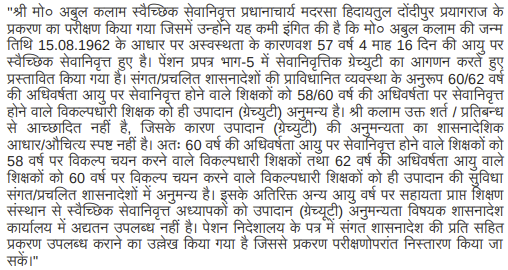
5. It is on the basis of the aforesaid note put up by the Joint Director (Pension), Prayagraj Division, Prayagraj that the District Minority Welfare Officer, Prayagraj has refused to re-consider his stand that gratuity may be payable to the petitioner though he has prematurely elected to retire at the age of 57 years 4 months and 16 days. For one he may clarify that the age of a retiring employee is never to be reckoned in terms of days and months. It is to be reckoned in terms of the completed age. Thus, so long as an employee does not turn fifty-eight, he is to be regarded as fifty-seven years old. The petitioner, therefore, is an employee, who has chosen to retire at the age of fifty-seven years. prematurely.
6. The Government Orders, under reference or rules, which these orders reflect or amplify, give effect to a scheme wherein a teacher, who serves for an extended tenure up to sixty-two years is deprived of his gratuity to which he would be entitled, if he were to retire at the conventional age of sixty years. He looses gratuity because he serves for two years more beyond the conventional years.
7. Here is a case, where the petitioner has chosen to retire at the age of fifty-seven years, prematurely. The option to retire at the age of sixty years is to be understood in contra-distinction to the option to retire at the unconventional and the higher age of sixty-two; it is not to be understood as an option vesting a teacher with a right to receive gratuity only if he elects to retire at sixty. Retirement at sixty years is not an entitling fact, which leads the employee to acquire a right to receive gratuity, which he otherwise does not have. An employ
AI

Entitlement to gratuity for teachers retiring at 60 years is established by interpreting Government Orders and previous judgments, irrespective of retirement date and age options.

Voluntary retirement constitutes an option for gratuity eligibility, regardless of not opting to retire at the age of 60.
The court established that the definition of 'employee' under the Payment of Gratuity Act includes the petitioner, entitling him to gratuity despite state claims of exclusion.
Service matter - Payment of a gratuity - Rule 5 of these Rules provided that a gratuity equal to six times pay last drawn by a teacher at time of his death would be payable provided he had put in not....

The main legal point established in the judgment is that the payment of gratuity for teachers in the Basic Education Department is governed by specific Government Orders, and petitioners must plead f....

Employees of aided educational institutions are entitled to gratuity for their entire service period, as per the applicable rules and acts.

Gratuity – Death-cum-retirement gratuity is benevolent scheme and same is extended to heirs/dependents of deceased employee.

The main legal point established in the judgment is that the amended definition of the word 'employee' under the Payment of Gratuity Act, 1972, covers contract-based Teachers, entitling them to claim....



An indispensable Tool for Legal Professionals, Endorsed by Various High Court and Judicial Officers
Please visit our Training & Support
Center or Contact Us for assistance

Scan Me!
India’s Legal research and Law Firm App, Download now!


For Daily Legal Updates, Join us on :



 Back to top


