
 Back
Back





IN THE HIGH COURT OF ALLAHABAD
Prakash Padia, J.
Ratan Kumar Yadav - Petitioner
Vs.
State Of Uttar Pradesh And Others - Respondent
WRIT - A No. - 20215 of 2019
Decided On : 06-05-2024
Fact of the Case:
The petitioner, a police officer, challenged the orders of compulsory retirement and penalties imposed on him, arguing that they were unjust and not based on a proper assessment of his service record. He had previously been injured in the line of duty and had received commendations, but faced disciplinary actions leading to his retirement.
Finding of the Court:
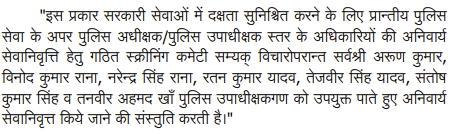
The court found that the Screening Committee did not adequately consider the petitioner's entire service record, including commendations and the lack of substantial evidence for the penalties imposed. The court ruled that the compulsory retirement order was based on insufficient grounds and cast a stigma on the petitioner.
Issues: Whether the compulsory retirement was justified based on the petitioner's service record and whether the penalties imposed were appropriate.
Ratio Decidendi: The court emphasized that an order of compulsory retirement must be based on a comprehensive evaluation of the employee's entire service record, including both positive and negative entries. It ruled that the Screening Committee's failure to consider the petitioner's commendations and the nature of the penalties imposed rendered the retirement order unsustainable.
Final Decision: The court quashed the order of compulsory retirement and allowed the petitioner to appeal the penalties imposed, directing the respondents to reinstate him and provide all consequential benefits.
JUDGMENT :
Prakash Padia, J.
1. Heard Sri Kripa Shankar Singh, learned Senior Counsel assisted by Sri Saurabh Singh, learned counsel for the petitioner and Sri Vijay Shankar Prasad, learned Additional Chief Standing Counsel for respondents.
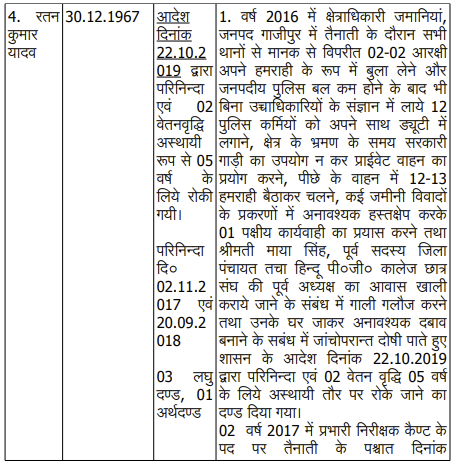
2. The present writ petition has been filed by the petitioner, with a prayer to quash the order dated 7.11.2019 passed by the State Government, compulsory retiring the petitioner and also quash the order dated 22.10.2019, by which the petitioner was awarded major penalty, i.e., stoppage of two increments for 5 years with temporary effect and one minor penalty of censure in terms of Rules 3 of Uttar Pradesh Government Servant (Disciplinary & Appeal), Rules, 1999 (hereinafter referred to as "Rules of 1999"). The petitioner has further challenged the order dated 20.9.2018 passed by the Director General of Police, by which the penalty of censure has been imposed upon the petitioner under Rule 3 of aforesaid Rules of 1999 as well as appellate order dated 1.5.2019.
3. The facts as stated by the petitioner in the writ petition are that the petitioner was directly recruited in the year 1998 on the post of Sub-Inspector of Police. During the course of duty in an encounter with Munna Bajrangi gang, the petitioner received five AK-47 bullet injuries. After recovering from the said injuries the petitioner was granted promotion to the post of Inspector in 2001 and he was also awarded with Presidential Medal.
4. The petitioner was subsequently promoted as Deputy Superintendent of Police on 11.7.2016 and was posted at Zamania District Ghazipur on 18.7.2016. He was suspended on 15.11.2016 on the basis of some enquiry conducted by Shri Anil Kumar Singh, Additional Superintendent of Police (Rural) Ghazipur. However, the said suspension was revoked on 3.1.2017. Thereafter he was served a charge-sheet dated 9.9.2017. In the said charge-sheet, following charges were levelled against the petitioner :-
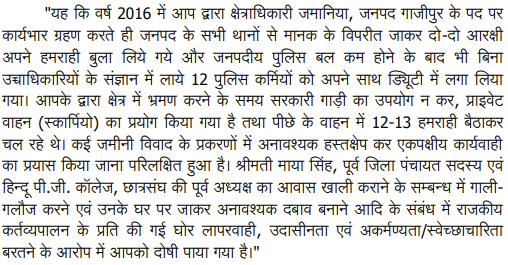
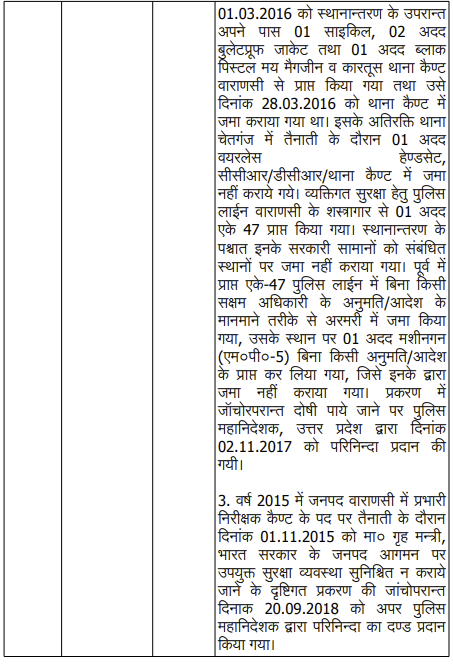
5. The petitioner submitted his reply to the said charge- sheet on 11.1.2018. The Enquiry Officer, i.e., Deputy Inspector General of Police, Azamgarh Zone, Azamgarh submitted his enquiry report on 5.7.2018. It is mentioned in paragraph 10 of the writ petition that the Enquiry Officer, while recording its finding in paragraph 9 of the enquiry report, has not at all considered the evidence adduced by the petitioner. The enquiry report dated 5.7.2018 was served upon the petitioner on 27.11.2018, directing him to submit his reply, which was submitted by the petitioner on 5.2.2019. The respondent no. 1 by an order dated 22.10.2019, imposed penalties, i.e., stoppage of two increments for 5 years with temporary effect along with censure entry.
6. It is further stated in the writ petition that in the preliminary enquiry conducted by Shri Keshav Chandra Goswami, ASP, City, Ghazipur, it was held that no charge has been proved against the petitioner. However, inspite of the same without any basis or disagreeing with the preliminary report dated 31.12.2016, the said enquiry report dated 31.12.2016 was forwarded to two officers, i.e., Sri Kamlesh Dixit, ASP and Dr. Anil Kumar Pandey, ASP who were of the equivalent rank i.e., ASP, for reviewing the report dated 31.12.2016. There is no provision for reviewing the preliminary enquiry report under the law. It is important to point out here that both the officers namely Sri Kamlesh Dixit and Dr. Anil Kumar Pandey did not make any enquiry independently rather reviewed the report submitted by Shri Keshav Chandra Goswami dated 31.12.2016 and formed their opinion. The said preliminary enquiry conducted by Shri Keshav Chandra Goswami, A.S.P., City, Ghazipur has not been considered. It is stated that the petitioner has been awarded double punishment i.e. stoppage of increments and censure entry for one and same charge.
7. By an order dated 20.9.2018, the petitioner was granted censure entry under Rule 3(1) of Rules of 1999. It is further stated that for awarding the said censure entry, no reason
AI

Point of Law : Dispensation of justice is not only an onerous duty but has been considered as akin to discharge of a pious duty, and therefore, is a very serious matter. The standards of probity, con....

The order of compulsory retirement of a judicial officer under Rule 53(1) of the Rajasthan Civil Services (Pension) Rules, 1996, is not arbitrary, unreasonable, discriminatory, or mala fide if it is ....

Point of law : Order of compulsory retirement against the petitioner is based upon subjective satisfaction of the entire record of the petitioner more particularly the recent record of the petitioner....


The decision to compulsorily retire a government servant under FR 56(j) must be made in public interest, and judicial scrutiny is limited to cases of mala fide exercise of power or lack of evidence. ....
The main legal point established in the judgment is that the order of compulsory retirement is based on the subjective satisfaction of the government, and the court will not interfere with such order....



An indispensable Tool for Legal Professionals, Endorsed by Various High Court and Judicial Officers
Please visit our Training & Support
Center or Contact Us for assistance

Scan Me!
India’s Legal research and Law Firm App, Download now!


For Daily Legal Updates, Join us on :



 Back to top


