
 Back
Back





IN THE HIGH COURT OF ALLAHABAD
J.J. MUNIR, J.
Lal Bahadur – Petitioner
Versus
Union of India and Others – Respondents
Writ (A) No. 15103 of 2023
Decided On : 13-05-2024
PENSION - OLD PENSION SCHEME vs. NEW CONTRIBUTORY PENSION SCHEME - Bank of Baroda (Employees) Pension Regulations, 1995; Contributory Pension Scheme; Article 14 of the Constitution - The court analyzed the applicability of the Old Pension Scheme versus the New Contributory Pension Scheme, emphasizing that the petitioner, despite being absorbed after the cut-off date, had rights under the tripartite settlement. The court interpreted the provisions of the pension regulations and constitutional rights, concluding that the delay in absorption did not negate the petitioner's entitlement to the Old Pension Scheme. However, the petitioner's acceptance of the new scheme and inaction in enforcing his rights were pivotal in the court's decision.
Fact of the Case:
The petitioner, a retired Peon of the Bank of Baroda, sought a mandamus for recognition under the Old Pension Scheme after his absorption post-01.04.2010 under the New Contributory Pension Scheme. His services were terminated in 1994, reinstated in 2005, and absorbed in 2012, but he was denied pension upon retirement in 2023.
Finding of the Court:
The court found that while the petitioner had rights under the tripartite settlement for regularization, his acceptance of the new pension scheme and failure to act promptly to enforce his rights led to the dismissal of his petition. The court noted that the petitioner had voluntarily accepted the terms of the new scheme and did not raise grievances during his service.
Issues: Whether the petitioner was entitled to the Old Pension Scheme despite being absorbed after the cut-off date and whether his acceptance of the new scheme constituted a waiver of his rights.
Ratio Decidendi: The court held that while fundamental rights cannot be waived, the principle of laches applies, and the petitioner’s inaction in enforcing his rights and acceptance of the new pension scheme precluded him from claiming benefits under the Old Pension Scheme.
Final Decision: The writ petition was dismissed, with no order as to costs.
JUDGMENT :
J.J. MUNIR, J.
1. This writ petition has been instituted by the petitioner, a retired Peon of the Bank of Baroda, praying that a mandamus be issued, ordering the respondents to consider the petitioner covered by the Old Pension Scheme and sanction him pension forthwith w.e.f. 01.08.2023. A further direction is sought to the effect that the respondents pay the petitioner regular monthly pension as also arrears worked out with effect from 01.08.2023, along with interest at such rate as this Court may determine, until realization. The petitioner prays that a further direction be issued, ordering the respondents not to treat the petitioner covered by the newly defined Contributory Pension Scheme, which is applicable to the persons appointed subsequent to 01.04.2010.
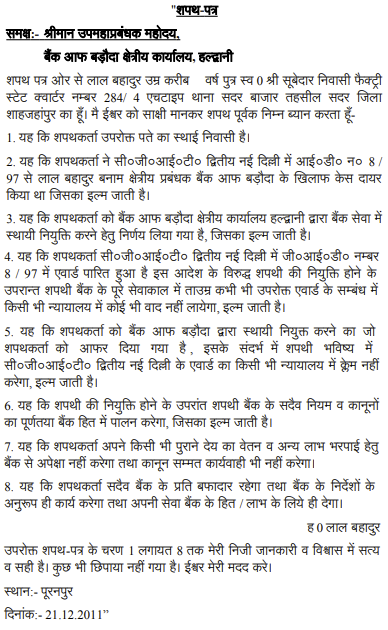
2. The petitioner's case is that he was a temporary Peon employed with the Govindganj Branch of the Bank of Baroda in District Shahjahanpur, falling under the Bank’s Shahjahanpur Region. This was the petitioner's status with the Bank in the month of November, 1989. He continued to function in the capacity of a temporary Peon till 19.11.1994, when his services were terminated. He raised an industrial dispute, when conciliation proceedings failed. The Central Government, by an order dated 07.01.1997, referred the dispute between the petitioner and his employer to the Central Industrial Tribunal-cum-Labour Court-II, Delhi. The reference was in terms if the action of the Management in terminating the petitioner's services w.e.f. 19.11.1994 was just and legal, and if not, what relief the petitioner was entitled to. The reference was registered on the file of the Central Industrial Tribunal-cum-Labour Court-II, New Delhi as Case No. 08 of 1997. The Presiding Officer, Central Government Industrial Tribunal-cum-Labour Court-II, New Delhi made an award dated 14.06.2005, answering the reference in the petitioner's favour and holding termination of his services illegal. A direction was issued to reinstate the petitioner in service with 50% back wages w.e.f. 19.11.1994.
3. The validity of the award dated 14.06.2005 was challenged by the respondent, Bank of Baroda by instituting Writ-C No. 73449 of 2005 before this Court. In the aforesaid writ petition, an interim stay order was granted on 01.12.2005 in terms that the award was stayed subject to the condition that the Bank would reinstate the petitioner within one month and ensure payment of wages at par with his counterparts. In compliance with the aforesaid interim order, the petitioner was reinstated in service subject to the outcome of Writ-C No. 73449 of 2005. The petitioner continued to function in terms of the said interim order. As the petitioner says, a Memorandum of Settlement was arrived at between the Management of the Bank of Baroda and its Workmen on 18.03.2008 before the Deputy Chief Labour Commissioner (Central), Mumbai with regard to absorption of Causal/ Temporary Peons/ Sweepers. The settlement that was arrived at was circulated by the General Manager (Human Resource & Marketing), along with a circular letter dated 24.03.2008. The Memorandum of Settlement under the tripartite settlement dated 18.03.2008 conferred right to absorption upon Casual/ Temporary Peon/ Sweepers in accordance with the stipulation carried in the settlement. The absorption that was agreed upon under the tripartite settlement was to be implemented in a phased manner.
4. The first phase comprised such Causal/ Temporary Peons/ Sweepers, who had worked between 01.01.1982 and 31.12.1989 or between 01.01.1990 and 31.12.1990 for 90 days or more and were still working. Absorption for this category of workmen was to be completed on or before 30.06.2008. The second phase of the absorption, that was contemplated, related to Causal/Temporary Peons/ Sweepers, who had worked for 240 days or more over a period of 12 months consecutively between 01.01.1991 and 29.02.1996 and were still working. These absorptions were to be implemented during the fina
AI
The acceptance of a new pension scheme and inaction in enforcing rights under a tripartite settlement can bar claims for benefits under an older pension scheme, despite potential entitlements based o....

The main legal point established in the judgment is that the right to be governed by a pension scheme is determined by the date of commencement of the recruitment process, and delay in appointment du....
The date of appointment, rather than joining, determines entitlement to pension schemes; rights crystallized before policy changes must be honored.

Delays in appointing candidates due to state inaction invalidate their placement under the new pension scheme, permitting claims to the old scheme benefits.

The court held that employees regularized despite not formally joining are still entitled to pensionary benefits, emphasizing fairness in public employment rights.


The acceptance of appointment under the New Pension Scheme precludes any claim for benefits under the Old Pension Scheme, demonstrating principles of waiver and estoppel.



An indispensable Tool for Legal Professionals, Endorsed by Various High Court and Judicial Officers
Please visit our Training & Support
Center or Contact Us for assistance

Scan Me!
India’s Legal research and Law Firm App, Download now!


For Daily Legal Updates, Join us on :



 Back to top


