
 Back
Back





IN THE HIGH COURT OF ALLAHABAD
ASHWANI KUMAR MISHRA, SYED QAMAR HASAN RIZVI, JJ.
Secretary Basic Shiksha Parishad - Appellant
Versus
Vinay Kumar Pandey and others - Respondents
Special Appeal Nos. 160, 175 of 2024, Special Appeal Defective Nos. 176, 180 of 2024, Special Appeal Nos. 194, 227, 255, 258 of 2024, Special Appeal Defective Nos. 168 and 186 of 2024
Decided on : 16-04-2024
| Table of Content |
|---|
| 1. introduction of appeal and delay condonation. (Para 1 , 2 , 3) |
| 2. background of candidate selection and teaching regulations. (Para 4 , 5 , 6 , 7) |
| 3. cancellation of earlier advertisements due to examination irregularities. (Para 8 , 9) |
| 4. judicial intervention regarding recruitment processes. (Para 10 , 11) |
| 5. discussion on the obligation of the state to fulfill constitutional mandates. (Para 12 , 13 , 14) |
| 6. court's observation on the fairness of the recruitment process. (Para 15 , 16) |
| 7. supreme court's directives relating to candidate appointment. (Para 18 , 19) |
| 8. final determination on the claims of shortlisted candidates. (Para 20 , 21) |
| 9. determination of appointment eligibility and process completion (Para 23 , 34 , 51) |
JUDGMENT :
Hon'ble Ashwani Kumar Mishra, J.-Delay in filing of defective appeals are explained to the satisfaction of the Court. Delay Condonation Applications are allowed. The appeals are treated to be filed within time and taken up on board for hearing with the consent of learned counsel for the parties.
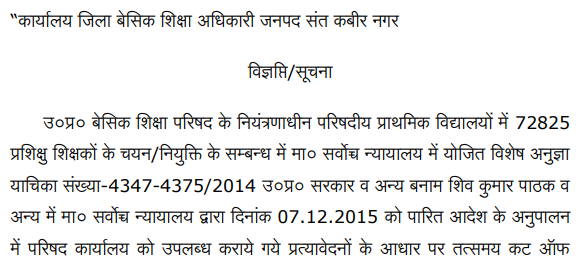
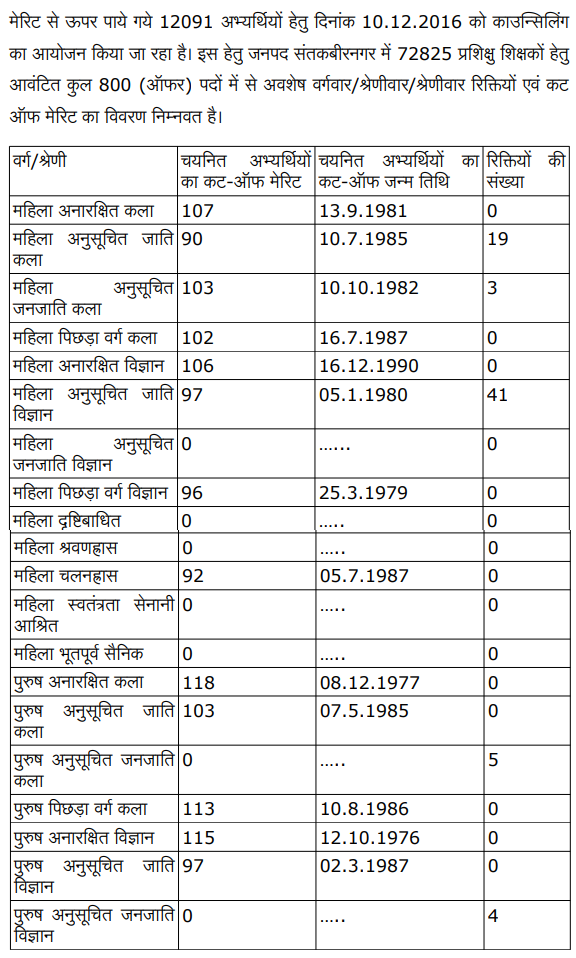
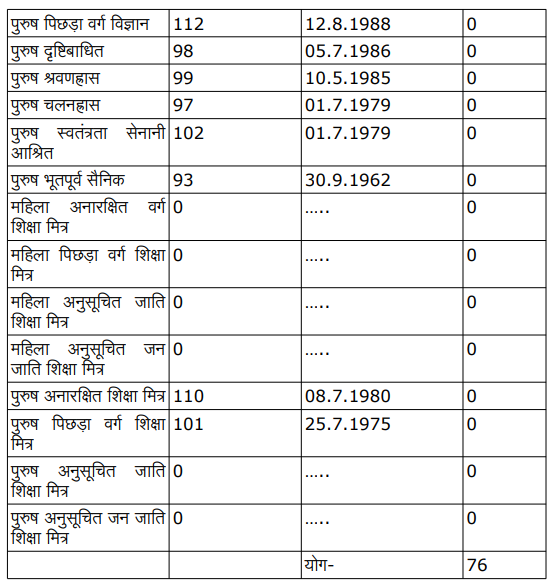
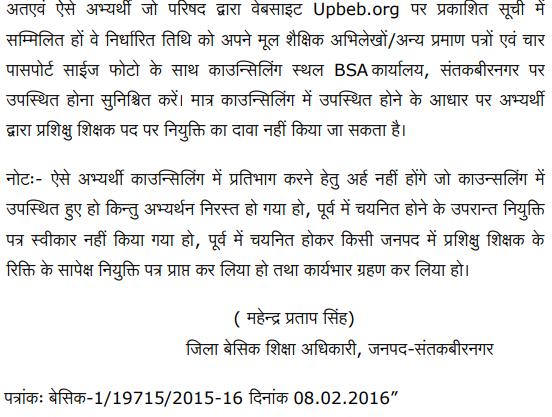
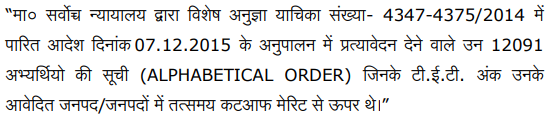
2. This bunch of special appeals arise out of the judgment of learned Single Judge dated 12.1.2024, passed in a batch of writ petitions raising similar questions of law and fact. While disposing of the writ petitions, learned Single Judge has allowed the claim of 12091 shortlisted candidates for appointment as trainee teachers while claim of others, who claimed parity with the 12091 shortlisted candidates on the ground that their performance was similar or superior has been rejected. To the extent claim of 12091 shortlisted candidates are allowed the State of Uttar Pradesh and the Secretary, Basic Shiksha Parishad, Uttar Pradesh, Allahabad are aggrieved and have filed Special Appeal Nos. 160 of 2024 and 175 of 2024. Other Special appeals are preferred by those candidates whose claim of parity with 12091 shortlisted candidates is rejected by the Learned Single Judge. The special appeal No. 160 of 2024 filed by the Secretary, Basic Shiksha Parishad, Uttar Pradesh, Allahabad is taken as the lead case.
3. Basic Shiksha Parishad is an authority established under Section 3 of the UTTAR PRADESH BASIC EDUCATION ACT , 1972 (hereinafter referred to as the 'Act of 1972'). It is entrusted with the task of managing basic education in State of Uttar Pradesh. Section 2(b) of the Act of 1972 defines basic education to mean education upto VIIIth Class imparted in schools other than High Schools or Intermediate Colleges. Recruitment of teachers in educational institutions established by the Basic Shiksha Parishad (also known as 'Board') are governed by the provisions contained in Uttar Pradesh Basic Education (Teachers) Service Rules, 1981 (hereinafter referred to as the 'Rules of 1981').
4. Constitution of India was amended vide Eighty-sixth Amendment Act, 2002 introducing Article 21-A, conferring right of compulsory education to all children in the age group of 6 to 14 years. In order to implement this fundamental right, the Parliament enacted the Right of Children to Free and Compulsory Education Act, 2009 (hereinafter referred to as 'RTE Act of 2009'). The RTE Act of 2009 envisioned an academic authority, authorized by the Central Government, to lay down minimum qualifications for appointment as a teacher in the institutions for the children in the age group of 6 to 14 years. The Central Government by way of a notification dated 31.3.2010 designated National Council for Teacher Education (NCTE) as the academic authority in terms of Section 23(1) of the RTE Act of 2009. NCTE, in turn, issued a notification on 23.8.2010 making it mandatory for every teacher to pass the Teacher Eligibility Test (TET). On 11.2.2011, the NCTE prescribed the qualifying marks to pass TET test as 60% or above. This notification conferred authority to provide concession to the candidates belonging to reserved category and also
AI
The court affirmed that appointment claims require direct engagement in the selection process, emphasizing no valid grievances from unlisted candidates based on prior judicial findings.


Candidates on a merit list do not have an indefeasible right to appointment if they fail to meet the prescribed cut-off marks, emphasizing the need for fair recruitment processes.

Parity – When there is a declaration of law by court, Judgment can be treated as Judgment in rem and require equities to be balanced by treating those similarly situated, similarly.

The main legal point established in the judgment is that candidates who have secured more marks than the last selected candidates are entitled to be considered for counseling and appointment, especia....
Appointment – Orders of Court cannot be allowed to operate at conflict with requirements of merit – Any eventuality leading to advantage of less meritorious candidates at the cost of meritorious one ....
Appointments for Grade III Teachers must reflect accurate merit while adhering to court directives on recruitment processes, ensuring transparency and fairness in selections.


The court upheld the CAT's direction for administrative examination of vacancy positions, clarifying that candidates on the replacement list must be considered unless barred by delay or conduct.



An indispensable Tool for Legal Professionals, Endorsed by Various High Court and Judicial Officers
Please visit our Training & Support
Center or Contact Us for assistance

Scan Me!
India’s Legal research and Law Firm App, Download now!


For Daily Legal Updates, Join us on :



 Back to top


