


 Back
Back





2024 Supreme(All) 1449
IN THE HIGH COURT OF JUDICATURE AT ALLAHABAD
ASHWANI KUMAR MISHRA, GAUTAM CHOWDHARY, JJ.
Maor Singh @ Mohar Singh & Ors. - Appellants
Versus
State of U.P. - Respondent
Criminal Appeal No. 3818 of 2022 With Criminal Appeal No. 3810 of 2022
Decided On : 25-10-2024
For the Appellant : Abhishek Mayank, Abhishek Srivastava, Arjit Srivastava, Usha Srivastava, Vinod Kumar Srivastava.
For the Respondent: G.A.
IMPORTANT POINT
The prosecution must establish guilt beyond reasonable doubt, particularly when relying on dying declarations that contain inconsistencies and lack corroborative evidence.
Headnote:
Indian Penal Code, 1860 - Sections 302/34, 452, 504 - Conviction and sentence of life imprisonment and fines imposed on appellants for murder and related offences - Prosecution relied on dying declarations of the victim, but inconsistencies and lack of eyewitness accounts raised doubts - Court found that the prosecution failed to establish guilt beyond reasonable doubt. (Paras 37, 56)
Facts of the case:
The incident occurred on 12.2.2016 when the victim was set on fire by the accused due to previous enmity. The victim, who was blind, made two dying declarations implicating the accused. (Paras 2, 34)
Findings of Court:
The court found the dying declarations unreliable due to inconsistencies and the victim's critical condition at the time of recording. (Paras 56)
Issues: The main issues were the reliability of the dying declarations and the absence of eyewitness testimony. (Paras 38, 56)
Ratio Decidendi: The court ruled that the prosecution failed to prove the case beyond reasonable doubt, particularly due to the inconsistencies in the dying declarations and lack of corroborative evidence. (Paras 56)
Result: Appeals allowed; conviction and sentence set aside. (Paras 57)
JUDGMENT :
Ashwani Kumar Mishra, J.
1. These appeals are directed against the judgment and order of conviction and sentence dated 8.3.2022, passed by the Additional Sessions Judge/Special Judge (E.C. Act), Mainpuri, in Session Trial No. 296 of 2016 (State Vs. Rani and another), arising out of Case Crime No.46 of 2016, Police Station Elaau, District Mainpuri, whereby the accused appellants Rani and Maor Singh alias Mohar Singh have been convicted and sentenced to life imprisonment alongwith fine of Rs.30,000/-, each, under Section 302/34 IPC and on failure to deposit fine to undergo additional rigorous imprisonment for one year; three years imprisonment alongwith fine of Rs. 5,000/-, each, under Section 452 IPC and on failure to deposit fine to undergo additional imprisonment for two months; and under Section 504 IPC to undergo one year imprisonment alongwith fine of Rs. 2000/-, each, and on failure to deposit fine to undergo one month additional imprisonment. All the sentences are directed to run concurrently.
2. Incident giving rise to this appeal occurred on 12.2.2016 when the informant had gone to Saifai Hospital for the treatment of his daughter leaving behind his wife at home. Informant’s wife had lost her eye-sight and she could not see. At about 4.00-4.30 pm, Rani W/o Maor Singh alongwith Maor Singh S/o Genda Lal; Ranjit S/o Taley Singh and Satyadeo S/o Balvir Singh on account of a previous fight between children and other enmity entered the house and started abusing informant’s wife. Informant’s wife could identify all these persons by their voice. It was at this stage that Rani with an intent to kill informant’s wife poured kerosene on her and accused Maor Singh lit matchstick and threw it upon the informant’s wife saying that as she hurls abuses so she should die, whereafter all the accused persons fled. Information about the incident was received by the informant while returning from Saifai and he rushed straight to District Hospital, Mainpuri. The incident was disclosed to the informant by the informant’s wife and none else was present at the spot. A written report was accordingly made to the police by the informant. This written report (Exhibit Ka-1) is the basis of first information report lodged at Police Station Elaau, District Mainpuri as Case Crime No. 46/2016, under Section 307, 452, 504 IPC on the date of incident i.e. 12.2.2016 (Exhibit Ka.2).
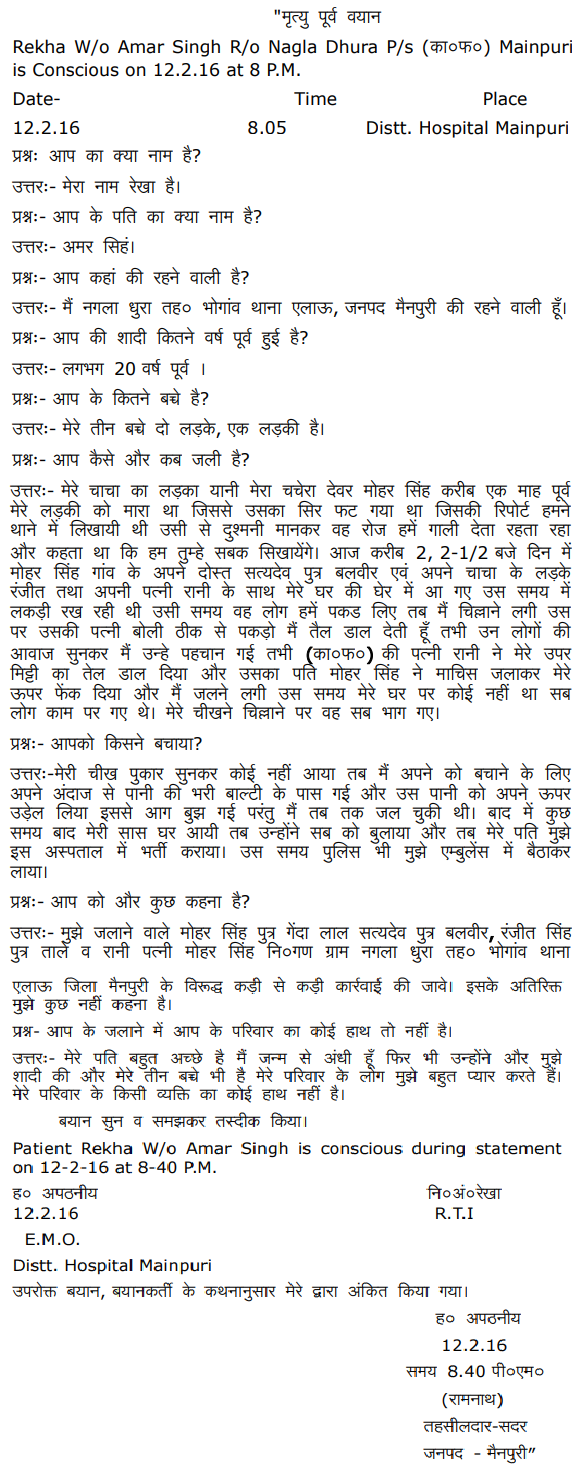
3. The informant’s wife (injured) was rushed to the hospital where her dying declaration was recorded on the date of incident i.e. 12.2.2016 at 8.40 pm by Ramnath, Tehsildar Sadar, District Mainpuri.
4. Since the prosecution case heavily relies upon the dying declaration, as such, its contents are extracted hereinafter:-
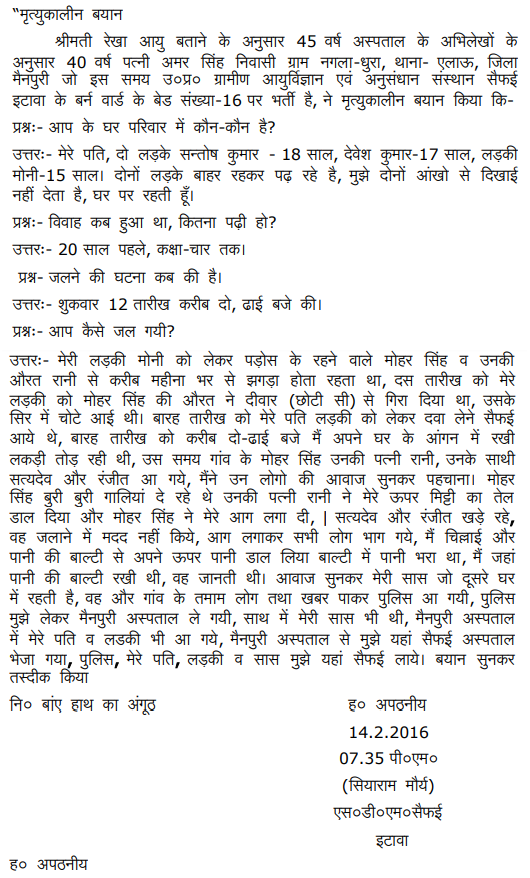
5. A second dying declaration was then recorded on 14.2.2026 by Siyaram Maurya, SDM Saifai, Etawah, while the patient was admitted at Saifai which is reproduced hereinafter:-
Dr. Ramkinker Pandey
P.G. JR-1, Gen. Surgery
UP RIMS & R Saifai-Etawah”
6. Investigating Officer inspected the spot and from the house of informant a glass bottle was recovered on the next day which had no kerosene, but its smell was present. Recovery memo in that regard was prepared on 13.2.2016 (Exhibit Ka-7). The deceased died during treatment at U.P. Rural Institute of Medical Sciences and Research, Saifai, Etawah at 5.50 pm on 18.2.2016. Inquest was conducted at the mortuary at Saifai Hospital at 11 am on 19.2.2016. The body was then sealed and sent for postmortem. The cause of death was 80-85% superficial to deep thermal burns. In the postmortem report age of the victim was assessed at 40 years. The body of the deceased was brought by Constable Brijendra Sachan. The autopsy commenced at 2.40 pm on 19.2.2016 and was concluded at 3.05 pm on the same day. The autopsy surgeon found following injuries on the deceased:-
"Superficial to Deep Burn. Present over chest & neck. Anus as well as posterior aspect of both legs, buttocks, abdomen, both upper extremites. Red line of demarcation prese












