
 Back
Back





IN THE HIGH COURT OF ALLAHABAD
SAURABH SHYAM SHAMSHERY, J.
Vandana Malviya – Appellant
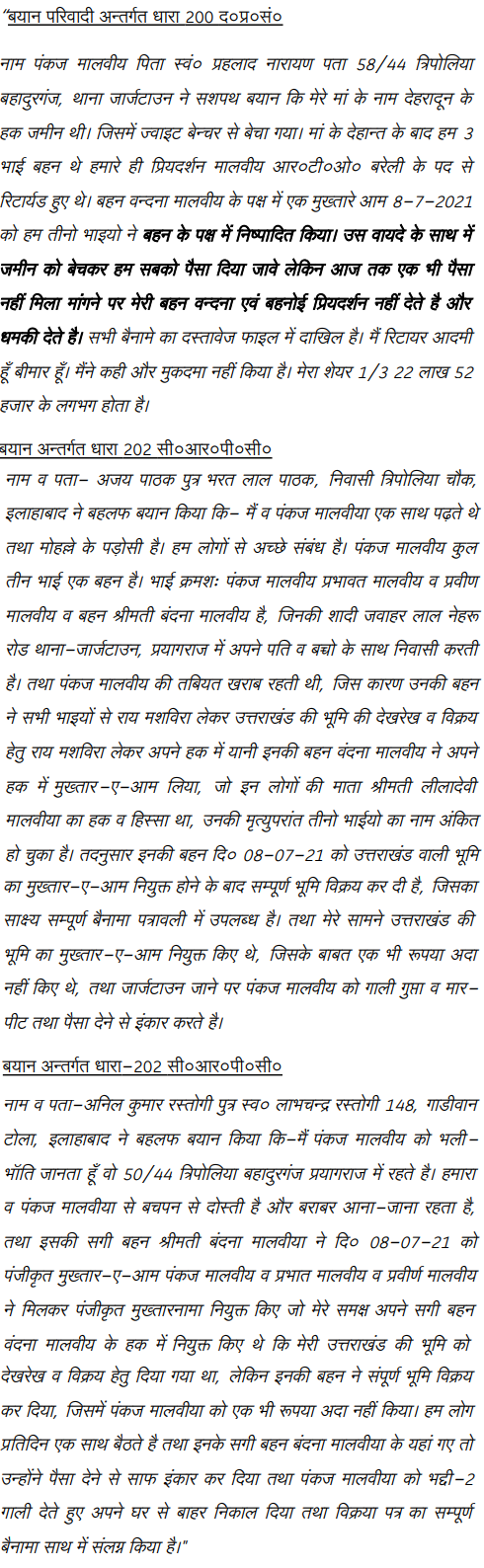
Versus
State of Uttar Pradesh and Another – Respondents
Application U/s 482 No. 17673 of 2024
Decided On : 13-08-2024
(A) Indian Penal Code, 1860 - Sections 323, 420, 506 - Criminal complaint filed against applicant alleging cheating and non-sharing of sale proceeds from properties sold under a General Power of Attorney - The court found no prima facie case established for the offences charged, emphasizing that interpretation of GPA clauses is a civil matter, not criminal - Summoning order quashed. (Paras 22 and 23)
(B) Criminal Procedure Code, 1973 - Section 204 - The court held that the summoning order did not adequately consider the necessary elements of the alleged offences, leading to its quashing. (Paras 22 and 23)
JUDGMENT :
SAURABH SHYAM SHAMSHERY, J.
1. Heard Sri Shashi Kant Shukla, learned counsel for applicant, learned AGA for State and Sri Aditya Gupta, Advocate for Opposite Party No. 2.
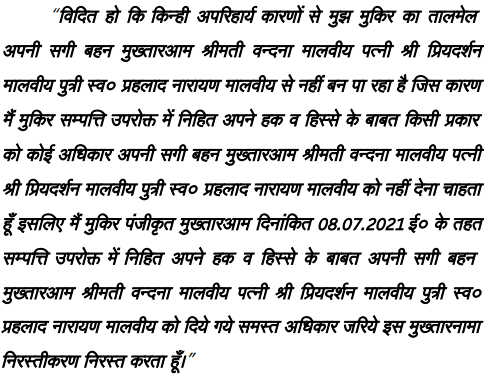
2. In the present case there are few undisputed facts that applicant is the sister of complainant. She has two other brothers also. Complainant and his two brothers have executed a registered General Power of Attorney (hereinafter referred to as “GPA”) on 05.07.2021 in favour of present applicant to sale out share of scheduled property situate in Uttarakhand. Relevant Clause 10 of GPA is reproduced hereinafter:
“10. To sell our share in the said Scheduled Property in whole or in parts, to any persons, to execute proper sale deeds, to present the same for registration, before the concerned Sub-Registrar of Assurances, to admit the execution thereof, to receive sale consideration by cheque/demand draft/RTGS/bank transfer in her name or in our names and to handover the possession to the purchasers on site and to issue receipt thereof.”
3. Further, undisputedly applicant has sold some part of scheduled properties by different sale deeds. Later on only complainant has executed a registered cancellation deed of GPA on 21.12.2021. It is also not under much dispute that even thereafter on basis of GPA applicant had sold some part of scheduled property by different sale deeds (from 30.11.2021 to 30.12.2021 as many as five sale deeds were executed on basis of GPA). It is the case of applicant that as soon as she came to know about cancellation of GPA she does not further execute any sale deed on basis of said GPA.
4. In aforesaid circumstances, only complainant, and not his two other brothers, filed a criminal complaint against applicant under Sections 323, 504, 506 419, 420 IPC on 19.04.2023. Relevant paragraphs of complaint are mentioned hereinafter:
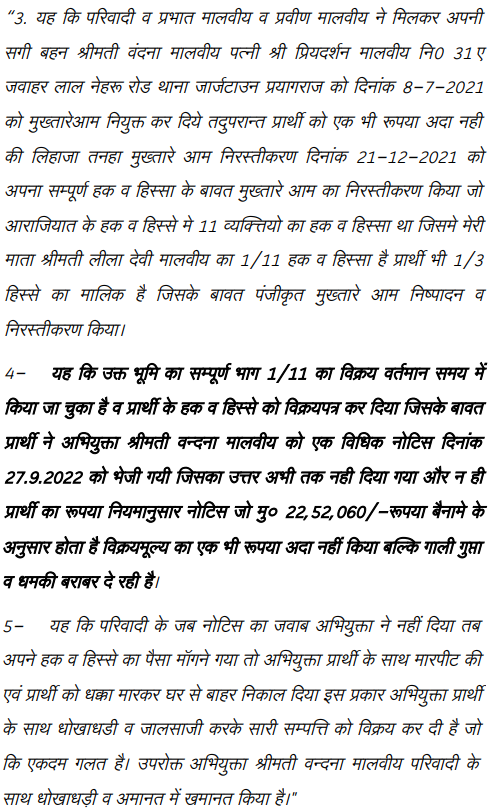
5. In pursuance of above complaint statement of complainant was recorded under Section 200 Cr.P.C. as well as statements of witnesses were also recorded under Sections 202 Cr.P.C. and they are reproduced hereinafter:
6. Chief Judicial Magistrate, Prayagraj vide impugned order dated 16.01.2024 summoned present applicant to face trial under Sections 323, 506, 420 IPC. Relevant part of impugned order is reproduced hereinafter:
“From perusal of documents, it transpires that a General Power of Attorney was executed by the complainant and his two brothers in favour of Vandana Malwiya on 08.07.2021 authorising her to execute sale deeds and receive consideration in her name or in the name of the brothers. This General Power of Attorney was cancelled by the complainant on 21.12.2021. The complainant has also filed copies of various sale deeds executed by Vandana Malwiya after the cancellation of the General Power of Attorney stating that the General Power of Attorney has not been revoked by its executants. The complainant has stated that he has not been given his share of the consideration by Vandana Malwiya and filed his bank statements in support thereof. A bare perusal of the bank statements show that no money was received from Vandana Malwiya. The complainant has also stated that Vandana Malwiya had threatened him and also beat him.
The evidence produced on record prima facie suggest that Vandana Malwiya had committed cognizable offences u/s 420, 323, 506 IPC. Hence, sufficient grounds exist to summon the accused.
Order
Vandana Malwiya is summoned u/s 420, 323, 506 IPC in complaint case no. 928/2023. The complainant shall take appropriate steps within 10 days. The office shall thereafter issue process. Fix 27.02.2024.”
7. The reasons assigned to summon applicant in aforesaid impugned order was that according to GPA share of proceeds of sale deeds was required to be given to applicant as well as his two brothers, however, with dishonest intention applicant though executed number of sale deeds but has not handed over share of proceeds thereof to complainant and his brothers.
8. Learned counsel for both parties have interpreted rel
AI
The court ruled that allegations of cheating under Section 420 IPC require proof of dishonest inducement at the inception of the transaction, which was absent in this case.

Criminal liability under IPC requires clear evidence of intentional wrongdoing, which was absent; thereby, genuine civil disputes cannot sustain criminal charges.

Deception must be present at the inception of a transaction for the offense of cheating under Section 415 of the Indian Penal Code.

The central legal point established in the judgment is the requirement of essential ingredients to constitute an offence under Section 420 of the IPC and the significance of final judgments in determ....

The judgment establishes that criminal proceedings cannot be initiated for disputes that are fundamentally civil in nature, and that the essential ingredients of the alleged criminal offences must be....

Criminal proceedings should not be initiated for disputes that are fundamentally civil in nature, and the essential ingredients of the alleged offenses must be clearly established for prosecution und....

Criminal proceedings should not be used to settle civil disputes, and the sale of properties covered by a power of attorney does not necessarily constitute criminal breach of trust or cheating.



An indispensable Tool for Legal Professionals, Endorsed by Various High Court and Judicial Officers
Please visit our Training & Support
Center or Contact Us for assistance

Scan Me!
India’s Legal research and Law Firm App, Download now!


For Daily Legal Updates, Join us on :



 Back to top


