
 Back
Back





IN THE HIGH COURT OF ALLAHABAD
Hon'ble Saurabh Shyam Shamshery,J.
Anuj Gupta And Others – Applicant
Versus
State Of UP Others – Opposite Parties
Application U/S 482 No. - 194 of 2024
Decided On : 09-07-2024
CRIMINAL LAW - CHEATING AND CRIMINAL BREACH OF TRUST - Sections 406, 415, 420 IPC; Section 156(3), 200, 202, 204 Cr.P.C. - The court discussed the essential ingredients of cheating and criminal breach of trust under IPC, emphasizing that mere civil disputes should not be cloaked as criminal offenses. The court highlighted that for Sections 420 and 406 IPC to apply, there must be clear evidence of dishonest intention and entrustment, which were absent in this case. The court ultimately quashed the proceedings, reinforcing the principle that civil disputes should be resolved through civil remedies rather than criminal prosecution.
Fact of the Case:
The complainant engaged in negotiations for a sale deed regarding a plot of land and paid an advance. A sale deed was executed in favor of the complainant's wife, but disputes arose over the adjustment of money and the area of land for a subsequent sale deed, which was never executed. The complainant alleged that the applicants threatened him when he sought the return of his money, leading to a complaint under Section 156(3) Cr.P.C.
Finding of the Court:
The court found that the allegations did not meet the necessary legal standards for cheating or criminal breach of trust. It noted that the complainant's claims were primarily civil in nature and that the essential elements of the alleged offenses were not present. The court emphasized that the complainant had not made the person who received the money (Vikas Sharma) an accused, which weakened the case against the applicants.
Issues: Whether the allegations made by the complainant constituted offenses under Sections 420 and 406 IPC, and whether the criminal proceedings were appropriate given the civil nature of the dispute.
Ratio Decidendi: The court reiterated that for a case to fall under Section 420 IPC, there must be evidence of dishonest intention and inducement to deliver property, which was not established. Similarly, for Section 406 IPC, there must be clear entrustment of property, which was absent as the money was paid to a third party not included in the complaint. The court emphasized the need to prevent the misuse of criminal proceedings for civil disputes.
Final Decision: The court quashed the summoning order and all proceedings against the applicants under Sections 420 and 406 IPC, recognizing that the matter was essentially a civil dispute.
JUDGMENT :
Hon'ble Saurabh Shyam Shamshery, J.
1. In the present case parties have negotiated to execute a sale deed with regard of certain plot. Complainant in pursuance of negotiation has paid some money in advance. After much negotiation finally a sale deed was executed by applicants in favour of wife of Complainant. However, the dispute remained about adjustment of some money.
2. It is further revealed from facts of present case that parties have further negotiated to execute another sale deed and finally a sale deed was prepared. However, again a dispute arose with regard to area of land. According to Complainant it ought to be 17x70 sq. ft. whereas as per applicants the area was about 8x70 sq. ft. and ultimately sale deed was not executed. It was alleged by Complainant that neither sale of larger area was executed nor money was adjusted nor it was returned back.
3. In aforesaid circumstances, Complainant filed an application under Section 156(3) Cr.P.C. alleging above referred allegations and that when Complainant asked to applicants to return the money which was not adjusted, they extended threats.
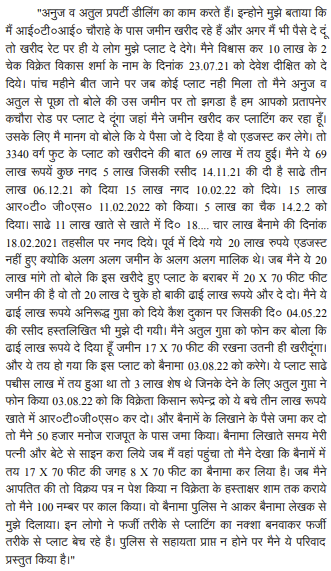
4. Aforesaid application filed under Section 156(3) Cr.P.C. was considered as a complaint and statement of Complainant as well as witnesses were recorded under Sections 200 and 202 Cr.P.C. respectively. Relevant statement of Complainant is reproduced hereinafter:
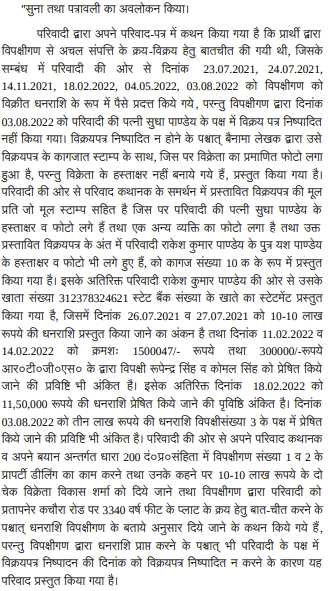
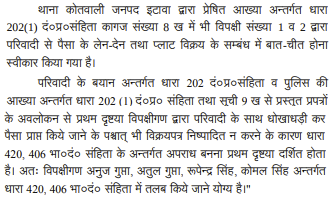
5. Trial Court concerned after considering statements passed impugned order dated 02.09.2023 under Section 204 Cr.P.C. whereby applicants have been summoned to face trial under Sections 420 and 406 IPC. Relevant part of impugned order is reproduced hereinafter:
6. Sri Akash Mishra, learned counsel for applicants has vehemently urged that factum of transaction of money and sale deed is not under much dispute though according to Complainant money was paid to one, Vikas Sharma, who was not proposed as accused in complaint. Applicants have executed a sale deed which has not been disputed as well as there is no challenge to it. The controversy is with regard to second sale deed which was not executed mainly on ground that there was a dispute with regard to area of land. Learned counsel submitted that such dispute is within the realm of civil dispute. Ingredients of Sections 420 and 406 IPC are not made out. There is no dishonest intention on behalf of applicants nor there is any entrustment over any property by applicants. Applicants are still ready to execute sale deed of lesser area.
7. Sri Mithilesh Kumar, learned AGA for State and Sri Rishi Kant Singh Chauhan, Advocate for Complainant, have opposed the aforesaid submissions. They submitted that since inception of negotiation applicants have intention to deceive and despite payment of large amount, sale deed with regard to corresponding area of land was not executed and money was also not returned back, though on basis of record it was undisputed that no complaint was made against Vikash Sharma, to whom Complainant has paid Rs. 20 lacs, which is the amount alleged to be not returned.
8. Heard learned counsel for parties and perused the material available on record.
9. Before adverting to rival submissions it would be relevant to refer few paragraphs of a recent judgement passed by Supreme Court in A.M. Mohan Vs. State Represented by SHO and another, 2024 SCC OnLine SC 339, as the facts of said case and discussion on law, would be relevant for consideration of present case :-
“9. The law with regard to exercise of jurisdiction under Section 482 of Cr. P.C. to quash complaints and criminal proceedings has been succinctly summarized by this Court in the case of Indian Oil Corporation v. NEPC India Limited1 after considering the earlier precedents. It will be apposite to refer to the following observations of this Court in the said case, which read thus:
“12. The principles relating to exercise of jurisdiction under Section 482 of the Code of Criminal Procedure to quash complaints and criminal proceedings have been stated a
AI
Criminal proceedings should not be initiated for disputes that are fundamentally civil in nature, and the essential ingredients of the alleged offenses must be clearly established for prosecution und....

Sections 406 and 420 of the IPC cannot co-exist in the same transaction; criminal breach of trust and cheating are distinct offences requiring different elements of fraud.


Mere breach of contract does not constitute cheating under IPC unless there is evidence of dishonest intention from the outset.

The Court held that the essential ingredients of the offences alleged against the petitioners are not present. The Court also noted that the dispute between the parties is essentially civil in nature....



An indispensable Tool for Legal Professionals, Endorsed by Various High Court and Judicial Officers
Please visit our Training & Support
Center or Contact Us for assistance

Scan Me!
India’s Legal research and Law Firm App, Download now!


For Daily Legal Updates, Join us on :



 Back to top


