
 Back
Back





IN THE HIGH COURT OF JUDICATURE AT ALLAHABAD
VIVEK KUMAR BIRLA, SYED QAMAR HASAN RIZVI, JJ.
Smt. Hasina Bano - Appellant
Versus
Mohammad Ehsan - Respondent
First Appeal No. 495 of 2024
Decided On : 12-09-2024
(A) Family Court Act, 1984 - Section 19 - Appeal against dismissal of Suit for declaration of matrimonial status - Delay in filing appeal condoned - The dissolution of marriage by way of mubara'at is undisputed; the Family Court is competent to declare divorce based on mutual consent without requiring original Talaqnama - No limitation period prescribed for declaration of matrimonial status under Family Courts Act. (Paras 1, 4, 19, 25)
(B) Jurisdiction of Family Court - The Family Court can endorse extrajudicial divorce and declare marital status without further enquiry if satisfied with the mutual consent of parties. (Paras 16, 18)
Facts of the case:
The marriage was solemnised on 18.12.1984, and the parties have been living separately since 16.07.1990. They mutually agreed to divorce on 15.11.1999, formalized on 07.03.2000. The Family Court dismissed their Suit for declaration of matrimonial status on technical grounds.
Findings of Court:
The dismissal of the Suit was unsustainable as the dissolution of marriage was not in dispute, and no limitation applies to such declarations.
Issues: Whether the Family Court erred in dismissing the Suit based on delay and non-filing of original Talaqnama.
Ratio Decidendi: The Family Court must endorse the mutual divorce if satisfied with the parties' agreement, and the absence of a limitation period for such declarations must be respected.
Result: Appeal allowed; matrimonial status declared as '˜divorced'.
JUDGMENT :
Syed Qamar Hasan Rizvi, J.
On the application for condonation of delay
As per the report submitted by the Registry, the present appeal under Section 19 of the Family Court Act, 1984 is barred by limitation as the same has been preferred by the appellant beyond 148 days of the prescribed limitation period. The cause of delay as explained by the appellant in the present application for condonation of delay duly supported by an affidavit is found satisfactory. The learned counsel appearing on behalf of the respondent has no objection against the aforesaid condonation of delay. Accordingly, delay in filing this appeal is condoned.
The present application for condonation of delay having application No. 01 of 2024 is allowed.
On the Memo of Appeal
1. Heard Sri Bhriguram Ji Pandey along with Sri Shashi Shekhar Maurya, learned counsels for the appellant and Sri Nilesh Kumar Dubey, learned counsel appearing for the respondent.
2. The present appeal under section 19 of the Family Court Act, 1984 has been filed, inter alia, praying for setting aside the impugned judgment and order dated 10.10.2023 and also the decree dated 19.10.2023 passed by the Additional Principal Judge, Family Court, Jhansi in Declaration Case No. 687/2021 whereby the ‘Suit for declaration of the matrimonial status’ of the parties has been dismissed. It has also been prayed that this Court may, in exercise of its appellate jurisdiction allow the said Suit, by declaring the matrimonial status of the parties as ‘divorced’ by way of mubara’at, as recognised under the Muslim Personal Law.
3. Facts of the case that are culled out from the material available on record is that the marriage between the appellant and the respondent was solemnised on 18.12.1984 in accordance with the recognised rites and customs of the Hanafi Muslim school of thought. The appellant in support of her stand filed a copy of the ‘nikahnama’ as Annexure No. 1 along with the stay application duly supported by an affidavit.
4. There is no dispute of the fact that out of their wedlock, a child was born in the year 1991 but due to some matrimonial dispute the parties preferred staying separately, giving rise to litigation. From the pleadings, it transpires that a case under section 125 Cr.P.C. was filed by the appellant which was registered as Case No. 194/1990 and a case under Section 127 Cr.P.C. was also registered as Case No. 43/1994. Further, a criminal case under Sections 498A, 323, 504, 506 I.P.C. was also filed in the Court of Chief Judicial Magistrate, Jhansi which was registered as Case No. 2454 of 1997 (Haseena Bano versus Ehsan). However, after a lapse of time, a settlement took place between the parties, out of Court and the aforesaid litigation came to an end. It is the admitted case of the parties to the present appeal that they are living separately since 16.07.1990 and on the intervention and persuasion of some respected persons of the society, the parties resorted to put an end to their marital tie and finally on 15.11.1999, they decided to accord divorce on the basis of mutual consent and dissolved their marriage by way of mubara’at as per the established principles under the Muslim Personal Law. Thereafter, on 07.03.2000 the appellant and the respondent reduced the aforesaid divorce in writing by means of a jointly signed notarised document titled as “Talaqnama Tehreer”.
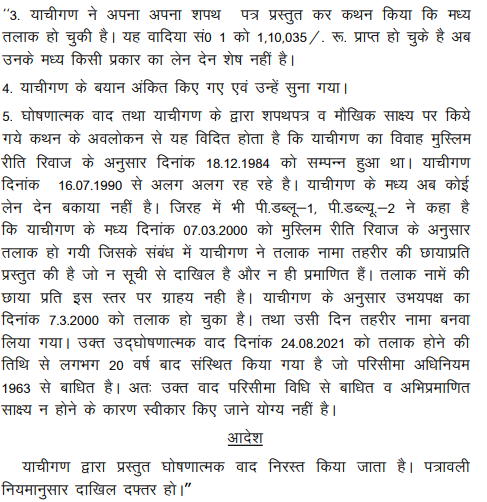
5. The parties to this appeal jointly filed a Suit being Declaration Case No.687 of 2021 before the competent Family Court at Jhansi, seeking declaration of their matrimonial status. However, the said Suit was dismissed by the learned Additional Principal Judge, Family Court, Jhansi, vide order dated 10.10.2023, on the ground of default of non-filing of the said ‘Talaqnama’ in-original by the plaintiffs along with the list of documents submitted in the Suit proceeding and also on the ground of delay in filing the Suit that having being instituted after a lapse of about 20 years from the date of its commencement of
AI
The Family Court can declare a divorce based on mutual consent without requiring original documents, and no limitation applies to such declarations.

The court affirmed that extra-judicial divorce via Mubaraat is valid and must be recognized by Family Courts, empowering them to declare marital status under Section 7 of the Family Courts Act.


(1) Family Court is competent to entertain suit seeking declaration regarding validity of marriage as also regarding matrimonial status of any person.(2) Dissolution of marriage by way of Mubaraat un....


A mutual consent divorce under 'mubaraat' in Muslim law is valid without a written agreement, affirming Family Court's jurisdiction to declare marital status under Section 7 of the Family Courts Act.
Mutual consent under Muslim Personal Law allows for divorce without judicial intervention if both parties agree, as established in the case.

Family Court only has to declare marital status by endorsing mubaraat invoking jurisdiction under Explanation (b) of Section 7(1) of Family Courts Act. Once a declaration of joint divorce invoking mu....



An indispensable Tool for Legal Professionals, Endorsed by Various High Court and Judicial Officers
Please visit our Training & Support
Center or Contact Us for assistance

Scan Me!
India’s Legal research and Law Firm App, Download now!


For Daily Legal Updates, Join us on :



 Back to top


