
 Back
Back





IN THE HIGH COURT OF ALLAHABAD
Saumitra Dayal Singh, Donadi Ramesh, JJ.
Smt. Pinki – Appellant
Versus
Pushpendra Kumar – Respondent
First Appeal No. - 155 of 2011
Decided On : 06-09-2024
(A) Hindu Marriage Act, 1955 - Section 28 and Section 13 - Divorce proceedings - The learned Court below erred in sustaining the objection to the maintainability of the second Written Statement and proceeding to hear the divorce suit on merits without fixing another date for hearing - The court must consider subsequent developments and the continued mutual consent of the parties before granting a divorce. (Paras 14, 20, 27, 34)
(B) Mediation - The court must take into account the outcomes of mediation attempts and any subsequent agreements or changes in circumstances that may affect the marital relationship. (Paras 16, 27)
Facts of the case:
The appellant contested the divorce proceedings initiated by the respondent on grounds of infertility, asserting that two children were born during the marriage, contradicting the respondent's claims. The court overlooked significant evidence regarding the marital relationship and mediation attempts.
Findings of Court:
The learned Court below's decree of divorce was based on insufficient evidence and failed to consider the changed circumstances and the appellant's withdrawal of consent.
Issues: The main issues were the maintainability of the second Written Statement and the validity of the grounds for divorce presented by the respondent.
Ratio Decidendi: The court ruled that the learned Court below erred in ignoring subsequent developments and the appellant's withdrawal of consent, emphasizing that a Hindu marriage cannot be dissolved without proven grounds.
Result: The impugned judgement and order dated 30.03.2011 are set aside, and the matter is remitted to the learned court below for further proceedings.
JUDGMENT :
1. This is an old appeal. It has remained pending for 13 years. List revised. None appears for the respondent in either call. On the last date as well, none had appeared for the respondent. The appeal is listed peremptorily today. Heard Shri Mahesh Sharma, learned counsel for the appellant and perused the record.
2. Present appeal has been filed by the appellant/wife under Section 28 of the Hindu Marriage Act, 1955 (hereinafter referred to as the 'Act') arising from the judgement and order dated 30.3.2011 passed by the learned Additional District Judge, Court no.8, Bulandshahar, in Original Suit No. 192 of 2008 (Pushpendra Kumar vs Smt. Pinki) whereby the learned Court below has dissolved the marriage between the parties under Section 13 of the Act, at the instance of the respondent/husband.
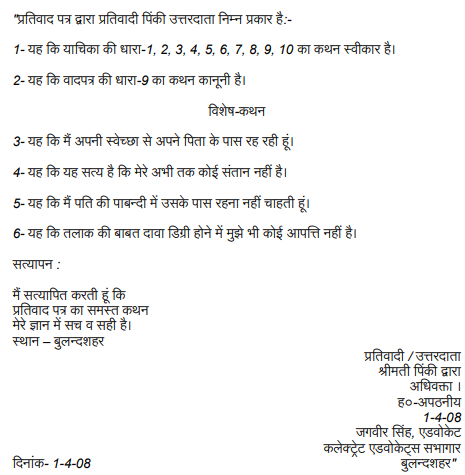
3. The parties were married on 2.2.2006 in accordance with the Act. At that time, the respondent was employed with the Indian Army. According to the plaint allegations, the appellant deserted her husband on 31.12.2007. On 11.02.2008, the respondent/husband instituted the divorce suit, primarily on the ground of infertility suffered by the appellant. On such suit being filed, a Written Statement was filed by the appellant, on 01.04.2008. Though it is disputed to the appellant, that document - described as the first Written Statement, reads as below:
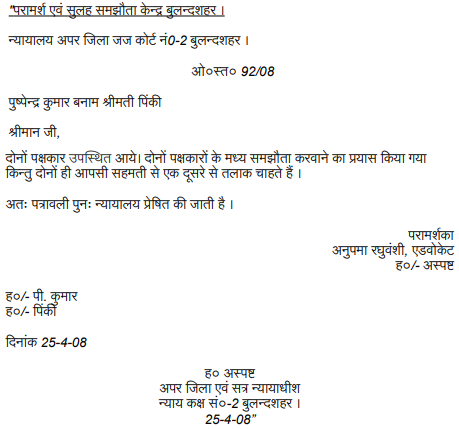
4. The matter was referred to mediation by the learned Court below. On that, first mediation was attempted by Ms. Anupama Raghuvanshi. It concluded on 25.4.2008. Paper no. 8C-2 which is the mediation report, reads as below:
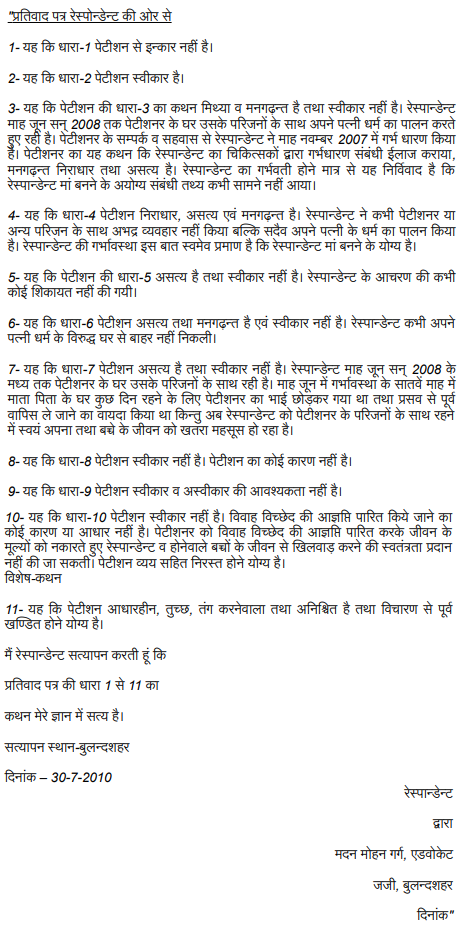
5. The matter remained pending for two years, thereafter. On 30.7.2010, the appellant/wife appears to have filed another/second Written Statement. It is Paper no.40A-1. It runs into eleven paragraphs. It reads as below:
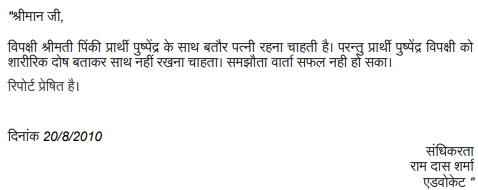
6. Thereafter, further mediation appears to have been conducted. It is dated 20.08.2010. That second mediation was attempted by Mr. Ram Das Sharma. Its report is Paper No. 44C-2. It reads as below:
7. In such status of pleading and proceeding, it is also borne out from the record - the oral statement of the appellant was recorded on 03.02.2011. She was also cross-examined. That statement reads as below:
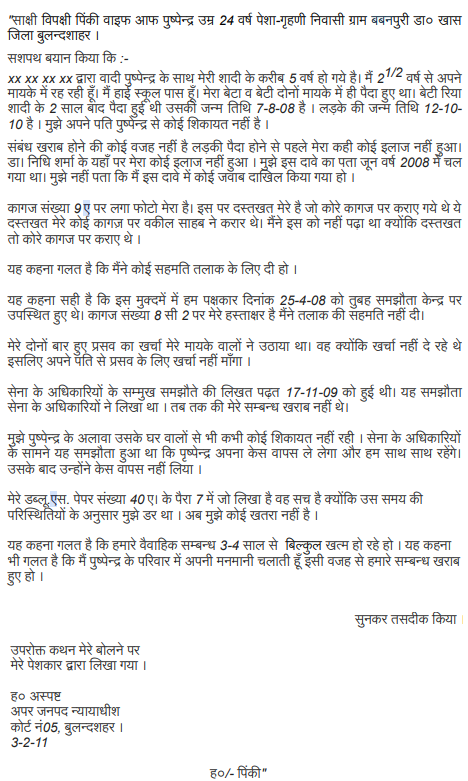
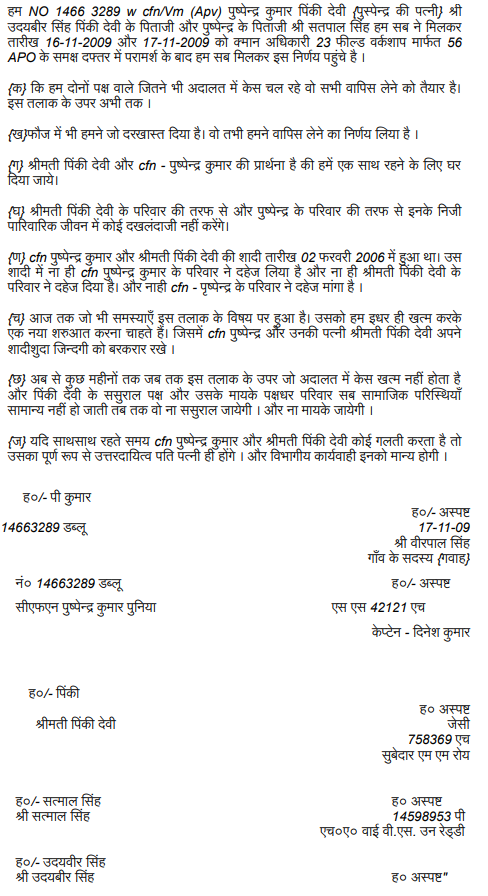
8. As extracted above, in her oral statement, the appellant referred to another/third mediation conducted between her and the respondent, before the army authorities, on 17.11.2009. That document is paper no. 56 C-1/6. We consider it appropriate to extract the same as well. It reads:
"JOINT STATEMENT - BY EFFECTED PARTY AND WITNESSES ON CASE CONSIDERING ON PUSHPENDRA KUMAR AND HIS WIFE SMT. PINKI ON 17 NOV. 2009.
9. Besides the above, the appellant had further filed certain documents to establish - neither she suffered from infertility nor it was true that no children were born to the parties. Her oral statement and documents on record indicate – she twice conceived and two children were born to her - on 7.2.2008 and 12.10.2010.
10. Thus, the appellant sought to contest the divorce proceedings - on the strength of her second Written Statement filed on 30.7.2010 and on the strength of evidence led by her.
11. The respondent raised objection that the second Written Statement filed by the appellant was not maintainable. He relied on Order VIII Rule 9, Code of Civil Procedure, 1908. In that status of the proceedings, the below quoted order dated 23.03.2011 was passed by the learned Court below:
**22-3-2011 vkt is'k gqvkA iqdkj ij i{kdkj gkftj gSA cgl fo}ku vf/koDrkx.k i{kdkj lquh x;hA okLrs fu.kZ; fnukad 29&3&11 dks is'k gksA**
12. On the next date - on 28.3.2011, instead of delivering the order, the learned Court below passed the following order:
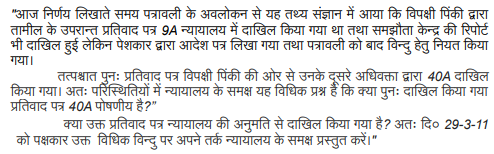
13. Clearly, the date 29.03.2011 was fixed for hearing on the objection raised as to the maintainability of the second Written Statement filed by the appellant (on 30.07.2010). However, on that date fixed, the learned court below not only proceeded to sustain the objection raised by the respondent and thus rejected the sec
AI
The court emphasized the necessity of mutual consent and the consideration of subsequent developments in divorce proceedings under the Hindu Marriage Act.

Point of law: Requirement under Section 13B(2) of Hindu Marriage Act is the “motion of both parties”.

The main legal point established in the judgment is that mutual consent for divorce must continue until the decree is passed, and the court must be satisfied about the existence of mutual consent bet....
The statutory cooling-off period under Section 13-B(2) of the Hindu Marriage Act is directory, allowing for a divorce by mutual consent even at the appellate stage.

A Divorce Petition can be maintainable under Section 13(1A)(ii) of the Hindu Marriage Act even after a prior dismissal if new grounds exist due to non-resumption of cohabitation.

An appeal against a decree of divorce by mutual consent is not maintainable if the consent is claimed to be obtained through fraud or misrepresentation.

The central legal point established is the court's reliance on mutual consent, settlement agreement, and absence of legal impediments to grant a decree of divorce by mutual consent and allow the waiv....

Point of law: Mutual divorce – Waiving of six month periods - it will be open to the Court to exercise its discretion in the facts and circumstances of each case where there is no possibility of part....

(1) Divorce – Consent of parties is not necessary to declare a marriage dissolved – A dead marriage must be given a decent quietus.(2) Matrimonial Proceedings – Bar of limitation – Word ‘proceedings’....

Divorce by mutual consent – No appeal would be maintainable against decree for divorce by mutual consent.



An indispensable Tool for Legal Professionals, Endorsed by Various High Court and Judicial Officers
Please visit our Training & Support
Center or Contact Us for assistance

Scan Me!
India’s Legal research and Law Firm App, Download now!


For Daily Legal Updates, Join us on :



 Back to top


