
 Back
Back





IN THE HIGH COURT OF JUDICATURE AT ALLAHABAD
SARAL SRIVASTAVA, J.
Dr. Rajeev Mittal - Petitioner
Versus
Smt. Sushila Devi and Another - Respondents
Matters Under Article 227 No. 9551 of 2024
Decided On : 14-08-2024
(A) Constitution of India - Article 227 - Revisional jurisdiction - The petitioner challenged the decree for eviction passed by the revisional court, which found that the trial court erred in law by not recognizing the evidence presented by the son of the landlady. The court emphasized that the revisional court can correct findings based on misinterpretation of law. (Paras 8, 10, 20, 34)
(B) Evidence Act - Section 15 - Admission of tenancy - The petitioner admitted the tenancy in the written statement, thus not requiring further proof under law. (Paras 24, 34)
Facts of the case:
The respondents filed a suit for eviction against the petitioner, claiming the tenancy had ended. The trial court ruled in favor of the petitioner, but the revisional court reversed this decision, citing errors in the trial court's findings.
Findings of Court:
The revisional court correctly identified that the trial court's findings were based on a misinterpretation of law and that the evidence presented was sufficient to prove the case.
Issues: The main issues were whether the revisional court exceeded its jurisdiction and whether the trial court's findings were legally sound.
Ratio Decidendi: The court ruled that the revisional court has the authority to correct findings based on legal misinterpretation and that admissions in the written statement negate the need for further proof.
Result: Petition dismissed.
JUDGMENT :
Saral Srivastava, J.
1. Heard Sri Syed Mohammad Abbas Abdy, learned counsel for the petitioner, and Sri Atul Dayal, learned Senior Counsel assisted by Sri Pawan Kumar Singh, learned counsel for the respondents.
2. The petitioner through present petition under Article 227 of the Constitution of India has assailed the judgment and decree dated 22.05.2024 passed by District Judge, Bulandshahar in SCC Revision No.96 of 2023 by which the revisional Court has decreed the suit of the plaintiffs/respondents for eviction of the petitioner/tenant.
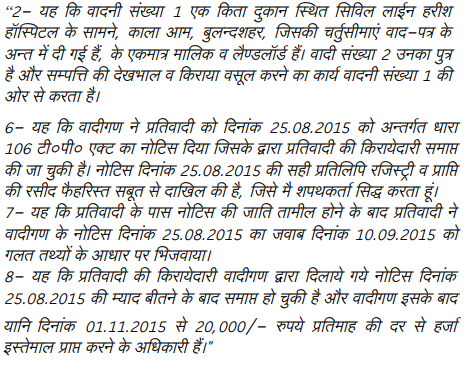
3. The facts, in brief, are that the respondents/plaintiffs instituted a SCC Suit No.31 of 2015 for eviction of the petitioner/tenant on the ground that the petitioner/tenant is a tenant of a shop situated in Civil Lines opposite Harish Hospital, Kala Aam, Bulandshahar on the rent of Rs.3750/- per month. It is further stated that Uttar Pradesh Act No.13 of 1972 does not apply to the said shop. It is further stated that the notice dated 25.08.2015 terminating the tenancy of the petitioner/tenant under Section 106 of the Transfer of Property Act was served upon the petitioner. The petitioner gave the reply to the aforesaid notice on 10.09.2015. Accordingly, it is stated that after the expiry of the period of notice dated 25.08.2015 for vacating the premises to the petitioner/tenant, the tenancy of the petitioner/tenant came to an end, and the status of the petitioner thereafter is that of an unauthorised occupant.
4. The aforesaid suit was contested by the petitioner by filing a written statement wherein he admitted in paragraph No.2 that he has been the tenant of the shop in question since 1989. Paragraph No.2 of the written statement is reproduced below :
^^2- ;g fd okn&i= dh /kkjk&2 ftl rjg ls rgjhj gS] Lohdkj ugha gSA D;ksafd çfroknh o"kZ 1989 ls mDr ç'uxr nqdku esa fdjk;snkj pyk vk jgk gSA**
5. He took several other pleas in the written statement disputing the correctness of the averments made in the plaint.
6. The trial court based on the pleading between the parties framed ten issues. However, in the instant case, the relevant issues are only issue Nos.1 & 2. Issue No.1 was whether the plaintiffs/respondents were the owner and landlord of the shop; issue No.2 was whether there was a relationship of landlord and tenant between the plaintiffs/respondents and the petitioner/tenant. Issue No.7 is also relevant in the context of the present case which was whether the tenancy of the petitioner/tenant was terminated by notice dated 25.08.2015.
7. The trial court decided the issue Nos.1 & 2 jointly and returned a finding that the plaintiffs/respondents failed to prove that plaintiff/respondent No.1 is the landlady of the shop in question since she did not appear to prove the plaint case. The trial court decided issue No.7 also against the respondent landlord holding that the plaintiffs have failed to prove the notice dated 25.08.2015 on the ground that the plaintiff/respondent No.1 did not appear in the witness box to prove the notice.
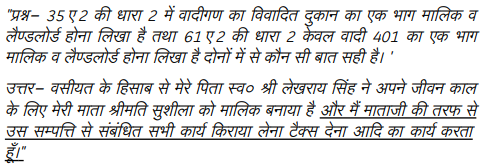
8. The respondents preferred SCC Revision No.96 of 2023 which was allowed by the revisional court on the ground that the trial court has erred in law in concluding that the plaintiffs/respondents failed to prove their case because the plaintiff/respondent No.1 who is the landlady of the shop in question did not appear to prove the case. The revisional court held that the case was proved by respondent no.2 who is the son of plaintiff/respondent No.1. In recording the aforesaid finding, the revisional court has placed reliance upon the judgment of this Court in the case of Syed Hasrat Ali & another Vs. Nazim Abbas and others, 2008 (1) ARC 532.
9. Challenging the aforesaid order, learned counsel for the petitioner has raised two-fold contention. The first contention advanced by learned counsel for the petitioner is that the revisional court has committed manifest error of law and has acted beyond jurisdiction in decreeing the suit inasmuch as if the revisional court w
AI
The revisional court can correct trial court findings based on legal misinterpretation, especially when admissions negate the need for further proof.

The Court emphasized the importance of proving a landlord's bona fide requirement for eviction and the need for tenants to provide evidence to rebut the landlord's assertions.
Point of law: When the aid of Revisional Court is invoked on the revisional side, it can interfere within the permissible parameters provided in the statute. It goes without saying that if a revision....


The court's decision emphasized the importance of evidence in supporting claims of personal necessity and highlighted the limited scope of revisional jurisdiction in re-assessing evidence.

Point of law: Eviction of tenant – Relief of arrears of rent - Court in exercise of powers under Section 25 of the Provincial Small Cause Court Act can interfere on limited grounds
The court affirmed the revisional court's findings on landlord-tenant relationships and notice validity, emphasizing statutory interpretation and jurisdictional limits under the Provincial Small Caus....

The revisional court's powers are limited, and it cannot disturb findings of fact unless they are perverse; additional evidence must be justified and not used to fill gaps.

Eviction of tenant - Unauthorized occupation of tenant - Intention and admission in pleadings indicates the creation of relationship of landlord and tenant and that the amount paid by the revisionist....



An indispensable Tool for Legal Professionals, Endorsed by Various High Court and Judicial Officers
Please visit our Training & Support
Center or Contact Us for assistance

Scan Me!
India’s Legal research and Law Firm App, Download now!


For Daily Legal Updates, Join us on :



 Back to top


