
 Back
Back





IN THE HIGH COURT OF ALLAHABAD
JAYANT BANERJI, J.
Ram Dular And 7 Others - Petitioners
Versus
Aliyar And 3 Others - Respondents
WRIT - B NO. 16373 OF 2016.
Decided On : 18-08-2023
| Table of Content |
|---|
| 1. inheritance and joint tenancy in family property (Para 2 , 3 , 4) |
| 2. application for restoration under cpc and limitation (Para 5) |
| 3. defendant's participation in prior proceedings (Para 6 , 8) |
| 4. validity of gift deed and ownership rights (Para 7) |
| 5. court's duty in assessing claims of fraud (Para 9 , 11) |
| 6. jurisdiction of revenue courts vs. civil courts (Para 10 , 12 , 13) |
| 7. grounds for appeal under zamindari abolition act (Para 14) |
| 8. orders of board of revenue reviewed (Para 15 , 16 , 17 , 18) |
JUDGMENT
Jayant Banerji, J.
Heard Shri Sanjeev Singh and Shri Amit Pathak, learned counsel for the petitioners and Shri R.C. Singh, learned Senior Advocate assisted by Shri N.D. Shukla, learned counsel appearing for the respondent no. 1. Respondent no. 2 is represented by the learned Standing Counsel. Notice on behalf of the respondent nos. 3 and 4 has been accepted by Shri Bhupendra Kumar Tripathi, learned counsel.
2. This writ petition has been filed for setting aside the order dated 17.3.2016 passed by the Board of Revenue, U.P. at Allahabad in Second Appeal No. 917 of 2015 ( Aliyar v. Ram Dular and others). By means of the impugned decision of the Board, (i) a preliminary decree dated 30.11.1998 and the final decree dated 12.8.1999 passed in a suit filed by the petitioners against the respondents under the provisions of Section 229B and Section 176 of the U.P.Z.A. and L.R. Act, 1950 were set aside and (ii) the order dated 20.9.2014 passed by the Assistant Collector (Class I), Varanasi rejecting the restoration application of the respondent no. 1 on the ground of it being barred by the limitation was set aside and, further, (iii) the order passed by the Additional Commissioner (Administration), Varanasi Division, Varanasi dated 7.4.2015 was also set aside.
3. The case of the petitioners is that they and the respondent no. 1 along with one Sambhoo Nath are the heirs of one Mansha Ram. The pedigree of the family is mentioned in paragraph no. 3 of the writ petition, which is as follows:
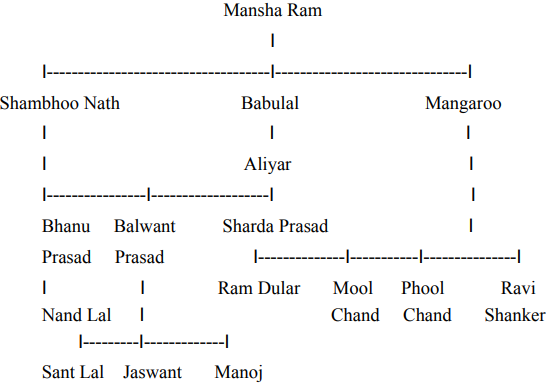
4. It is stated that Mansha Ram was married to the daughter of one Chirkit resident of Village Bachchhawan (Pashchimpur), Pargana Kaswar Raja, Tehsil and District Varanasi. Chirkit had no male issues. He had landed properties in Village Bachchhawan (Pashchimpur) as well as in Village Khalilpur, which two villages are adjacent to each other. It is stated that after the death of Chirkit, his land and other properties were inherited by Mansha Ram and after the death of Mansha Ram, the land was inherited by his three sons, namely, Sambhoo Nath, Babulal and Mangaroo jointly. All three sons of Mansha Ram became the joint tenants of the aforementioned landed properties belonging to Late Chirkit. It is stated that since Babulal was the Karta in the joint Hindu family, only his name was entered in the revenue records, although the lands were under the joint tenancy of Sambhoo Nath, Babulal and Mangaroo. It is stated that there was mutual understanding between the three brothers and nobody objected to the name of the Babulal as Karta in the joint Hindu family to be entered into the revenue records. It is stated that after the death of Babulal, his son Aliyar became the Karta in the joint Hindu family and only his name was mentioned in the revenue records with regard to the landed properties aforesaid. It is stated that consolidation operations in the villages Bachchhawan and Khalilpur were started by a notification made under the Consolidation of Holdings Act, 1953 followed by a notification under Section 52 in the year 1988. It is stated that even though the whole family was a joint family, to avoid future disputes a memo of partition was prepared on 15.1.1998 which was termed as a family settlement. It is stated that to avoid any further controversy or dispute, an Original Suit No. 197 of 1998 was instituted under Section 176 read with Section 229B of the Zamindari Abolition Act in the court of the Sub-Divisional Officer by the petitioners on 5.
AI

The Board of Revenue's judgment setting aside trial court findings was arbitrary, lacking proper legal basis and factual consideration, thus the trial court's decree was affirmed.
Restoration applications for ex-parte decrees are maintainable and do not abate under the U.P.C.H. Act, even if consolidation operations are ongoing.

The Board of Revenue erred in disregarding documentary evidence supporting the plaintiffs' claims and overstepped its jurisdiction by reversing concurrent factual findings of lower courts.
The court ruled that title objections under the U.P. Consolidation of Holdings Act must be decided on merit, emphasizing the need for proper jurisdiction and evidence rather than relying on alleged c....
The court affirmed that the trial court's decree granting bhumidhari rights was valid, and the Board of Revenue acted within its jurisdiction in upholding this decision.
Restoration applications under CPC do not abate under Section 5(2) of the Consolidation Act, allowing for adjudication on merits.



An indispensable Tool for Legal Professionals, Endorsed by Various High Court and Judicial Officers
Please visit our Training & Support
Center or Contact Us for assistance

Scan Me!
India’s Legal research and Law Firm App, Download now!


For Daily Legal Updates, Join us on :



 Back to top


