
 Back
Back





IN THE HIGH COURT OF ALLAHABAD
J.J. Munir, J.
Shilpi, Class III (Cashier) – Petitioner
Versus
State of U.P. and Others – Respondents
Civil Misc. Writ Petition No. 17463 of 2023
Decided On : 27-05-2024
JUDGMENT :
J.J. Munir, J.
1. This writ petition is directed against an order dated 25.8.2023 passed by the Chief Executive Officer/Secretary of the District Cooperative Bank Ltd., Kanpur, rejecting the petitioner's application for grant of maternity leave and notified by an order of the said date, issued by the Deputy General Manager (Administration), District Cooperative Bank Ltd., Kanpur.
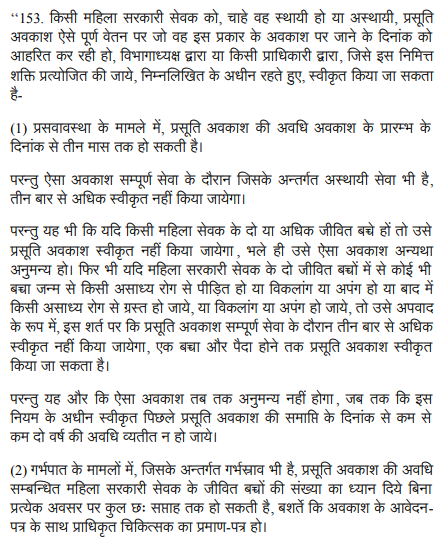
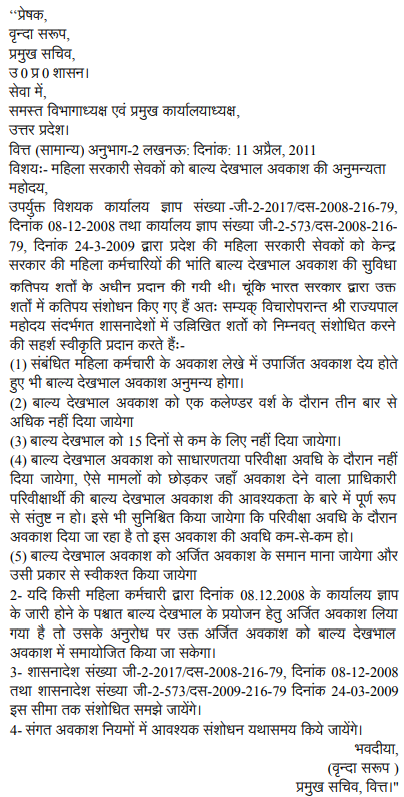
2. The petitioner is a Cashier, a Class-III employee with the District Cooperative Bank Ltd., Kanpur (for short, 'the Bank'). She is posted with Branch Akbarpur, District Kanpur Dehat. The petitioner was appointed vide letter of appointment dated 22.6.2016 and has been working eversince. She moved an application on 18.8.2023 to the Secretary/Chief Executive Officer of the Bank, requesting grant of maternity leave. The said application was forwarded by the competent Authority to the Secretary/Chief Executive Officer of the Bank for consideration. The petitioner's application was rejected by the Secretary/Chief Executive Officer vide order dated 25.8.2023, citing the reason that under the Uttar Pradesh Employees Service Regulations read with Rules 101 and 153 of Chapter III, Volume II, Parts 2-4 of the Financial Handbook, Maternity Leave Rule No. 1 provides that the said leave would not be admissible unless a minimum period of two years has elapsed since the last maternity leave availed had come to an end. The impugned order goes on to remark that the petitioner's first maternity leave ended on 5.3.2022, and, therefore, a period of two years has not elapsed since the end of her last maternity leave. For the said reason, it was held by the Secretary/Chief Executive Officer of the Bank that the petitioner is not entitled to avail her second maternity leave. The said decision was notified by the Deputy General Manager (Administration) vide order dated 25.8.2023, which, in substance, is a communication of the order made by the Secretary/Chief Executive Officer of the Bank.
3. It is the petitioner's case that she had been granted maternity leave earlier, which ended on 5.3.2022, relative to her first pregnancy, and, the present application was made on 25.8.2023, when she conceived a second time. In the normal course of nature, after her first pregnancy, the petitioner was blessed with a daughter, named Kritika, who was born on 19.11.2021. The petitioner says that if her maternity leave is considered for a period of 180 days, she may be granted the said leave since 25.8.2023 to 18.2.2024. It is pleaded that according to the foetal biometry, given the estimated time of delivery advised, the petitioner expects on 2nd October, 2023. She has annexed a medical report of hers dated 30.8.2023 in this regard. The petitioner applied for a review of the order dated 25.8.2023 on 28.8.2023, referring to an order passed by this Court, where she would be entitled to a second maternity leave within two years of the end of her first leave of the same category. It is the petitioner's case that she is entitled to the benefit of Section 27 of the Maternity Benefit Act, 1961 (for short, 'the Maternity Act'), which has overriding effect, vis-a-vis any other law, whether made before or after coming into force of the Maternity Act. The petitioner has pleaded a case that the provisions of the Maternity Act prevail over Rule 153(1) of the Financial Handbook, Volume II, Part 2-4.
4. The petitioner has also pleaded that the right to conceive and give birth to a child is a fundamental right of a woman and it cannot be curtailed by law. It is also her case that if any application of a female employee for the grant of maternity leave is rejected, the same would constitute violation of the fundamental right of a person, which includes a woman, under Article 21 of the Constitution. It is urged that any rule, which curtails a woman's right to avail the benefit of maternity leave, would come in conflict with the provisions of the Maternity Act and in such cases, the special law shall pr
AI
The Maternity Benefit Act, 1961 prevails over conflicting state regulations, affirming women's fundamental right to maternity leave.

The Maternity Benefit Act, 1961 prevails over the Financial Handbook's provisions, allowing second maternity leave regardless of a two-year gap requirement.

The Maternity Benefit Act, 1961 does not apply to government servants, and state policy restricting maternity leave for the third child is valid.

Maternity leave under CCS(Leave) Rules Rule 43 granted for third biological child via purposive interpretation, limited to 12 weeks guided by Maternity Benefit Act, considering divorce, child disabil....

Point of Law : Act of 1961 was enacted to secure women's right to pregnancy and maternity leave and to afford women with as much flexibility as possible to live an autonomous life, both as a mother a....

An alternate efficacious remedy though available has not been resorted to by the petitioner and hence the writ petition is not maintainable.

The main legal point established in the judgment is the entitlement of a female government servant to maternity leave under Rule 43 of the Central Civil Services (Leave) Rules 1972, emphasizing a pur....

The Maternity Benefit Act has an overriding effect as per Section 27, and the applicability of other laws to an establishment must be carefully considered.



An indispensable Tool for Legal Professionals, Endorsed by Various High Court and Judicial Officers
Please visit our Training & Support
Center or Contact Us for assistance

Scan Me!
India’s Legal research and Law Firm App, Download now!


For Daily Legal Updates, Join us on :



 Back to top


