
 Back
Back





IN THE HIGH COURT OF ALLAHABAD
Saurabh Shyam Shamshery, J.
Prem Chand Verma - Applicant
Versus
State of U.P. and another - Respondents
Criminal Misc. Application No. 4204 of 2024
Decided On : 30-07-2024
JUDGMENT :
Saurabh Shyam Shamshery, J.
Heard Sri A Kumar Srivastava, learned counsel for applicant, Sri Raj Kumar Singh, learned counsel for opposite party No. 2 and Sri Rakesh Kumar Mishra, learned A.G.A. for State.
2. The applicant is aggrieved by an impugned order dated 10.10.2023 passed by learned Magistrate, under Section 204 Cr.P.C., whereby applicant is being summoned to face trial under Section 420, 406 I.P.C. in a Criminal Complaint Case No. 4623 of 2022, Police Station-Kotwali, District-Ballia. For reference, impugned order in its entirety is reproduced hereinafter :
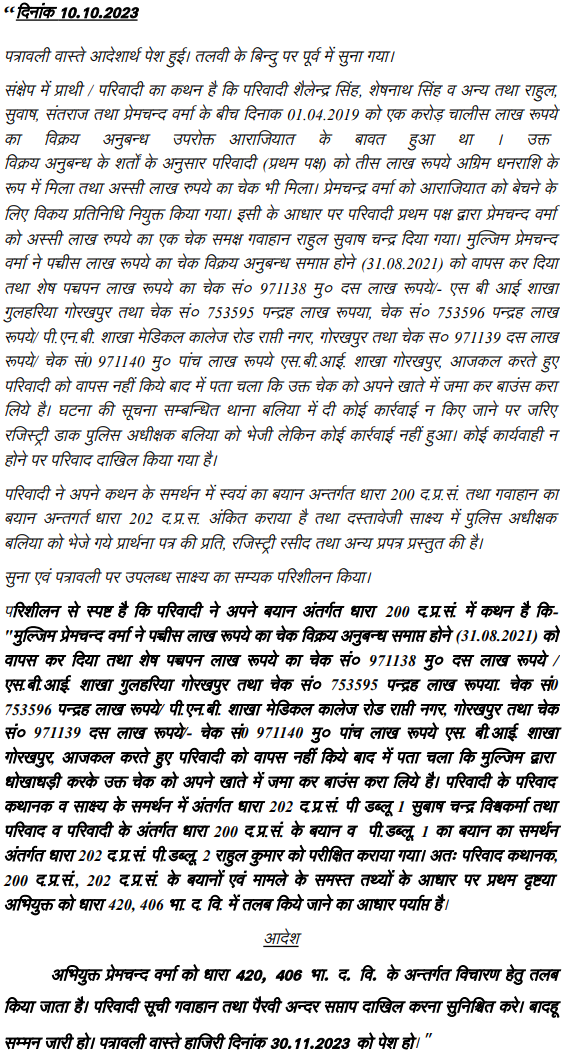
3. Learned counsel for applicant has submitted that on basis of contents of complaint, statements recorded under Sections 200 and 202 Cr.P.C., offence under Section 420, 406 I.P.C. could not be made out as not only both offences could not run together but their respective ingredients are also not made out.
4. The aforesaid submissions are opposed by learned counsel for opposite party No. 2, that there are sufficient grounds to proceed against the applicant.
5. In order to appreciate rival submissions, I have carefully perused impugned order as well as other material placed on record. The case as put by complainant was that the applicant was his authorized representative and he was executing a deal struck between parties, settled for amount of Rs. 1 crore 40 lakh for sale of land owned by the complainant, out of which Rs. 30 lakh was given as advance amount and Rs. 80 lakh were given in form of different cheques by vendees.
6. It was further alleged that agreement to sale does not finally take place, therefore, a cancellation deed was prepared and according to its terms Rs. 30 lakh (earnest amount) was returned by complainant to vender through transfer in bank account. It was further alleged that applicant has returned a cheque of Rs. 25 lakh to complainant and further alleged that dispute remained in regard to five cheques of Rs. 10 lakh, 15 lakh, 15 lakh, 10 lakh and 5 lakh respectively (total Rs. 55 lakh), which ought to have been returned to complainant but the applicant allegedly misused it and deposit it in the bank, which got dishonoured though no complaint was filed under Negotiable Instruments Act.
7. Learned Trial Court on basis of above referred allegations come to conclusion that there are sufficient grounds to proceed against applicant and summoned him under Section 420, 406 I.P.C. So far as ingredients of Sections 415, 420 I.P.C. is concerned, it would be relevant to quote few paragraphs of a recent judgment passed by Supreme Court in case of Raju Krishna Shedbalkar v. State of Karnataka and another, 2024 SCC OnLine SC 200 and relevant paragraphs thereof are reproduced hereinafter :
''6. Cheating is defined under Section 415 of IPC which reads as follows:-
''415. Cheating.-Whoever, by deceiving any person, fraudulently or dishonestly induces the person so deceived to deliver any property to any person, or to consent that any person shall retain any property, or intentionally induces the person so deceived to do or omit to do anything which he would not do or omit if he were not so deceived, and which act or omission causes or is likely to cause damage or harm to that person in body, mind, reputation or property, is said to ''cheat''.
7. A perusal of the aforesaid provision shows that the offence of cheating is in two parts. The first is where a person fraudulently or dishonestly deceives another in inducing that person to deliver any property to any person etc. The second part of the offence would be made out if somebody is deceived to do an act which causes damage or harm to that person ''in body, mind, or reputation or property is said to have cheated''. Time and again, this Court has reiterated that in order to make out an offence under cheating the intention to cheat or deceive should be right from the beginning. By no stretch of imagination, this is even reflected from the complaint made by the informant.
8. In the case of Hridaya Ranjan Prasad Ver
AI
Mere breach of contract does not constitute cheating under IPC unless there is evidence of dishonest intention from the outset.

Criminal proceedings should not be initiated for disputes that are fundamentally civil in nature, and the essential ingredients of the alleged offenses must be clearly established for prosecution und....


The court found no basis for criminal breach of trust under Section 406 IPC, deeming the case a civil dispute and quashing the charge-sheet due to mala fide initiation.

Non-payment in a commercial transaction does not constitute criminal breach of trust or cheating unless there is evidence of dishonest intention from the inception.

Insufficient evidence of dishonest intent or misappropriation negates criminal charges under Sections 406 and 420 IPC, emphasizing the necessity of proving criminal intent in such transactions.

Sections 406 and 420 of the IPC cannot co-exist in the same transaction; criminal breach of trust and cheating are distinct offences requiring different elements of fraud.



An indispensable Tool for Legal Professionals, Endorsed by Various High Court and Judicial Officers
Please visit our Training & Support
Center or Contact Us for assistance

Scan Me!
India’s Legal research and Law Firm App, Download now!


For Daily Legal Updates, Join us on :



 Back to top


