
 Back
Back





IN THE HIGH COURT OF ALLAHABAD
ANJANI KUMAR MISHRA, JAYANT BANERJI, JJ.
The Mechanical Department Primary And Another - Petitioners
Versus
Union of India And Another - Respondents
Writ - C No. 6744 of 2019
Decided On : 10-02-2025
(A) Cooperative Societies Act, 1912 - Multi-State Cooperative Societies Act, 2002 - Banking Regulation Act, 1949 - The petitioners sought registration under the Multi-State Cooperative Societies Act, 2002, asserting that they had members across multiple states. The Central Registrar rejected their application citing lack of evidence for multi-state operations. The court emphasized the necessity of demonstrating that the society's objects were not confined to one state, as required under Section 2 of the Act, 1942, and reiterated that the Circular of the Reserve Bank of India mandating prior approval for by-law amendments is legally valid. (Paras 3, 12, 59, 60)
(B) Writ Jurisdiction - The court held that the petitioners failed to establish their claims regarding multi-state operation and registration, resulting in the dismissal of the writ petition. (Paras 62)
Key Points: - A cooperative society must demonstrate that its objects are not confined to one state to qualify for registration under the Multi-State Cooperative Societies Act, 2002 (!) (!) (!) . - The petitioner failed to provide conclusive evidence, such as certified by-laws or a list of members from multiple states, to prove multi-state operations (!) (!) . - The Reserve Bank of India's circular requiring prior permission for by-law amendments is legally valid as it falls under the Union List entry for banking regulation (!) . - The Central Registrar was justified in rejecting the registration application due to the lack of prior permission from the Reserve Bank of India (!) . - Cooperative banks are governed by the Banking Regulation Act, 1949, and must comply with RBI directives regarding licensing and operational permissions (!) (!) . - The High Court dismissed the writ petition as the petitioners did not meet the statutory requirements for multi-state registration (!) (!) . - Previous court orders granting directions were set aside or found inapplicable because the core issue of registration was not conclusively established (!) (!) . - The petitioner's claim of having branches in Bihar and Uttarakhand was not supported by sufficient documentary evidence of licensed operations (!) (!) . - The court held that the petitioner must operate as a Uni-State Cooperative Bank until it obtains the necessary approvals from the Reserve Bank of India (!) . - The judgment emphasizes that the aspect of registration is distinct from the aspect of amending by-laws, both requiring strict compliance with applicable laws (!) .
JUDGMENT :
Jayant Banerji, J.
1. The array of parties in this petition is as follows:-
“1. The Mechanical Department Primary Co-operative Bank Limited, North Eastern Railway, Gorakhpur through its Secretary Mr. Balwant Kumar Shahi.
2. Mr. Balwant Kumar Shahi son of Late Prasiddh Narain Shahi Secretary, The Mechanical Department Primary Co-operative Bank Ltd., North Eastern Railway, Gorakhpur.……………..PETITIONERS
VERSUS
1. Union of India through Secretary, Ministry of Agriculture & Co-operative, Government of India, New Delhi.
2. Central Registrar, Co-operative New Delhi/Joint Secretary, Government of India Krishi Bhawan New Delhi.
3. Reserve Bank of India through its Manager, 8-9 Vipin Khand, Gomti Nagar, Lucknow...………..RESPONDENTS.”
2. This writ petition has been filed seeking the following reliefs:-
“I. Issue a writ, order or direction in the nature of certiorari quashing impugned order dated 26.12.2018 passed by Central Registrar, Co-operative New Delhi/Joint Secretary Government of India Krishi Bhawan, New Delhi/respondent no.2 (Annexure no.20 to the writ petition).
II. Issue a writ, order or direction in the nature of mandamus commanding Central Registrar, Co-operative New Delhi/Joint Secretary, Government of India, Krishi Bhawan, New Delhi/respondent no.2 to treat the petitioners’ bank registration in Multi State Co-operative Societies Act, 2002.”
3. The petitioner No. 1 [petitioner-bank] is stated to have been registered under the Cooperative Societies Act, 1912 [Act, 1912] on 31.5.1919 bearing registration No. 275 and at that point of time, the petitioner-bank was named “The Mechanical Department Credit Society Ltd. Gorakhpur”. It is stated that time to time, necessary amendments were made in the years 1962-1966. Again amendment was done on 3.5.1973 by the Central Registrar Co-operative Societies, U.P. Lucknow, whereby the name of the petitioner-bank became Mechanical Department Primary Co-operative Bank Ltd. In 1982, the Reserve Bank of India granted licence to the petitioner-bank under Section 23 read with Section 56(p) of the Banking Regulation Act, 1949 [B.R. Act] to open an office at Izzat Nagar, District Bareilly apart from Gorakhpur for working and functioning of the petitioner-bank.
4. The petitioner-bank has sought to demonstrate its being subjected to regulatory control under the Multi-State Cooperative Societies Act, 1984 [Act, 1984] by the respondent no.2 by stating that a letter dated 14.3.1997 was sent by the Registrar of the Cooperative Societies, U.P. Lucknow to the Joint Secretary/Central Registrar on the subject of prior approval of supersession of governing body of the petitioner-bank under Section 48 of the Act, 1984; a reminder letter dated 31.3.1997 was again issued. Thereafter, the respondent no.2, Central Registrar issued a letter dated 2.4.1997 to the Registrar Cooperative Societies, U.P. conveying his approval to initiate action against the Board of Directors of the petitioner-bank under Section48 of the Act, 1984. By an order dated 10.4.1997, the respondent no.2, Central Registrar superseded the petitioner-bank and appointed a Board of Administrators comprising of three administrators to administer the affairs of the petitioner-bank. The petitioner-bank then filed a writ petition No. 43087 of 1998 which was disposed of by a judgment and order dated 18.1.1999.
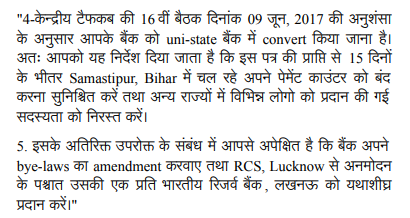
5. It is stated that it was held by this Court in the aforesaid writ petition of 1998 that the Board of Administrators was legally put in office; it was directed, inter alia, that the existing Board of Administrators, which would be functioning only till such time the newly elected Board of Directors was constituted by the close of the month of February 1999, shall merely manage day to day affairs of the petitioner-bank and shall not take any policy decision and shall also not make any fresh appointments; the Chief Mechanical Engineer, North Eastern Railway, Gorakhpur as well as the Central Registrar were directed to ensure that the elections to constit
A cooperative society must demonstrate its multi-state operations to be registered under the Multi-State Cooperative Societies Act, 2002, as per legal requirements and Reserve Bank directives.

The court established that State legislation under the Maharashtra Co-operative Societies Act can apply to banking cooperatives without infringing on Central jurisdiction, affirming the dual regulato....

(1) Multi-State cooperative society – Domicile or residence of members is irrelevant for determining whether a society attains status of a multi-State cooperative society – A cooperative society whos....


Point of Law : Section 74A of 1969 Act was incorporated to ensure that benefits of DICGC Act, 1969 were extended to Co-operative Banks as well.

Merger of cooperative banks does not violate statutory regulations when properly sanctioned; the petitioner acted out of self-interest and lacking standing.

Cooperative banks are categorized under the Banking Regulations Act, 1949, thereby requiring debt recovery through federal legislation and not state mechanisms.

An appeal against the order of amalgamation of co-operative banks approved by the RBI is barred under Section 79 of the Chhattisgarh Co-operative Societies Act.

The court ruled that cooperative banks fall within the definition of 'Financial Establishment' under the MPID Act, thereby affirming the Act's applicability to such entities despite their regulation ....



An indispensable Tool for Legal Professionals, Endorsed by Various High Court and Judicial Officers
Please visit our Training & Support
Center or Contact Us for assistance

Scan Me!
India’s Legal research and Law Firm App, Download now!


For Daily Legal Updates, Join us on :



 Back to top


