
 Back
Back





IN THE HIGH COURT OF ALLAHABAD
Chandra Kumar Rai, J.
Ram Jiyawan and Others – Petitioners
Versus
State Of UP and Others – Respondent
Writ - B No. - 1997 of 2024
Decided On : 19-11-2024
| Table of Content |
|---|
| 1. hearing of the case and record of supplementary affidavit. (Para 1 , 2) |
| 2. detailed factual background of consolidation proceedings. (Para 3) |
| 3. court's directive on status updates for further proceedings. (Para 4) |
| 4. arguments by petitioners and state respondents regarding legality of consolidation orders. (Para 6 , 7) |
| 5. analysis of cancellation of proceedings and implications. (Para 8 , 9 , 10 , 11 , 12 , 13) |
| 6. conclusion on necessity of interference in matters. (Para 14) |
| 7. dismissal of writ petition with no order as to costs. (Para 15 , 16) |
JUDGMENT :
Chandra Kumar Rai, J.
1. Heard Shri Rahul Kumar Tyagi, learned counsel for the petitioners, Shri Ashutosh Kumar Rai, learned Additional Chief Standing Counsel for the State- respondents.
2. Supplementary affidavit on behalf of the petitioners is taken on record.
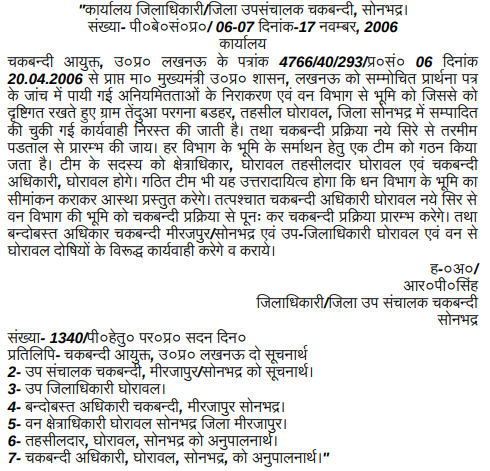
3. Brief facts of the case are that Village Tendua Pargana Badhahar Tehsil Ghorawal District Sonbhadra came under operation of U.P. Consolidation of Holdings Act, 1953 hereinafter referred to as U.P.C.H. Act by way of notification issued under Section 4 of U.P.C.H. Act. During consolidation proceeding, an order dated 5.9.2003 was passed by Consolidation Officer deciding the inter-se dispute between petitioners and respondent no.4. Against the order of Consolidation Officer dated 5.9.2003, an appeal was filed before Settlement Officer Consolidation which was dismissed vide order dated 29.6.2006. Contesting respondent no.4 filed a revision under Section 4 8 of U.P.C.H. Act before Deputy Director of Consolidation against the appellate order dated 29.6.2006 which has been registered as revision No. 32/ 138 of 2007. During pendency of the aforementioned revision, an order dated 17.11.2006 was passed by District Magistrate/ District Deputy Director of Consolidation Sonbhadra on the basis of the order/ letter dated 20.4.2006 issued by Consolidation Commissioner U.P. Lucknow for cancelling the proceeding up to the stage of Section 20 of U.P.C.H. Act and for initiating fresh consolidation proceeding in the Village in question. On the basis of the order dated 17.11.2006 passed by District Magistrate/ District Deputy Director of Consolidation, an order dated 19.6.2007 was passed by respondent no.2 staying the proceeding of revision No. 32/ 138 under Section 4 8 (1) of U.P.C.H. Act. In pursuance of the order dated 17.11.2006, proceeding under Section 8 of the U.P.C.H. Act was completed in the Village on 20.9.2009/ 23.11.2012, proceeding under Section 9 of the U.P.C.H. Act was completed on 31.12.2012 and proceeding under Section 20 of U.P.C.H. Act was completed on 28.2.2014. Village in question was notified under Section 23 of U.P.C.H. Act on 4.6.2015 and notification under Section 52 (1) of U.P.C.H. Act in respect to the Village in question has been issued on 16.6.2017. Petitioners filed an application dated 3.3.2023 before Consolidation Officer in the proceeding under Section 9 A (2) of U.P.C.H. Act stating that in view of the earlier adjudication take place between the parties by consolidation authorities,the petitioners are entitled to be recorded over the plot in question and no further adjudication is required in the matter. The aforementioned application dated 3.3.2023 filed by petitioners has been rejected by Consolidation Officer vide order dated 29.12.2023 and fix the proceeding for evidence for the parties. Petitioners challenged the order of Consolidation Officer dated 29.12.2023 by way of revision under Section 4 8 of U.P.C.H. Act which has been rejected vide order dated 14.3.2024. Hence this writ petition for the following relief:-
"Issue an appropriate writ, order or direction quashing the impugned judgement and order dated 14.3.2024 passed by respondent no.2 in revision No. 0045 of 2024, computer case No. 0045 of 2024, computer case No. 202454166600000045 Ram Jiyawan and others Vs. Bhagwan Das, the impugned judgment and order dated 29.12.2023, passed by respondent no.3 in computer cases No. 202155166603
AI
The court established that cancellation of earlier consolidation proceedings under the U.P.C.H. Act allows for new proceedings and does not accord finality to prior adjudications between the parties.
Revisional jurisdiction under consolidation laws requires adherence to legal procedures, especially concerning time-barred claims and the provision of interim protection.

Revisions involving the same parties and disputes must be consolidated for efficient resolution under the U.P. Consolidation of Holdings Act.

The court upheld the Consolidation Commissioner's order, affirming that the provisions of Rule 17 of the U.P. C.H. Rules are guidelines, not mandatory, allowing for subjective discretion in consolida....
The Deputy Director of Consolidation's remand for a fresh hearing was justified to ensure fairness, given the significant delay and procedural irregularities in prior decisions.
The court established that excessive delay in filing title objections under the U.P. Consolidation of Holdings Act cannot be condoned, especially when the petitioner was aware of the proceedings.
The court affirmed that orders of the Consolidation Officer are not subject to challenge under Article 226, and applications under Rule 109-A are not maintainable when related appeals are pending.
The court ruled that time-barred objections cannot disturb previously established rights in consolidation proceedings, reinforcing the principle of finality in administrative decisions.



An indispensable Tool for Legal Professionals, Endorsed by Various High Court and Judicial Officers
Please visit our Training & Support
Center or Contact Us for assistance

Scan Me!
India’s Legal research and Law Firm App, Download now!


For Daily Legal Updates, Join us on :



 Back to top


