
 Back
Back





HIGH COURT OF JUDICATURE AT ALLAHABAD LUCKNOW
Rajesh Singh Chauhan, Pramod Kumar Srivastava, JJ.
Kumari Janki (Name Changed) - Appellant
Versus
State of U.P. Thru. Prin. Secy. Home Lko. - Respondent
Jail Appeal No. - 62 of 2024
Decided On : 05-02-2026
| Table of Content |
|---|
| 1. circumstances leading to the case (Para 3 , 4 , 5) |
| 2. contentions regarding trial procedure and evidence quality (Para 8 , 9 , 10 , 11) |
| 3. significance of dying declaration in proving guilt (Para 18 , 21 , 22) |
| 4. limits of sentencing under juvenile justice act (Para 24 , 26 , 29) |
| 5. modification of trial judgment regarding sentencing (Para 32 , 33) |
JUDGMENT :
Kumar Srivastava, J.
1. Heard, Shri Arvind Saroj, Advocate holding brief of Shri Dinesh Kumar, learned counsel for the appellant and Shri Anirudh Kumar Singh, learned AGA for the State.
2. The instant appeal has been preferred against the impugned judgment and order dated 01.08.2023 passed by the learned Special Judge, Court No. 44, Barabanki, in Criminal Trial No. 51 of 2018 (State Vs. Kumari Janki), arising out of Case Crime No. 0118 of 2017, under Sections 302 and 120B IPC, Police Station Haidargarh, District Barabanki, whereby the learned Trial Court convicted the accused appellant for the offence under Section 302 IPC and awarded the sentence of 10 years imprisonment with a fine of Rs.5,000/-, and under Section 120B IPC for 25,000/-, and under Section 120B IPC for 2 years imprisonment.
Factual Matrix
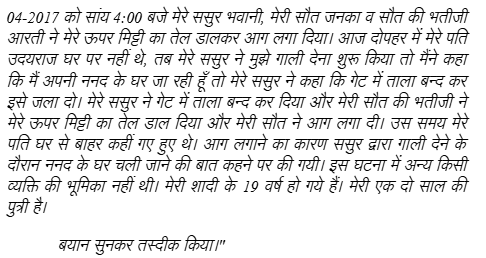
3. The facts giving rise to this case are that the complainant's daughter, Chamela, was married to Udai Raj approximately 20 years ago. However, Udai Raj kept a mistress named Kumari Janki ( Name Changed). It is averred that Udai Raj, along with his mistress Kumari Janki (Name Changed), and others named Rameshwar and Bahadur, were pressuring Bhawani Prasad, the deceased's father-in-law, to dispose of land situated in Dandupur. The deceased opposed this transaction. Consequently, on April 4, 2017, at approximately 2:00 PM, the accused persons allegedly locked the deceased inside the house and set her ablaze, resulting in her death from severe burn injuries. In this regard, the complainant, Chotka (mother of the deceased), moved an application at Haidargarh police station. On that basis, a First Information Report (FIR) was lodged under Sections 302 and 120-B of the Indian Penal Code (IPC) against Udai Raj, Kumari Janki (Name Changed), Bhawani Prasad, Bahadur, and Rameshwar. The deceased was admitted to the hospital, where her statement (dying declaration) was recorded by a Magistrate. Following the victim's death, an inquest report was prepared, and the body was sent for autopsy. The Investigating Officer (I.O.) prepared the site plan, inspected the place of occurrence, and recorded the statements of the witnesses. After collecting sufficient evidence against the accused persons, the I.O. concluded the investigation and filed a charge sheet under Sections 302 and 120-B of IPC. The appellant claimed she was a juvenile at the time of the occurrence. Consequently, the Juvenile Justice Board (JJB) determined her age based on her academic documents and found that, as her date of birth is October 24, 1999, she was 17 years, 5 months, and 10 days old at the time the offense was committed. Accordingly, she was declared a juvenile.
4. In view of above and the provisions of the Juvenile Justice (Care and Protection of Children) Act, 2015 (in short Act), it was observed that the appellant’s age falls within the age group of 16 to 18 years at the time of the incident. Since the charges leveled were for a heinous offence under Section 302 of the IPC, the case falls under the category of heinous crimes as defined by the Act under Section 2(33) IPC. Consequently, a preliminary assessment was conducted under Section 15 of the Act, which determined that the appellant possessed the mental and physical capacity to understand the nature and consequences of the alleged offence. Based on this assessment, and in accordance with Section 18(3) of the Act, the case was transferred to the Children's Court for trial. The proceedings were subsequently conducted by the Children's Court in a consolidated manner alongwith the other co-accused. Upon the framing of charges, the appellant and co-ac

AI
Juveniles must not face imprisonment beyond three years for heinous crimes, as established by the Juvenile Justice Act, despite conviction under IPC.

The admissibility and reliability of dying declarations, the need for caution in evaluating such evidence, and the determination of juvenile status in criminal cases.

Court emphasized that a magistrate's dying declaration carries significant weight over oral declarations, affecting conviction in murder cases.
A dying declaration recorded from a surviving individual cannot be treated as substantive evidence for conviction; it may only be used to corroborate testimony.


Dowry Death - Dying declaration - Conviction can be based on dying declaration alone without corroboration if the court finds the dying declaration trust-worthy and genuine.

An individual assessed to be a juvenile at the time of offence must not be tried as an adult, with their age determination being essential for proper legal proceedings.

A dying declaration must be trustworthy and corroborated; significant discrepancies in the statement led to acquittal due to reasonable doubt not established by prosecution.

witnesses of both the sides (prosecution and the defence) sail on the same boat both have to be given same treatment at par to appraise on the touchstone of credibility and truthfulness which has not....
The court emphasized the necessity of corroborating dying declarations and established that dowry-related cruelty leading to death constitutes an offence under Section 304B IPC.



An indispensable Tool for Legal Professionals, Endorsed by Various High Court and Judicial Officers
Please visit our Training & Support
Center or Contact Us for assistance

Scan Me!
India’s Legal research and Law Firm App, Download now!


For Daily Legal Updates, Join us on :



 Back to top


