Back
Back





2026 Supreme(All) 286
HIGH COURT OF JUDICATURE AT ALLAHABAD
Chandra Dhari Singh, Devendra Singh-I, JJ.
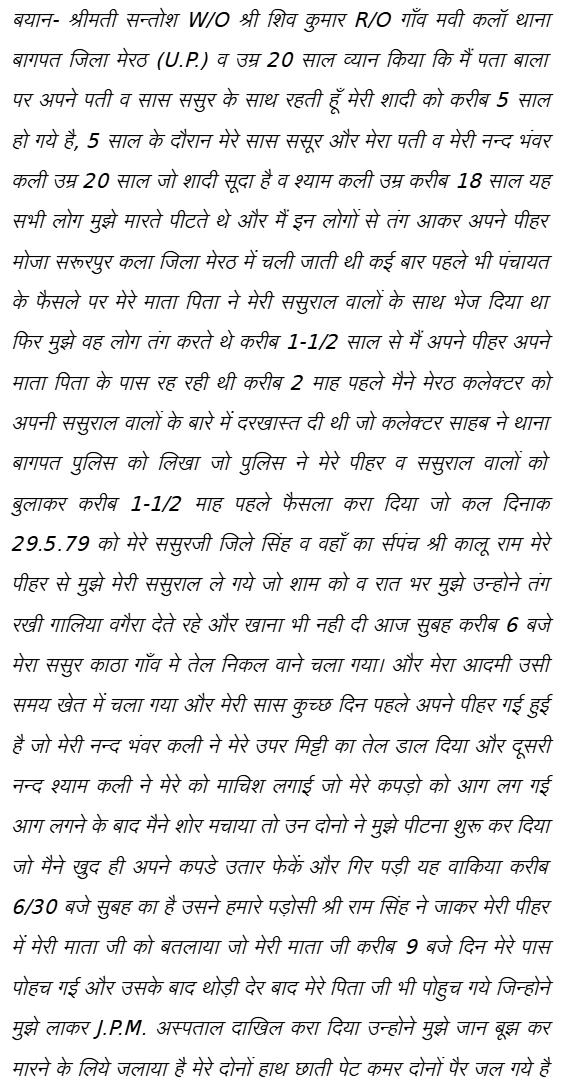
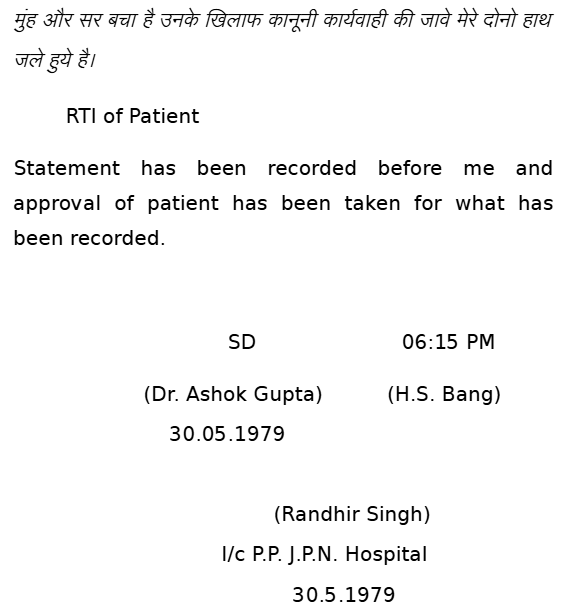
Bhanwarkali and another - Appellants
Versus
State of U.P. – Respondent
Criminal Appeal No. - 2487 of 1985
Decided On : 02-4-2026
For the Appellant : Amit Daga, R.N.sharma
For the Respondent: A.G.A
The court established that a dying declaration, when properly recorded and corroborated, is admissible and sufficient for conviction, despite procedural concerns regarding its recording.
Headnote:(A) Indian Penal Code, 1860 - Section 302/34 - Criminal procedure - The appellants were convicted for the murder of Smt. Santosh by setting her on fire due to marital discord and dowry demands - Key evidentiary issues involved the admissibility of a dying declaration and the sufficiency of witness testimony. (Paras 1-2, 16, 25, 30, 43-44)
(B) Dying Declaration - Requirements for admissibility - Must be made in a fit mental condition and free from influence - Recorded by a responsible officer; reliability can be determined even if not by a magistrate - In this case, the court found the dying declaration credible due to corroborating witness statements and the absence of external influences (Paras 30-36)
(C) Evidence - Immediate examination of witnesses - The absence of local witnesses was not deemed fatal as the procedural lapses were adequately covered by the substantive evidence provided in court. (Paras 51-54)
(D) Burden of Proof - Prosecution's duty to prove guilt beyond a reasonable doubt; the court confirmed that due process was followed and the convictions were substantiated by evidence from credible witnesses. (Paras 68-69)
Facts of the case:
The deceased suffered 75% burns inflicted by the appellants. A dying declaration identified them as responsible for the assault, corroborated by subsequent testimonial evidence. Appellants contested the evidence on procedural grounds and alleged lack of sufficient witness examination.
Findings of Court:
The trial court's conviction was upheld based on the totality of evidence, particularly emphasizing the reliability of the dying declaration and corroborative testimonies.
Issues: The main issues revolved around the admissibility and credibility of the dying declaration and whether the evidence presented was sufficient to uphold convictions.
Ratio Decidendi: The court affirmed that a dying declaration can stand as credible evidence when accurately recorded and corroborated, reinforcing the principle that a declaration made in extremity is not prone to falsehood.
Result: Appeal dismissed; conviction upheld.
| Table of Content |
|---|
| 1. conviction and sentencing of appellants. (Para 1 , 2) |
| 2. facts surrounding the incident and initial reporting. (Para 3 , 4 , 5 , 6 , 7 , 8 , 9) |
| 3. defects in the prosecution's case. (Para 18 , 19 , 20) |
| 4. definition and importance of dying declarations. (Para 28 , 29 , 30 , 31) |
| 5. conditions under which a dying declaration is admissible. (Para 35 , 50) |
| 6. final decision and directions for further actions. (Para 69 , 71) |
JUDGMENT :
Chandra Dhari Singh, J.
1. This Criminal Appeal has been filed against a judgement and order dated 12.09.1985 passed by the Fourth Additional Sessions Judge, Meerut in ST No. 319 of 1980 whereby the learned Judge convicted and sentenced the appellants Bhanwarkali and Shyam Kali to imprisonment for life and a fine of Rs. 2,000/- each under section 302/34 IPC and in case of default in payment of fine, they shall further undergo imprisonment for three months.
2. Pursuant to the order of this Court dated 02.02.2026, criminal appeal filed on behalf of the appellant Bhanwarkali has been disposed of as abated and now this Court is only concerned with the appeal of Shyam Kali.
Facts of the case
3. The facts that formed the bedrock of the present appeal are that a written report was given at police station Baghpat at 11:00 PM on 30.05.1979 by Tota Ram, son of Sher Singh, resident of Village Saroorpur Kalan (hereinafter referred to as the first informant) with the allegations inter alia that he got her daughter married to Shiv Kumar, son of Ziley Singh about five years back. There were certain differences, which were mutually resolved. On 29.05.1979, i.e. a day before the occurrence. The daughter of the first informant, Smt. Santosh went to her in-law’s house with Ziley Singh and Sarpanch Kalu Ram. On 30.5.1979, a person from village Mawi Kalan informed him that his daughter has been burnt. On that information, the first informant reached the village Mawi Kalan where he came to know that Bhanwar Kali had sprinkled kerosene on the body of the Smt. Santosh and Shyam Kali had set her on fire with an intention to kill her, due to which she had badly injured. The first informant took his daughter to Delhi Hospital where after getting her admitted, went to the police station and lodged the report. The first information report further recounts that in the incident in question, Ziley Singh and his son have also hands because before before leaving the house, they had given certain instructions to the accused.
4. On the basis of the aforesaid information, a Chik report was prepared for the offence at 11:00 PM on 30.5.1979. On completion of investigation, the investigating officer submitted the charge sheet against the appellants.
5. Before the first information report could be lodged PW-6, ASI Ranbir Singh, who was posted as In-Charge, Out Post, on getting Medico Legal Sheet through Constable Ram Autar, in respect of Smt. Santosh, he rushed to the spot and recorded the dying declaration of Smt. Santosh (hereinafter referred to as the deceased), which ended at 06:15 PM on 30.5.1979. The deceased died in Delhi, but before her death, her dying declaration was recorded.
6. As the case was exclusively triable by the Court of Sessions, learned Magistrate committed the case to the Court of Sessions, where case was registered as ST No. 319 of 1980 and the learned 7th Additional Sessions Judge, Meerut, vide order dated 28.10.1980 framed the charges against the accused-appellants under Section 302/34 IPC, which was read over and explained to the accused, who pleaded not guilty and claimed to be tried.
7. To bring home guilt of the appellants, the prosecution has examined as many as six witnesses. PW- 1, Total Ram, is the first informant of the case, PW-2, Smt. Mahendri is the mother of the deceased, PW-3, Pran Sukh Sharma was the Chik writer of the FIR, PW-4, Dr. Vishnu Kumar, who inspected the body of the deceased after her death, PW-5, Dr. P.K. Govila, who proved the admission slip and endorsement of Dr. Ashok Gupta and PW-