Back
Back





2026 Supreme(All) 372
HIGH COURT OF JUDICATURE AT ALLAHABAD
HARVIR SINGH, J.
Amit Kumar Rana -Petitioners
Versus
State of U.P. and another –Respondents
Matters Under Article 227 No. 9426 of 2025
Decided On : 10-04-2026
For the Petitioners: Ram Bilas Prasad
For the Respondents: Anoop Singh, G.A., Janardan Singh
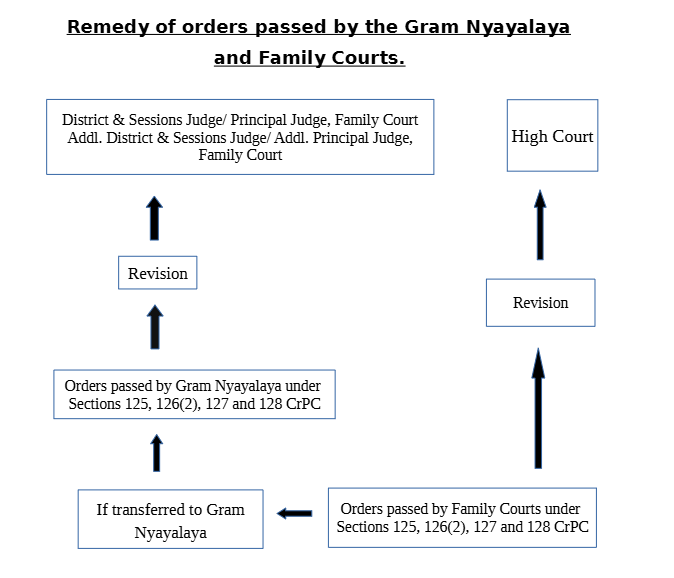
Concurrent jurisdiction between Family Courts and Gram Nyayalaya over maintenance orders creates inconsistencies, and only Family Courts can adjudicate such matters to ensure sufficient legal oversight.
Headnote:(A) Code of Criminal Procedure, 1973 - Sections 125 and 127 - Family Courts Act, 1984 - Gram Nyayalaya Act, 2008 - Maintenance order challenged - The petitioner contended that the respondent, having remarried, is not entitled to maintenance. However, the court held that only the Family Court can review a maintenance order and the concurrent jurisdiction between Family Courts and Gram Nyayalaya leads to disparity. The orders passed by the Gram Nyayalaya were quashed as they were inconsistent with the Family Courts Act. (Paras 4, 8, 24)
(B) Jurisdiction - The Gram Nyayalaya lacks competency to review or alter decisions made by the Family Court regarding maintenance orders, given the hierarchical disparity. (Paras 9, 24)
(C) Legal remedy - The petitioner is directed to pursue available remedies within the Family Court framework, emphasizing that cases should not be transferred to Gram Nyayalaya if a substantive order has been made. (Paras 24).
| Table of Content |
|---|
| 1. initial maintenance order and its context. (Para 2 , 3) |
| 2. remarriage's impact on maintenance. (Para 4 , 5) |
| 3. jurisdictional challenges between family court and gram nyayalaya. (Para 6 , 8 , 9) |
| 4. concurrent jurisdiction competition and implications. (Para 7 , 10 , 11 , 12) |
| 5. legislative intent on jurisdictional conflicts. (Para 13 , 14 , 15 , 16) |
| 6. respondent’s defense regarding jurisdiction validity. (Para 17 , 18 , 19) |
| 7. need for further analysis of jurisdictional overlap. (Para 20) |
| 8. debate on jurisdiction transfer and its conditions. (Para 21 , 22) |
| 9. final ruling on jurisdictional inconsistency and orders. (Para 23 , 24 , 25) |
JUDGMENT :
HARVIR SINGH, J.
1. Heard learned counsel for the parties and perused the material available on record.
2. The instant petition has been filed against the impugned orders dated 25.3.2025 and 1.10.2024 under Section 127 Cr.PC, passed by the Gram Nyayalaya, Dhampur, District Bijnor.
3. Learned counsel for the petitioner submits that initially, an order dated 6.3.2019 was passed by Principal Judge, Family Court, Bijnor, under Section 125 of the Code of Criminal Procedure, 1973 (corresponding Section 144 of Bharatiya Nagarik Suraksha Sanhita, 2023), wherein the learned Principal Judge, Family Court, Bijnor has awarded a sum of Rs. 3,000/- to respondent No.2, as monthly maintenance, to be paid from the date of filing of application i.e. 28.4.2016. Thereafter, aggrieved by order dated 6.3.2019, the petitioner moved a Criminal Revision No.1804/ 2019, challenging the order dated 6.3.2019 on various grounds taken in the petition, wherein an order was passed by this Court on 3.5.2019. The relevant/ operative portion of the said order dated 3.5.2019 passed by this Court is reproduced herein-under:-
"The operation of impugned order dated 06.3.2019 shall remain stayed provided and with the condition that the applicant shall continue to pay the maintenance amount Rs.3000/- to the opposite party no.2 per month regularly from the date of order and not from the date of filing of application, during the pendency of this application or till further orders of this Court.
It is clarified that only the payment of arrears amount, accruing for the period in between the date of application and the date of order, is being stayed by this Court till further orders of this Court.
It is observed that if the applicant fails to comply with the aforesaid condition, the interim order of stay passed by this Court shall be deemed to have been vacated automatically."
4. Thereafter, the only point stressed before the Court by the petitioner is that the respondent no.2, i.e. his wife, got remarried on 26.01.2020, with one Manoj Kumar, therefore, she is not entitled for any maintenance amount. On the other hand, it may usefully be noted that respondent no.2 filed an application under Section 125 of the Code of Criminal Procedure, 1973 (corresponding Section 144 of Bharatiya Nagarik Suraksha Sanhita, 2023) on 28.04.2016 i.e. much earlier than the date of alleged marriage and that, she was granted maintenance from the date of application only. It may be noted that, under the provision of Section 127 of the Code of Criminal Procedure, 1973, on proof of change in the circumstances of the income of a person, who is receiving any monthly maintenance under Section 125 of the Code of Criminal Procedure, 1973 (corresponding Section 144 of Bhartiya Nagrik Suraksha Sanhita, 2023), the Magistrate/ Court concerned may make such alteration in the order of maintenance, as he thinks fit. The Court concerned has power to cancel any order, which was passed by it, (under Section 125 of the Code of Criminal Procedure, 1973) in respect of a woman, from the date of her remarriage. Thus it is clear from the above provision, that in case of such an eventuality, husband may approach the Court concerned for recall/ cancellation of the order. This fact can not be decided in the instant petition, there being an alternate efficacious statutory remed