
 Back
Back





HIGH COURT OF JUDICATURE AT ALLAHABAD LUCKNOW
RAJNISH KUMAR, ZAFEER AHMAD, JJ.
Dev Bahadur Yadav @ Matru Yadav - Appellant
Versus
State of U.P. - Respondent
Jail Appeal No. - 212 of 2011
Decided On : 04-05-2026
| Table of Content |
|---|
| 1. procedural initiation and identification of the appeal before the high court. (Para 1 , 2) |
| 2. summary of prosecution case, charge framing, and defense plea. (Para 3 , 4 , 5 , 6 , 7 , 8 , 9 , 10) |
| 3. competing arguments regarding reliability of evidence and applicability of culpability provisions. (Para 11 , 12) |
| 4. summary of oral testimony and evidence presented during the trial. (Para 13 , 14 , 15 , 16 , 17 , 18 , 19 , 20 , 21 , 22 , 23) |
JUDGMENT :
Zafeer Ahmad, J.
1. Heard, Sri Dhananjay Kumar Singh, learned Amicus Curiae for the appellant and Sri Pawan Kumar Mishra, learned AGA for the State. Perused the records.
2. The aforesaid jail appeal arises out of judgment and and order dated 27.10.2010 passed by the Additional Sessions Judge/Special Judge, Pratapgarh in S.T. No. 248 of 2009 (State v. Dev Bahadur @ Matru Yadav), arising out of case crime no. 62 of 2009, Police Station Antu, Sub-District Sadar, District Pratapgarh, whereby the appellant has been convicted under Section 302 of Indian Penal Code, 1860 (in short I.P.C.) for life imprisonment along with a fine of Rs. 20,000/ and in case of non-payment of fine, an additional imprisonment of six months.
Prosecution Story in Nutshell:
3. The prosecution story, in brief, is that on 27.03.2009, complainant Ram Bodh Yadav, s/o Sukhai Yadav, r/o village Shukulpur, Police Station Antu, District Pratapgarh submitted a written report stating therein that his daughter, Sunita, was married to Dev Bahadur @ Matru, s/o Nanda Yadav, r/o village Babu Ka Purwa Majra Umri, Police Station Antu, around fifteen years ago. On 27.03.2009 he received an information over telephone that his daughter, Sunita, had been murdered by her husband, Dev Bahadur @ Matru, with an axe at around 6:00 AM. On receiving such information he came to village Babu ka Purwa Majra Umri and saw that his daughter’s body was lying on a cot under a thatched roof.
4. On the basis of the written report, an F.I.R was registered under Section 302 I.P.C against the accused, Dev Bahadur @ Matru. The investigation of the case was entrusted to S.I. Upendra Yadav, who proceeded to the place of occurrence on the same day and conducted the inquest proceedings.
5. Upon completion of investigation, charge-sheet was submitted against the accused-appellant under Section 302 I.P.C. Thereafter, the case was committed to the Court of Session, where charge under Section 302 IPC was framed against the accused.The accused denied the charge, pleaded not guilty, and claimed trial.
6. In order to prove its case, the prosecution examined Ram Bodh Yadav (PW-1), Shalu(PW-2), Dr. Alok Shukla (PW-3), Constable Raj Bahadur Yadav (PW-4), Constable Gaya Prasad Patel (PW-5), and S.I. Upendra Yadav (PW-6).
7. Besides the aforesaid witnesses, the Trial Court, in exercise of its powers, examined S.I. Jai Shankar Ram as Court Witness (CW-1). The defence, however, did not adduce any oral or documentary evidence in support of its case.
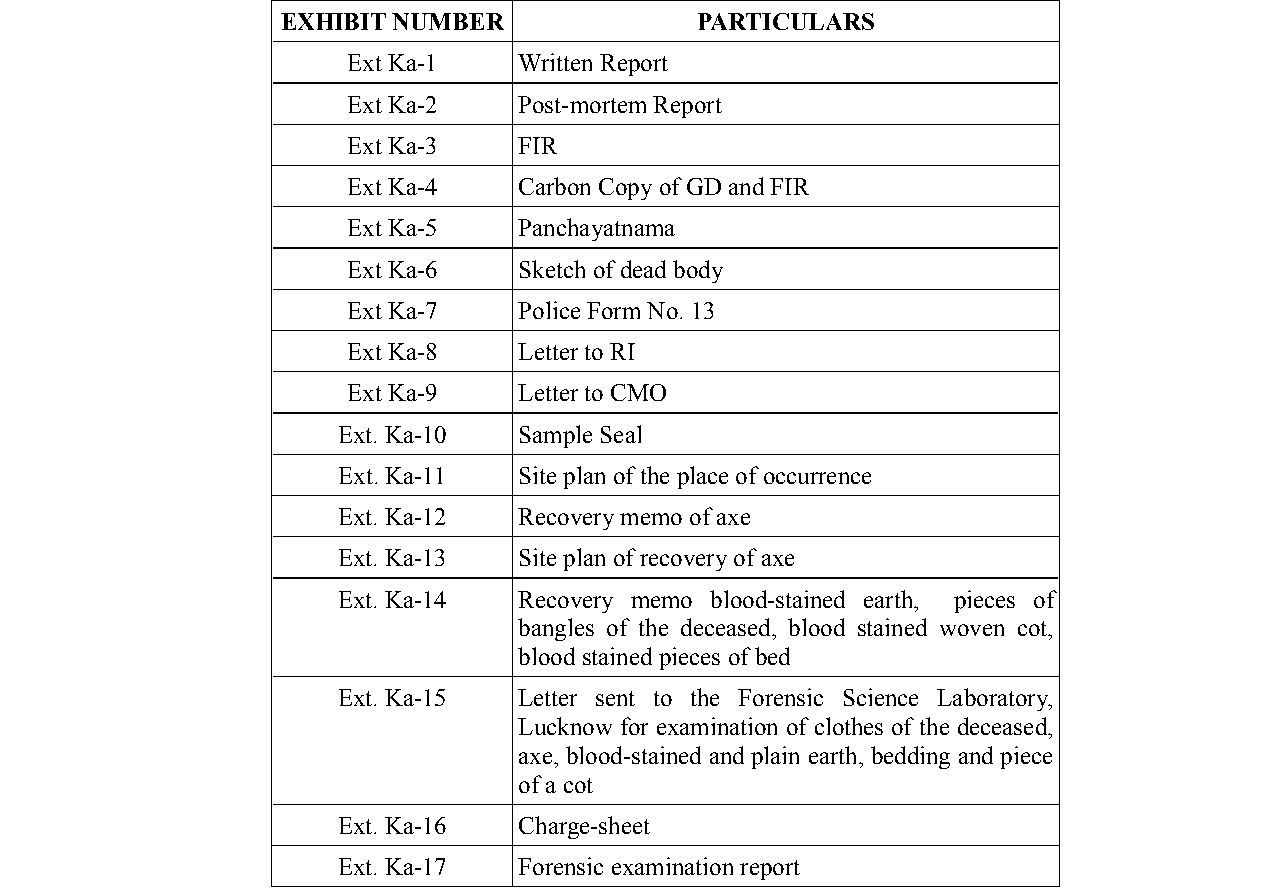
8. The following exhibits were produced and proved before the Trial Court:
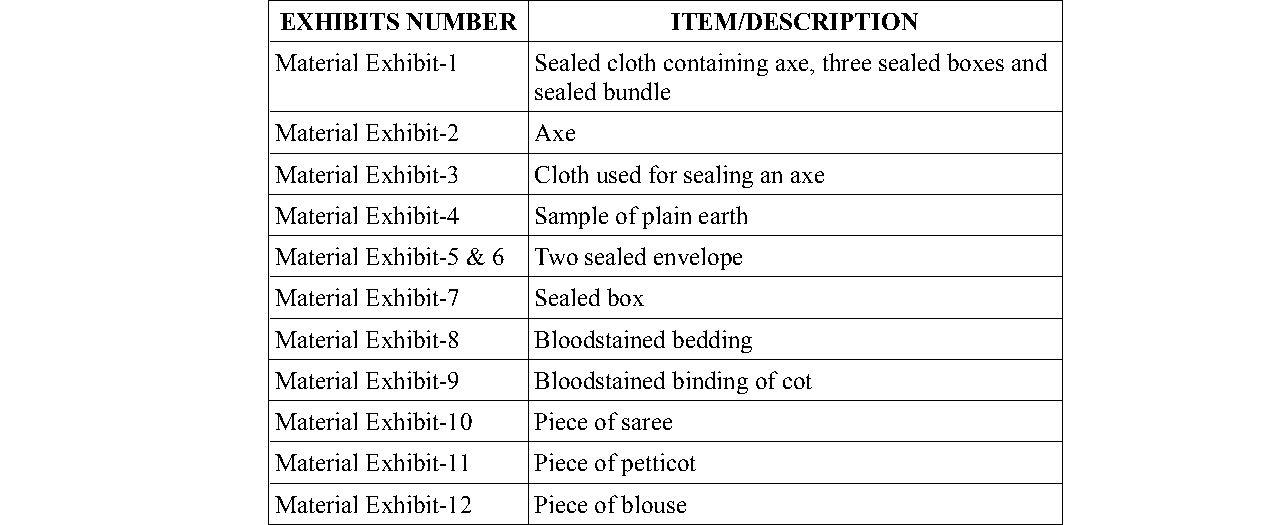
9. The following material exhibits were produced and proved before the Trial Court:

10.The statement of the accused–appellant was recorded under Section 313 Cr.P.C., wherein he denied that he had ever been previously arrested in connection with any complaint lodged by the deceased, and that his arrest in present case and the recovery of the weapon were fabricated and wrong. He refused to have given any confessional statement to the police and alleged that the recovery of the T- shirt was also fabricated. He further stated that the FIR and GD are ante-timed and that the witnesses have given false testimony to frame him. The statement of the accused–appellant was recorded under Section 313 Cr.P.C., wherein he stated that he was not previously arrested on the basis of the complaint of the deceased and that his arrest and the recovery of the weapon were fabricated and wrong. He refused to have given any confessional statement to the police and alleged that




AI

It would always be open for prosecution to decide on quality and quantity of evidence that they wish to lead in order to establish charge and this Court cannot comment on such aspect of matter, as lo....

Motive is not essential for conviction in murder cases if direct and credible eyewitness testimony is present.

The main legal point established in the judgment is the distinction between murder under Section 302 IPC and culpable homicide not amounting to murder under Section 304 Part II IPC, based on the sudd....
The court ruled that solitary eyewitness testimony can suffice for conviction in murder cases, especially when corroborated by medical evidence. The culpable act did not fall under provocation except....

Section 299 relates to causing death by doing an act with intention of causing death or with intention of causing bodily injury as is likely to cause death.
The court clarified that mere teasing does not constitute grave provocation sufficient to reduce a murder charge under Exception 4 of Section 300 IPC.

Conviction under Section 302 cannot rest on sole eyewitness testimony riddled with contradictions, delay in naming accused, medical inconsistencies, and unnatural conduct; prosecution must prove guil....



An indispensable Tool for Legal Professionals, Endorsed by Various High Court and Judicial Officers
Please visit our Training & Support
Center or Contact Us for assistance

Scan Me!
India’s Legal research and Law Firm App, Download now!


For Daily Legal Updates, Join us on :



 Back to top


