
 Back
Back





IN THE HIGH COURT OF JUDICATURE AT ALLAHABAD
SAUMITRA DAYAL SINGH, SWARUPAMA CHATURVEDI, JJ.
M/s Maruti Enterprises – Appellant
Versus
State of U.P. and Another – Respondents
Writ Tax Nos. 1423, 1573, 2001, 2445, 2451 of 2026
Decided On : 14-05-2026
| Table of Content |
|---|
| 1. factual background involving seizure of transit goods. (Para 1 , 2 , 3 , 4) |
| 2. arguments on jurisdictional power of transit state authorities. (Para 5 , 6 , 7 , 8 , 9 , 10 , 11 , 12) |
| 3. legislative framework and statutory provisions governing goods in transit. (Para 13 , 14 , 15 , 16 , 17 , 18 , 19 , 20 , 21 , 22 , 23 , 24 , 25) |
| 4. transit states lack jurisdiction to penalize without tax nexus. (Para 26 , 27 , 28 , 29 , 30 , 31 , 32 , 33 , 34 , 35 , 36 , 37 , 38 , 39 , 40 , 41 , 42 , 43) |
| 5. final holding: penalty orders quashed as transit state lacks jurisdiction. (Para 44 , 45 , 46 , 47) |
JUDGMENT :
1. Heard learned counsel for the parties and perused the record.
2. The present petitions have been filed challenging the individual penalty orders passed against the petitioners, under Section 129 (1)(d) of the GST Act, 2017 (hereinafter referred to as the "State Act"), read with the provisions of the Central Goods and Services Tax Act, 2017 (hereinafter referred to as the "CGST Act") and the Integrated Goods and Services Tax Act, 2017 (hereinafter referred to as the "IGST Act").
3. The brief details of the penalty orders impugned in the individual petitions, are as under:
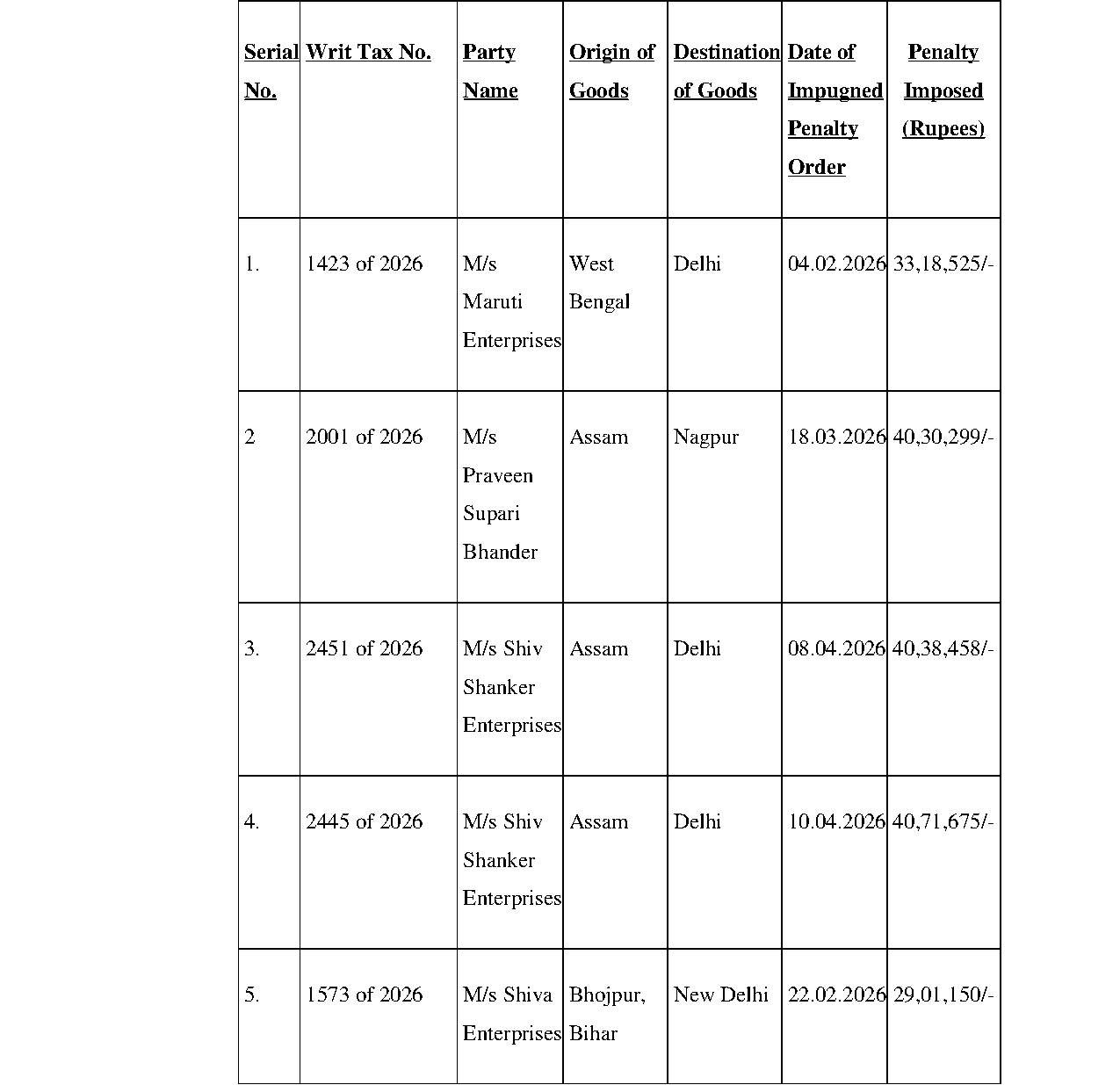
4. Facts are similar. Since, additional ground exists in Maruti Enterprises, facts relevant to that case are being noted below:
a. The petitioner, M/s Maruti Enterprises, is registered under the Delhi Goods and Services Tax Act, 2017 (hereinafter referred to as "Delhi Act") bearing GSTIN No. 07ACCFM9401F1ZF. The petitioner purchased 30,100 kgs of dried Areca nuts from M/s A.K. Enterprises, a person registered under the West Bengal Goods and Services Tax Act, 2017 (hereinafter referred to as the "West Bengal Act"), bearing GSTIN No.19FGDPR7364N1ZF.
b. The said transaction is covered by Tax Invoice-cum-Challan No. AKE/25-26/19. Those goods are described to have been dispatched by road, on truck bearing No. HR-61E-7511, against e-Way Bill No.881632659464.
c. Thus, the goods started their journey from Falakata in West Bengal to New Delhi, accompanied with Tax Invoice and e-Way bill. When the goods reached District Gautam Buddh Nagar in the State of Uttar Pradesh, (which according to the petitioner was near the exit point in the State of U.P.), and were set to enter the State of Delhi, they were intercepted by respondent no. 2, on 24.01.2026. Against Interception Memo thus issued, physical verification was conducted on 26.01.2026. Thereafter, objection arose that the goods were not accompanied with e- Tax Invoice, as mandated under the Rule 48 of the CGST Rules, 2017 (hereinafter referred to as the Central Rules). It may be noted, parallel Rules exist in all the States including State of West Bengal, State of Uttar Pradesh and the State of Delhi.
d. Though, reply was submitted to the Show Cause Notice dated 29.01.2026 issued under section 129(3) of the GST Act, it remains admitted to the petitioner that the supplier M/s A.K. Enterprises had not issued e-Tax Invoice to the petitioner. The petitioner describes it as a technical defect. The detaining authority acquired further information through the Common Portal that the petitioner was not registered to trade in the commodity dried Areca Nuts. Also, its registration has been suspended after filing of the writ petition. Further, the supplier dealer M/s A.K. Enterprises has obtained supplies of dried Areca Nuts from such firms, whose registration had either been suspended or cancelled.
e. Thus, rejecting the explanation furnished by the petitioner the goods have been detained and penalties imposed as described above. In such facts, upon the writ petition being filed, affidavits have been exchanged and parties heard.
5. The issues to be considered at this stage are as under:
(i) Whether the State GST authorities of State of Uttar Pradesh have any jurisdiction vested in them, to detain goods and impose penalties referable to IGST Act, Central Act and the State Act, with respect to transaction of inter-state sale of g
AI


The court established that the authority that initiates tax enforcement proceedings retains jurisdiction to complete the investigation, reinforcing the principle of cross empowerment between Central ....


Cross-empowerment of State GST officers under the CGST Act requires a government notification; without it, their actions are invalid.

Section 6(2)(b) of the CGST Act and the Circular dated 05.10.2018 have limited application and are not a bar to multiple search operations and summons issued by multiple agencies in certain circumsta....



An indispensable Tool for Legal Professionals, Endorsed by Various High Court and Judicial Officers
Please visit our Training & Support
Center or Contact Us for assistance

Scan Me!
India’s Legal research and Law Firm App, Download now!


For Daily Legal Updates, Join us on :



 Back to top


