
 Back
Back





IN THE HIGH COURT OF JUDICATURE AT ALLAHABAD
SIDDHARTH NANDAN, J.
Khwaja Asher (Minor) Khwaja Shamshad Ahmad – Appellant
Versus
State of U.P. and Others – Respondents
Writ (C) No. 34106 of 2023
Decided On : 24-04-2026
| Table of Content |
|---|
| 1. overview of the writ petition regarding school admission procedures under rte act. (Para 1 , 2 , 3 , 4) |
| 2. evaluation of whether online-only application procedures supersede manual application rights. (Para 5 , 6 , 7) |
| 3. constitutional mandate for accessible education outweighs rigid procedural hurdles. (Para 8 , 9 , 10 , 11 , 12 , 13) |
| 4. systemic failure in school allotment and implementation of rte act 2009. (Para 14 , 15 , 16 , 17 , 18) |
| 5. judicial directions for processing manual applications and systematic compliance. (Para 19 , 20 , 21 , 22) |
JUDGMENT :
SIDDHARTH NANDAN, J.
1. Heard Shri Khwaja Shamshad Ahmad, Petitioner representing Khwaja Asher (minor) and Shri Vaibhav Tripathi, learned Standing Counsel for the State-respondents.
2. The present writ petition has been filed seeking issuance of a writ of mandamus commanding the respondents to admit the petitioner in Class Nursery under Section 12(1)(c) of the Right of Children to Free and Compulsory Education Act, 2009 (hereinafter referred to as the 'Act, 2009'). For ready reference, Section 12(1)(c) of the Act, 2009 is reproduced below:
"12. Extent of school's responsibility for free and compulsory education.—
(1) For the purposes of this Act, a school—
(c) specified in sub-clauses (iii) and (iv) of clause (n) of section 2 shall admit in class I, to the extent of at least twenty-five per cent of the strength of that class, children belonging to weaker section and disadvantaged group in the neighbourhood and provide free and compulsory elementary education till its completion:
Provided that where a school specified in clause (n) of section 2 imparts pre-school education, the provisions of clauses (a) to (c) shall apply for admission to such pre-school education."
3. The case of the petitioner is that he had applied manually in the office of the Basic Siksha Adhikari, Prayagraj along with the letter dated 05.04.2023, expressing his inability to upload the form online, and therefore had requested the Basic Siksha Adhikari, Prayagraj to submit the same as per the provisions of the Government Order dated 03.03.2016. He has relied upon the Government Order dated 03.03.2016, wherein it has been provided that for admission, the parents of the child can apply in the office of District Basic Siksha Adhikari and further has relied upon the notification dated 06.02.2017 issued by the Additional Project Director, wherein also under Clause 2(d), it has been provided that for any reason an application cannot be made online, under the said circumstances, the same can be made through Block Siksha Adhikari. For ready reference, Section 2(d) of the notification dated 06.02.2017 is reproduced below:
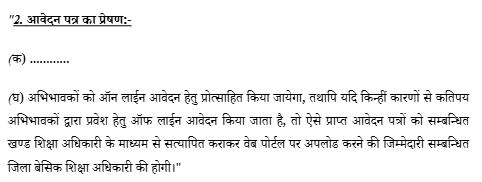
4. In pursuance of the order of this court dated 09.04.2026, an affidavit of respondent no.2 has also been filed along with a copy of Government Order dated 03.03.2016 (wrongly transcribed as 03.03.2018 in the notification dated 30.01.2023) has been filed wherein it is provided that it is the duty of the District Basic Siksha Adhikari to forward the manual application, in case, the parents are not able to upload the same online. It also records that no child can be denied admission for whatsoever reason, as per the mandate of Section 12(1)(c) of the Act, 2009. It also provides that the admission has to be made in the school which is situated in the neighboring area or nearest to the residence of the child, in case schools are not available in the block in which the family resides.
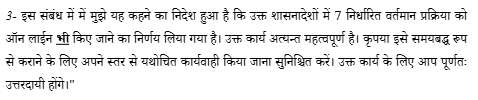
5. Shri Vaibhav Tripathi, learned Standing Counsel has placed reliance on the letter of the Special Secretary to the State Project Director (Education For All) dated 20.01.2017, and submits that as per the Government Order dated 03.03.2016, the procedure for application under Section 12(1)(c) of the Act, 2009, has been made online.
6. However, a perusal of Paragraph no.3, of the letter dated 20.01.2017, clearly states that as per the Government order, the online procedure is " also" being implemented, facilitating
AI


The obligation of neighborhood schools to admit 25% of children from weaker sections under the Right to Education Act is a constitutional mandate that requires effective implementation through enforc....


The main legal point established in the judgment is that the denial of admission to the petitioners was unjustified and not supported by the provisions of Sec. 15 of the Act of 2009, which guarantees....



An indispensable Tool for Legal Professionals, Endorsed by Various High Court and Judicial Officers
Please visit our Training & Support
Center or Contact Us for assistance

Scan Me!
India’s Legal research and Law Firm App, Download now!


For Daily Legal Updates, Join us on :



 Back to top


