


1. Protest petition against final report in case alleging police custodial torture and caste-based slurs. (Para 2 , 3 , 4 , 5 )
 Back
Next 





2026 Supreme(All) 975
HIGH COURT OF JUDICATURE AT ALLAHABAD
SANTOSH RAI, J.
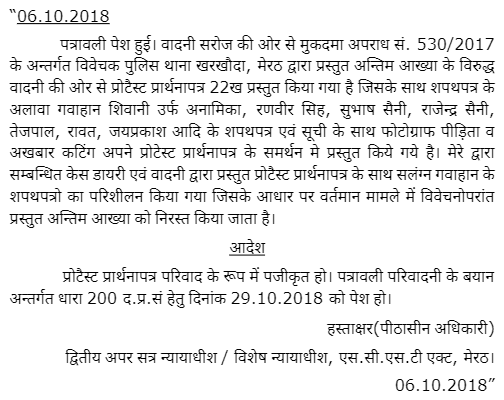
Bhuvnesh Kumari and 12 others – Appellant
Versus
State of U.P. and another – Respondents
Criminal Appeal No. - 7399 of 2026
Decided On : 15-09-2026
Important Points
An order treating a protest petition as a complaint is an intermediate order amenable to appeal. Cognizance requires reasoned analysis of the case diary, adherence to Sessions Court procedure, and consideration of Section 197 CrPC sanction for public servants, rather than mechanical reliance on extraneous materials.
Subject
Criminal Law - SC/ST (Prevention of Atrocities) Act
Act Referred
Headnote
(A) SC/ST (Prevention of Atrocities) Act, 1989 - Sections 14 and 14-A; Code of Criminal Procedure, 1973 - Sections 190(1)(a), 197, 200, 202, 244, 245 and 465 - Order treating protest petition as complaint - Maintainability of appeal - An order taking cognizance and summoning an accused is an "intermediate order"; since its reversal results in the termination of proceedings, it is not a purely interlocutory order and is amenable to appeal under Section 14-A of the Act. (Paras 14-21)
(B) Cognizance and Protest Petition - Rejection of Final Report - Cognizance cannot be taken mechanically on the basis of affidavits, photographs, and newspaper cuttings without a reasoned examination of the case diary and a recorded finding as to why the conclusion of the Investigating Officer in the final report was unacceptable. (Paras 31-38, 41)
(C) Section 197 CrPC - Protection of public servants - Where the alleged acts have a reasonable nexus with the discharge of official duty, previous sanction is a condition precedent for taking cognizance. Failure to examine this statutory safeguard renders the order of cognizance legally unsustainable. (Paras 42-50)
(D) Procedure of Special Court - Special Court under the SC/ST Act is essentially a Court of Session - Trial must be conducted in accordance with Chapter XVIII of the CrPC (Sections 227 and 228) and not under the procedure applicable to warrant cases before a Magistrate (Sections 244 and 245). (Paras 51-55) (E) SC/ST Act - Essential ingredients - Every insult or intimidation of a person belonging to a Scheduled Caste or Scheduled Tribe does not constitute an offence; the act must be committed specifically on account of the victim belonging to such caste or tribe. (Paras 25-26)
Facts of the case:
A complainant alleged custodial torture and caste-based slurs by police personnel. The Investigating Officer submitted a final report recommending closure of the case. The trial court rejected the final report and treated the protest petition as a complaint, summoning the accused. The accused, who are police officers, challenged the order on the grounds of lack of sanction, procedural irregularities, and the absence of specific caste-based allegations.
Findings of Court:
The impugned order was non-speaking and lacked judicial application of mind. It relied on extraneous materials such as affidavits and newspaper cuttings instead of the case diary. The court ignored the mandatory requirement of sanction under Section 197 CrPC and erroneously applied Magistrate trial procedures instead of the mandatory Sessions Court procedure.
Issues: Whether an order treating a protest petition as a complaint is an interlocutory order; whether cognizance can be taken based on affidavits and newspaper cuttings; whether sanction under Section 197 CrPC was required; and whether the Special Court followed the correct procedural law.
Ratio Decidendi: An order of cognizance is an intermediate order amenable to appeal. Cognizance requires a reasoned judicial determination, not a mechanical exercise based on extraneous materials. Public servants acting in official capacity are protected by Section 197 CrPC. A Special Court under the SC/ST Act must follow the procedure of a Court of Session under Chapter XVIII CrPC.
Result: Appeal allowed. The impugned order dated 06.10.2018 is set aside, and all further proceedings against the appellants are quashed.
Legal Category Hierarchy
- crime and sentencing
-
practice and procedure
- criminal procedure
- appeal
- evidence
Advocates appeared:
Counsel for Appellant(s) :Mohd Raghib Ali, Sr. Advocate
Counsel for Respondent(s): G.A., Sanjay Kumar Srivastava
Table of Contents
2. Appellants challenge order treating protest petition as complaint without mandatory sanction and proper procedure. (Para 8 , 9 )
3. Order rejecting final report lacked reasoning, relied on extraneous material, and ignored procedural safeguards. (Para 22 , 23 , 24 , 25 , 26 , 27 , 31 , 32 , 33 , 34 , 35 , 36 , 37 , 38 )
4. Protest petition affidavits cannot substitute substantive evidence; sanction under Section 197 CrPC must be considered. (Para 37 , 48 , 49 , 50 )
5. Appeal allowed; impugned order set aside; all consequential proceedings quashed and appellants discharged. (Para 67 , 68 )
6. Can a court reject a final report and treat a protest petition as a complaint based solely on affidavits?
No. Affidavits, photographs, and newspaper cuttings are not substantive evidence for rejecting a final report without judicial scrutiny. (Para 37 , 38 )
7. Is prior sanction under Section 197 CrPC necessary before taking cognizance against police personnel for acts during official duty?
Yes. When allegations have a reasonable nexus with official duty, the court must consider Section 197 CrPC before taking cognizance. (Para 48 , 49 , 50 )
8. What procedure must a Special Court under the SC/ST Act follow when treating a protest petition as a complaint?
The Special Court must follow the Sessions trial procedure under Chapter XVIII CrPC, not the Magistrate's procedure under Sections 244-245 CrPC. (Para 53 , 54 , 55 )
9. Does every insult or intimidation of a Scheduled Caste person constitute an offence under the SC/ST Act?
No. The insult or intimidation must be specifically on account of the victim's caste status, not merely because the victim belongs to a Scheduled Caste. (Para 25 , 26 )
10. Is an order rejecting a final report and treating a protest petition as a complaint an interlocutory order?
No. It is an intermediate order substantively affecting rights, so an appeal under Section 14-A of the SC/ST Act is maintainable. (Para 19 , 20 , 21 )
JUDGMENT
SANTOSH RAI, J.
1. Heard Sri Saghir Ahmad, learned Senior Counsel assisted by Sri Mohd. Raghib Ali, learned counsel for the appellants; Sri Sanjay Kumar Srivastava, learned counsel for opposite party no.2; Sri Shyam Narayan Rai, learned AGA for the State and perused the material on record.
2. The present criminal appeal has been filed by the appellants with a prayer to set aside the impugned order dated 6.10.2018 passed by IInd Additional Session Judge/Special Judge, SC/ST Act, Meerut in Criminal Misc. No.203 of 2018 (Smt. Saroj vs. Station House Officer Sandeep Kumar Singh and 15 others), arising out of Case Crime No.530 of 2017, under Sections 323, 332, 351, 354B, 376B, 392, 406, 499, 504, 506, 509, 120B IPC and Sections 3(2)(1), 7, 3(XI) of the Scheduled Castes and Scheduled Tribes (Prevention of Atrocities) Act, 1989, P.S.- Kharkhoda, District- Meerut, whereby the trial court has rejected the final report and treated protest petition as complaint case.
3. The brief contents of the complaint/FIR involve allegations by the complainant, Smt. Saroj, that after she demanded the repayment of a loan of Rs.20,000/- from one Sonu, Sonu colluded with the Station House Officer (SHO) Pradeep Kumar Singh and other police personnel of Police Station Kharkhoda, Meerut. The complainant states that on June 18, 2017, she was summoned to the police station where she faced severe caste-based slurs, physical assault, brutal custodial torture, and humiliation by the named police officers and other individuals. Furthermore, she alleges that valuables and cash were missing following the incident, that she was coerced under threats during her production before the magistrate, and that local authorities failed to take timely action on her initial complaints, leading her to seek legal remedy under relevant sections of the IPC and the SC/ST (Prevention of Atrocities) Act.
4. The Investigating Officer has submitted final report concluding that the case (Crime No.530/2017) was registered against the SHO and 15 others pursuant to a court order under Section 156(3) CrPC lacked supporting evidence during the course of the investigation, which included reviewing statements, site inspections, and affidavits. The officer noted that the allegations made by the complainant were not substantiated by eyewitnesses and appeared to be a counterblast to Case Crime No.299/2017. Consequently, due to this complete lack of evidence, the final report recommended closing the investigation and requested the court's approval to accept the closure.
5. After submission of final report by the I.O, the compainant has filed protest petition supported by affidavits of Shivani @ Anamika, Ranbir Singh, Subhash Saini, Rajendra Saini, Tejpal, Rawat and Jay Prakash alongwith newspaper cutting, photographs etc in order to support the ‘contents of protest petition’.
6. The trial court vide order dated 6.10.2018 has treated the protest petition into complaint case and passed following order:-
7. Thereafter the accused appellants were summoned by the trial court under Sections 323, 504, 506, 354B, 509, 120B and Sections 3(2)(7), 3(1)(r), 3(2)(va) SC/ST Act on the basis of evidence available on record during the course of inquiry proceeding.
8. In brief the grounds of appeal are that the application under Section 156(3) CrPC was entertained despite the complainant having allegedly failed to comply with the mandatory requirement of Section 154(3) CrPC, thereby vitiating the initiation of the proceedings. After a full-fledged investigation culminating in the Final Report dated 24.01.2018, the learned court rejected the Final Report and treated the protest petition as a complaint without exercising jurisdiction in accordance with Section 190(1)(a) Cr.P.C., rendering the impugned order dated 6.10.2018 legally unsustainable. The appellants, being police officials posted at Police Station Kharkhauda at the relevant time, were alleged to have acted in the discharge of their official duties, and t









