
 Back
Back





IN THE HIGH COURT OF UTTARAKHAND AT NAINITAL
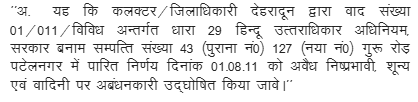
SHARAD KUMAR SHARMA, J.
State of Uttarakhand and Another - Appellants
Versus
Meenakshi Chaudhary – Respondent
Second Appeal No. 31 of 2015
Decided On : 22-05-2019
Advocates Appeared :
For the Appellants : Mr. M.C. Pandey, Mr. Devesh Ghildiyal
For the Respondent : Mr. Ajay Veer Pundir
| Table of Content |
|---|
| 1. defendants' appeal against prior judgment. (Para 1 , 2) |
| 2. discussion on property rights under hindu succession act. (Para 3 , 4 , 5 , 6) |
| 3. court's view on the legitimacy of the will and sale deed. (Para 7 , 8 , 15 , 16 , 17) |
| 4. defendants contesting the legitimacy of documents. (Para 9 , 10 , 11 , 12) |
| 5. issues raised regarding argument validity concerning evidence. (Para 18 , 19 , 20 , 21 , 22) |
| 6. court finds no evidence against validity of registered documents. (Para 24 , 25 , 26 , 27) |
| 7. court's ruling against escheat property claims. (Para 28 , 29) |
| 8. arguments on appellate court's considerations. (Para 30 , 31 , 32) |
| 9. substantial questions regarding escheat and will execution. (Para 36 , 37) |
| 10. final court ruling dismissing the second appeal. (Para 48 , 49) |
JUDGMENT :
Sharad Kumar Sharma, J.
1. This is defendants’ Second Appeal, wherein the defendants have questioned the propriety of the judgement rendered by Civil Judge, (Senior Division), Dehradun in Original Suit No. 23 of 2012, Meenakshi Chaudhary v. State of Uttarakhand and another , which was decreed in favour of the plaintiff/respondent on 30th March 2013. The said judgement was put to challenge in a Civil Appeal by the Defendants/appellants being Civil Appeal No. 66 of 2013, State of Uttarakhand and another v. Meenakshi Chaudhary . The said Appeal too was dismissed by the Court of 4th Additional District Judge, Dehradun impugned judgement order dated 25th November, 2014, thereby dismissing the Appeal and had affirmed the decree of declaration rendered in favour of the plaintiff/respondent by the learned trial Court.
2. The brief facts, which require for consideration before this Court in the present Second Appeal is that the plaintiff/respondent herein on 24th January 2012, had instituted a Suit being Suit No. 23 of 2012, Meenakshi Choudhary v. State of Uttarakhand and others, whereby she has sought a decree of declaration of a right in relation to the property, which has been more particularly, described at the foot of the plaint constituting, being the property bearing Municipal No. 43 new number 127, Guru Road, Patel Nagar, Dehradun, the part of which has been claimed by the plaintiff/respondent in her pleading, which has been purchased by her virtue of a sale deed dated 8th July, 2008 and the remaining part i.e. an area equivalent to 249.07 square metres having an area of 13.38 square metres which is being vested with the plaintiff/respondent by virtue of a registered Will dated 28th November 2007. The contention of the plaintiff/respondent in the Suit was that the declaration which has been sought for by the defendant to the Suit by treating the property as to be an “escheat” property by virtue of the Case No. 1 of 2011, State v. Property No. 43 (Old No.), New No. 127, Guru Road, Patel Nagar, Dehradun preferred under Section 29 of the Hindu Succession Act, 1956, was sought to be declared as a nonest decree being rendered on 1st August 2011, and to be declared as to be “null and void”.
3. She has contended that since the property in question stood vested in her in pursuance to the unassailed Will dated 28th November 2007 and the sale deed dated 8th July 2008, the property in dispute will never fall to be within the ambit of the definition of “Escheat” property under Section 29 of the Hindu Succession Act, 1956, which deals with the “escheat” property.
4. Before venturing further, it would be relevant and essential to refer Section 29 of the Hindu Succession Act, 1956, which reads as under:-
“29 Failure of heirs .—If an intestate has left no heir qualified to succeed to his or her property in accordance with the provisions of this Act, such property shall devolve on the government; and the government shall take the property subject to all the obligations and liabilities to which an heir would have been subject. State Amendments Chapter IIA Andhra Pradesh: After Chapter II, insert the following Chapter, namely:—"Chapter IIA Succession by survivorship”
5.
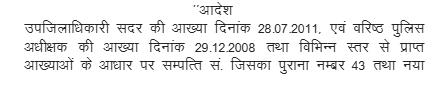
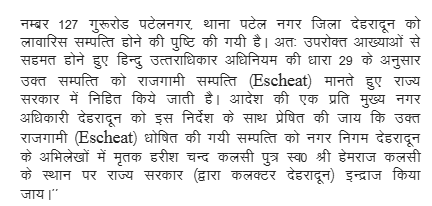
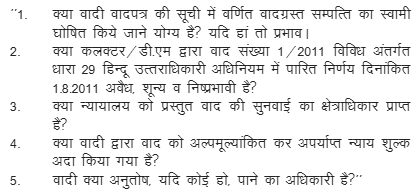
The court held that property claimed under a valid registered Will and sale deed cannot be declared escheat if a legal heir exists, emphasizing the validity of registered documents.

The central legal point established in the judgment is the mandatory requirement of proving the execution of a Will through an attesting witness as per Section 68 of the Indian Evidence Act, 1872, an....


The court reaffirmed the validity of judicial decisions and the presumption of regularity in judicial acts, underlining that a decree, once established, remains binding unless proven fraudulent by su....


The execution and validity of a Will require strict adherence to statutory provisions, including proper attestation, which was not proven in this case, rendering the claimed interests void.

Registered attested documents like settlement deeds require proof of execution under S.68/69 Evidence Act; registration presumes no validity when challenged.



An indispensable Tool for Legal Professionals, Endorsed by Various High Court and Judicial Officers
Please visit our Training & Support
Center or Contact Us for assistance

Scan Me!
India’s Legal research and Law Firm App, Download now!


For Daily Legal Updates, Join us on :



 Back to top


