
 Back
Back





IN THE HIGH COURT OF MADHYA PRADESH AT JABALPUR
MANINDER S. BHATTI, J.
Chandra Kumar Mishra - Appellant
Versus
The State Of Madhya Pradesh And Others - Respondent
Writ Petition No. 11398 Of 2008
Decided On : 14-08-2025
| Table of Content |
|---|
| 1. factual background of the case. (Para 2) |
| 2. arguments for reinstatement and justification. (Para 3 , 4) |
| 3. analysis of the disciplinary process and evidence. (Para 7 , 8 , 9 , 10 , 11) |
| 4. legal standards regarding unauthorized absence and penalties. (Para 12 , 14) |
| 5. conclusion and order for reinstatement. (Para 15 , 16) |
ORDER :
MANINDER S. BHATTI, J.
This petition under Article 226 of the Constitution of India has been filed by the petitioner seeking following reliefs:-
"(i) The Hon'ble Court may kindly be pleased to call for the records pertaining to issue of order dated 17.6.2004 as contained in Document No. P/18 from the office of the respondent No.4, as also the order dated 1.10.2004 as contained in Document No. P/20 from the office of respondent No.3 and the order dated 6.5.2005 as contained in Document No. P/22 from the office of respondent No.2, and be further pleased to examine the same and to quash the said orders by issuance of a writ of certiorari.
(ii) The Hon'ble Court may kindly be graciously pleased to issue a writ of mandamus commanding the respondents to reinstate the petitioner in service from the date of his dismissal and grant him all the privileges of such service, such as pay, allowances, seniority of the post etc.
(iii) Any other reliefs which this Hon'ble Court deem fit in the circumstances of the case, may also be granted to the petitioner together with the cost of this writ petition."
Facts:
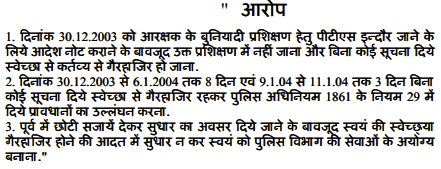
2) The facts, as narrated in the petition, in nutshell, are that the present petitioner was appointed as Constable in the Police Department way back on 17.4.1989. In the year 1992, the petitioner suffered some cardiac issues and was being treated at Jabalpur. The petitioner also came across certain orthopedic disorders and was being treated at various places including Gangaram Hospital, New Delhi. On 26.3.2004, the petitioner was served with a charge-sheet vide Annexure P-8 in which as many as 3 charges were levelled against him. The charge No. 1 was that the petitioner had not attended the basic training which was scheduled to be held from 30.12.2003 at PTS, Indore; charge No. 2 was pertaining to unauthorized absence of the petitioner of 11 days i.e. from 30.12.2003 to 6.1.2004 (for 8 days) and from 9.1.2004 to 11.1.2004 (for 3 days) and charge No. 3 was that there was no improvement in the conduct of the petitioner despite the fact that he was punished with minor penalties in past on the allegation of unauthorized absence. The petitioner submitted reply to aforesaid charge-sheet. Thereafter enquiry proceedings were drawn. Enquiry report was submitted vide Annexure P-17 and then the Disciplinary Authority passed the impugned order vide Annexure P-18 removing the petitioner from service. The petitioner preferred an appeal as well as mercy petition, however, both have been dismissed. Hence this petition has been filed.
Contentions:
3) The counsel for the petitioner contends that the impugned order is liable to be set aside, inasmuch as, it was not a case of willful absence from duty. Undisputedly, the petitioner was indisposed at the time when the order to undergo the training was issued. The petitioner could not make himself available for the said training on account of his ailment. The petitioner had also produced the medical documents pertaining to his treatment in order to demonstrate his illness. However, the Authority without having considered the same, proceeded to pass the impugned order. It is further contended that it is a case where the factum of illness of the petitioner was not questioned by the Authority. The Authority has only observed that the petitioner, just in order to avoid the duty, projected himself to be indisposed and such conduct was unbecoming of a member of a Disciplined Force. It is contended that the Disciplinary Authority has passed the impugned order in a purely mechanical manner. It had to apply its mind and pass an order which should be enriched with cogent reasons and findin
AI
Disciplinary authority must prove willfulness of unauthorized absence; absence due to illness is not misconduct and penalties must be consistent across similar cases.

The court upheld the dismissal of a disciplined force member for unauthorized absence and providing false information, emphasizing the importance of discipline and the limited scope of judicial revie....


Disciplinary actions must follow due process, and absence due to illness cannot be deemed willful misconduct without proper inquiry.


Sub-Section (2) of Section 145 of 'the Act' speaks about withdrawal from duty in contravention of Section 29 of 'the Act'. Section 29 of 'the Act' provides that no Police Officer shall withdraw himse....



An indispensable Tool for Legal Professionals, Endorsed by Various High Court and Judicial Officers
Please visit our Training & Support
Center or Contact Us for assistance

Scan Me!
India’s Legal research and Law Firm App, Download now!


For Daily Legal Updates, Join us on :



 Back to top


