
 Back
Back





IN THE HIGH COURT OF MADHYA PRADESH AT JABALPUR
SANJAY DWIVEDI, J.
Chandra Bai and Others - Appellants
Versus
Champa Bai and Another - Respondents
Second Appeal No. 928 of 2005
Decided On : 20-05-2025
| Table of Content |
|---|
| 1. appeal concerning property share entitlement. (Para 1 , 2) |
| 2. respondent claims share adjustment post-preliminary decree. (Para 3) |
| 3. appellant contends sale deed implies share forfeiture. (Para 4 , 5) |
| 4. analysis of succession rights under hindu law. (Para 6 , 7 , 10 , 15) |
| 5. solidifying legal standing on property division. (Para 18 , 19) |
| 6. final decree issuance and dismissal of appeal. (Para 20 , 21 , 22 , 24) |
JUDGMENT :
SANJAY DWIVEDI, J.
1. Appellants have filed this appeal under Section 100 of the Code of Civil Procedure assailing the judgment and decree dated 25.03.2005 passed by the II Additional District Judge, Seoni in Regular Civil Appeal No. 6-A/2005 modifying the judgment and decree passed by the trial Court in Civil Suit No. 254-A/2002 filed by the plaintiff/respondent No.1.
2. The first appellate Court has finally held that the respondent No.1 is entitled to get 1/3 share in the suit property i.e. Kh. No. 32/1 area measuring 0.470 hectare and Kh. No. 33 and 34 area measuring 2.144 hectare whereas the trial Court while passing the judgment and decree granted 1/2 share in favour of plaintiff/respondent No.1. The appellate Court modified the judgment and decree passed by the trial Court to the extent that instead of 1/2 share the respondent/plaintiff was entitled to get 1/3 share in the property.
3. A cross objection has also been filed under Order 41 Rule 22 of CPC by the respondent/plaintiff claiming that the preliminary decree has been passed by the Court but no final decree has been passed. It is averred in the objection that if during the interregnum period i.e. after passing of the preliminary decree and before the final decree, the events and supervening circumstances occur necessitating changes in the share then the Court can modify the preliminary decree and another preliminary decree can be passed redetermining the right and interest of the parties considering the changed circumstances. As per the respondent, Section 6 of the Act, 1956 has been amended w.e.f. 9th September, 2005 and as such taking note of the said aspect it is clear that the respondent is entitled to get 1/2 share in the suit property and thus preliminary decree passed by the trial Court may be affirmed and respondent be granted half of the share.
4. Learned counsel for the appellant has challenged the impugned judgment and decree mainly on the ground that the Court below though modified the impugned judgment and decree of the trial Court, but still it failed to consider that the sale deed i.e. Ex D/1 executed by the original defendant i.e. Ganpatlal in favour of plaintiff/respondent namely, Champabai itself indicates that the respondent had given up her share and accepted Ganpatlal to be the owner of the suit property, which is undisputably the ancestral property, and after the death of Basodilal, the suit property came to Ganpatlal as the wife of Basodilal namely, Smt. Kallobai died in the year 1970 and plaintiff/respondent Champabai being the daughter was having no interest over the suit property and even otherwise she herself had given up her right accepting the sale deed purchasing the land from Ganpatlal only.
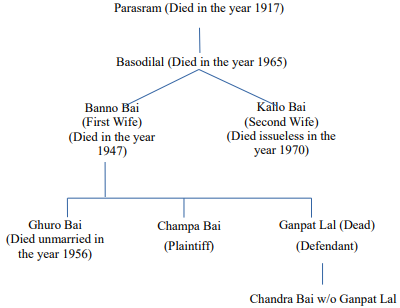
5. Learned counsel for the respondent/plaintiff has opposed the submission made by the learned counsel for the appellant and also criticized the finding given by the appellate Court holding the respondent entitled to get 1/3 share in the suit property modifying the impugned judgment and decree. He submits that by the sale deed Ex. D/1 transfer of only 600 sq.ft. was executed out of the total almost 2.614 hectare land and he submits that it does not seem appropriate that for 600 sq.ft. land the plaintiff/respondent has given up her share over more than two acres of land. He has also submitted that the first appellate Court has not considered the share which goes to Kallobai wife of Basodilal. He has submitted that Kallobai died in the year 1970 and as such the said property shall be devolved between the respondent/plai
AI
A sale deed does not negate ancestral property rights, and the statutory provisions guiding succession must be properly applied to determine share distribution.


The ancestral property, while partitioned, remains joint family property, allowing children of a coparcener to claim their legitimate share despite their father's sale to others.

The court affirmed that partition shares from ancestral property remain joint family property for descendants, entitling them to assert claims over the inherited property.

The court established that ancestral property retains its coparcenary character despite partition, affirming the rights of legitimate heirs under Hindu law.
The right of a daughter to a share in paternal property as a legitimate heir is reaffirmed, irrespective of marriage status, under Section 8 of the Hindu Succession Act, 1956.

The amendment to Section 6 of the Hindu Succession Act grants daughters equal rights as coparceners, allowing them to claim shares in ancestral properties irrespective of their birth date.
The properties in question were determined to be ancestral, granting coparcenary rights to the daughter under the Hindu Succession (Amendment) Act, 2005.



An indispensable Tool for Legal Professionals, Endorsed by Various High Court and Judicial Officers
Please visit our Training & Support
Center or Contact Us for assistance

Scan Me!
India’s Legal research and Law Firm App, Download now!


For Daily Legal Updates, Join us on :



 Back to top


