
 Back
Back





HIGH COURT FOR THE STATE OF TELANGANA AT HYDERABAD
J. SREENIVAS RAO, J.
Mr. V. Narayana Reddy and another – Petitioners
Versus
State of Telangana Rep. by its Public Prosecutor – Respondents
Criminal Petition Nos. 402, 407, 422 and 1044 of 2018
Decided On : 08-01-2026
| Table of Content |
|---|
| 1. overview of complaint basis and parties involved. (Para 2) |
| 2. court's observations on complaint processes and legal standing. (Para 3 , 6 , 7 , 10 , 11) |
| 3. arguments regarding authority and statutory notice relevance. (Para 4 , 5) |
| 4. judicial analysis of statutory compliance and disputes. (Para 8 , 9 , 12 , 14 , 15 , 19) |
| 5. conclusions on the petitions and procedural orders. (Para 16 , 18 , 20 , 21 , 22 , 23) |
COMMON ORDER:
J. SREENIVAS RAO, J.
These Criminal Petitions are filed under Section 482 of the Code of Criminal Procedure, 1973 (for short, ‘Cr.P.C.’) by the petitioners/accused Nos.3 and 4 seeking to quash the proceedings in C.C.Nos.1607, 1476 & 1617 of 2016 and 185 of 2017 respectively, on the files of the XVIII Additional Chief Metropolitan Magistrate, Secunderabad, for the offence under Section 138 of the Negotiable Instruments Act, 1881 (for short, ‘the NI Act’).
1.1. Since the parties and the issues involved in all four criminal petitions are similar, they were heard together and are being disposed of by this common order.
1.2. The parties hereinafter referred to as they were arrayed in the complaints.
2. Brief facts of the case:
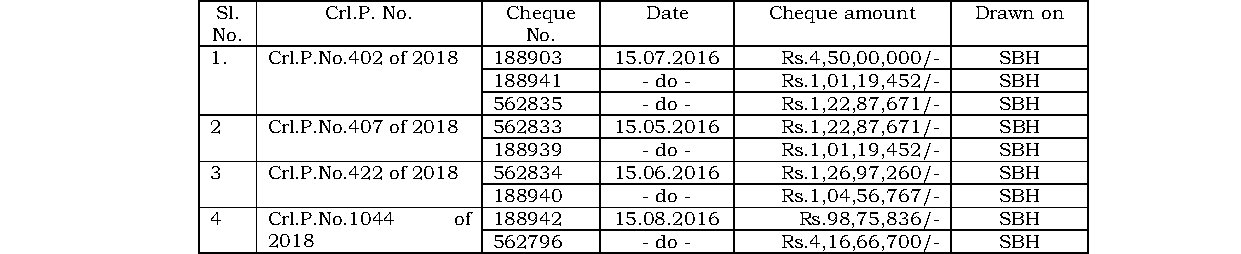
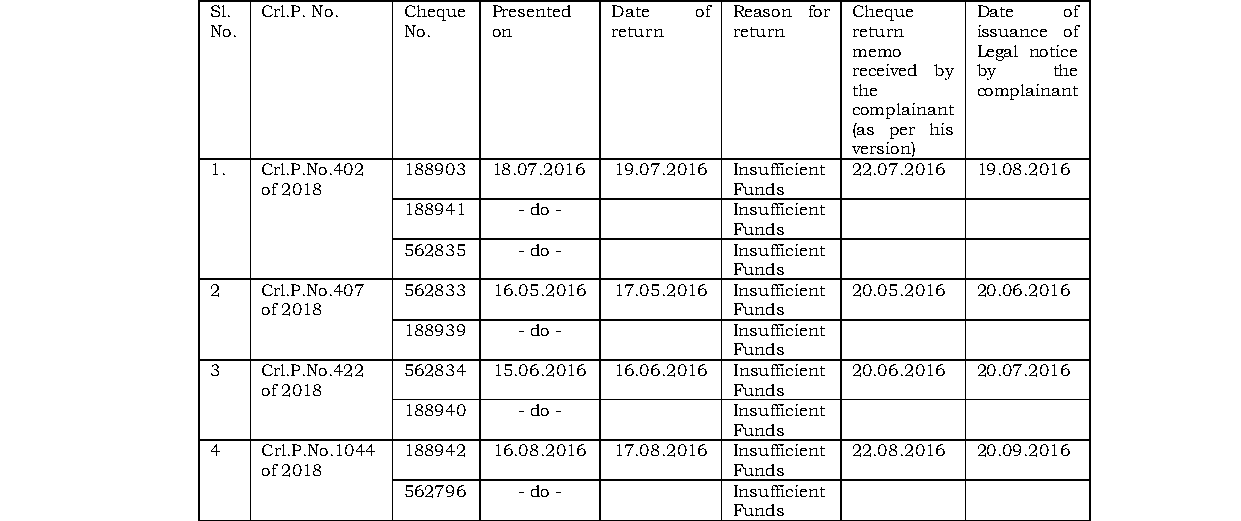
Respondent No.2-complainant filed private complaints stating that IFCI Limited is a Government of India company and a financial institution within the meaning of Companies Act, 2013, and is engaged in the business of providing short and long term financial assistance. Accused No.1 is a company registered under the Companies Act, having its registered office at Hyderabad and is engaged in infrastructure development projects/services. Accused Nos.2 and 3 are the promoters and directors, and accused No.4 is the nominee director (Sycamore) of accused No.1 company. At the request of accused, the complainant sanctioned a corporate loan of Rs.90 crores vide letter of intent dated 08.09.2014 and further sanctioned another corporate loan of Rs.100 crores vide letter of intent dated 06.04.2015. The said loans were duly availed by accused No.1 company and were repayable as per the repayment schedule annexed to the loan agreements dated 15.09.2014 and 05.05.2015 respectively. Accused No.1, through accused No.3, issued cheques dated 15.07.2016, 15.05.2016, 15.06.2016 and 15.08.2016 in favour of the complainant for Rs.4,50,00,000/-, Rs.1,01,19,452/- & Rs.1,22,87,671/- (C.C.No.1607 of 2016); Rs.1,22,87,671/- & Rs.1,01,19,452/- (C.C.No.1476 of 2016); Rs.1,26,97,260/- & Rs.1,04,56,767/- (C.C.No.1617 of 2016); and Rs.98,75,836/- & Rs.4,16,66,700/- (C.C.No.185 of 2017) respectively, towards part discharge of accused’s liability. The said cheques were presented for encashment by the complainant on 18.07.2016, 16.05.2016, 15.06.2016 and 16.08.2016 respectively through its banker, i.e., HDFC Bank, Begumpet Branch, Hyderabad, to the accused’s banker i.e., State Bank of Hyderabad. However, the cheques were returned unpaid on 19.07.2016, 17.05.2016, 16.06.2016 and 17.08.2016 respectively by accused banker with the endorsement ‘Insufficient Funds’. The bank return memos along with the unpaid cheques were received by the complainant on 22.07.2016, 20.05.2016, 20.06.2016 and 22.08.2016 respectively. Thereafter, the complainant issued legal notices dated 19.08.2016, 20.06.2016, 20.07.2016 and 22.08.2016, calling upon the accused to make payment of Rs.6,74,07,123/-, Rs.2,24,07,123/-, Rs.2,31,54,027/- and 5,15,42,536/- respectively, within 15 days from the date of receipt of the said notices. All the accused received the notices on 22.08.2016, however, they neither complied with the demand made in legal notices nor issued any reply. Thereby, the accused have committed the offence under Section 138 of the N.I. Act and are liable for punishment and sought imposition of a fine of double the cheque amounts by way of compensation to the complainant under Section 357 of the Cr.P.C.
3. Heard Mr. Sharad Sanghi, learned counsel for the petitioners, Mr. Praveen Kumar, learned counsel for respondent Nos.2 to 4 and Mr. M. Viv
AI
Statutory notice for cheque dishonor must be issued within prescribed time; failure or competence of complaint representative are factual matters for trial, not grounds for quashing under Section 482....


Directors of a company can be held vicariously liable under Section 141 of the Negotiable Instruments Act if they were in charge of the company's affairs at the time of the offense.


The liability of the company and its officers under Section 141 of the Negotiable Instruments Act was established based on the specific averments in the complaint and the company's reply, and the cou....

A person who is not a signatory to the cheque cannot be prosecuted under Section 138 of the Negotiable Instruments Act, 1881, for the offence of dishonour of cheque for insufficiency of funds.

The judgment emphasizes the importance of trial to determine liability under settlement agreements and the applicability of Section 141 of the N.I. Act. It also clarifies the conditions under which t....
Liability of directors under Section 138 of the Negotiable Instruments Act depends on their active role and responsibility for the company's business conduct, not merely their directorship.

The main legal point established in the judgment is that a complaint filed by a company under Section 138 of the Negotiable Instruments Act must be in the name of the company and can be represented b....



An indispensable Tool for Legal Professionals, Endorsed by Various High Court and Judicial Officers
Please visit our Training & Support
Center or Contact Us for assistance

Scan Me!
India’s Legal research and Law Firm App, Download now!


For Daily Legal Updates, Join us on :



 Back to top


