
 Back
Back





IN THE HIGH COURT FOR THE STATE OF TELANGANA AT HYDERABAD
APARESH KUMAR SINGH, C.J., G.M.MOHIUDDIN, J.
The State of Telangana, rep. by its Principal Secretary, School Education Department and Another – Appellants
Versus
D. Ramchander – Respondent
Writ Appeal No.1370 of 2024
Decided On : 29-12-2025
JUDGMENT :
Aparesh Kumar Singh, CJ.
Sri Santhapur Satyanarayana Rao, learned Government Pleader for Services-I, appears for the appellants.
Sri Goda Siva, learned Senior Counsel, representing Ms. Goda Ramalakshmi, appears for the respondent.
2. Heard learned counsel for the parties.
3. The State of Telangana and Jawahar Bal Bhavan, the respondents in W.P.14373 of 2023, are the appellants herein aggrieved by the judgment dated 14.06.2024 rendered by the learned writ court quashing the impugned G.O.Ms.No.14, School Education (Vigilance) Department, dated 12.04.2023, whereby the respondent herein (hereinafter referred to as ‘the writ petitioner’) was dismissed from service. The learned writ court also directed the appellants to pay all the consequential benefits to the writ petitioner as per his entitlement.
4. The narration of facts as furnished in the form of a tabular chart containing the genesis of the dispute from the year 2002 when the writ petitioner was promoted to the post of Senior Assistant from the post of Junior Stenographer in the office of appellant No.2 are extracted hereunder:-
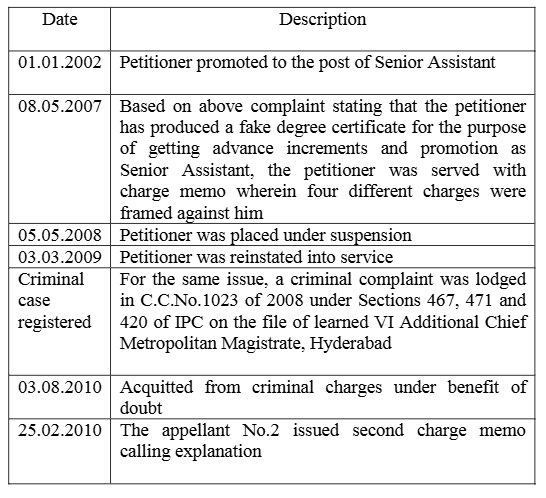
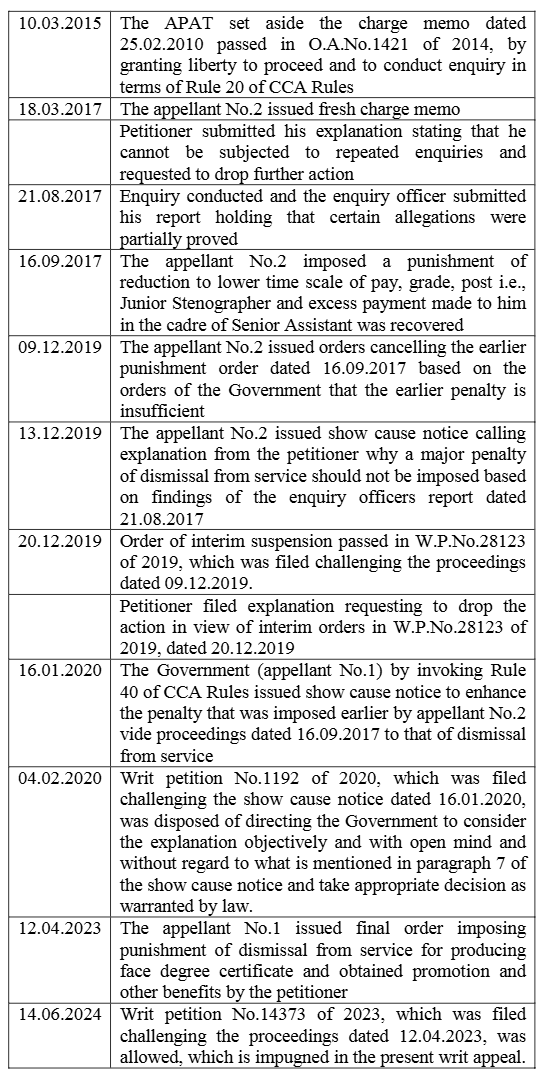

5. The present controversy revolves around the dismissal of the writ petitioner by impugned G.O.Ms.No.14, dated 12.04.2023, passed under Rule 40 (iv) of the Telangana Civil Services (Classification, Control and Appeal) Rules, 1991 (hereinafter referred to as ‘CCA Rules’), and as per G.O.Ms.No.2, General Administration (Ser.C) Department, dated 04.01.1999, read with clause (x) of Rule 9 of the CCA Rules passed by the Secretary to Government.
6. Rule 40 of the CCA Rules reads as under:
“40. (1) Notwithstanding anything contained in these rules.
(i) the Government, or
(ii) in the case of a Government servant serving in a department or office under the control of a head of department such head of the department directly under the Government; or
(iii) any appellate authority, or
(iv) any other authority specified in this behalf by the Government by a general or special order, and within such time as may be prescribed in such general or special orders may where a revision petition is preferred by the Government servant within one year of the date of receipt by him of the order sought to be revised, and in cases where no .such revision petition is preferred within four years of the date of the order proposed to be revised, either suo-motu or otherwise and after calling for the records of any inquiry and examination, revise any order of penalty made under these rules or under the rules repealed by the rule 45, after consultation with the commission where such consultation is necessary. The said authority may exercise the power suo-motu within four years from the date of issue of order of penalty by the competent authority or within one year of the date of receipt of the petition either confirm or reduce or set aside the order of penalty or any other order already issued, and where it is proposed to enhance the penalty, such authority may exercise the power within four years from the date of receipt of the petition and revise any order made under rule 45 after consultation with the commission where such consultation is necessary, and
(a) confirm, modify or set aside the order; or
(b) confirm, reduce, enhance or set aside the penalty imposed by the order, or impose any penalty where no penalty has been imposed; or
(c) remit the case to the authority which made the order or to any other authority directing such authority to make such further inquiry as it may consider proper in the circumstances of the case; or
(d) pass such other orders as it may deem fit;
Provided that the Special Inspector-General of Police (Law and Order) or the Deputy Inspector-General of Police or an officer of the corresponding rank may, of his own motion or otherwise, revise an order passed on appeal by the authority subordinate to him:
Provided further that no order imposing or enhancing any penalty shall be made by any revising authority unless the Government servant concerned has been giv
AI
In disciplinary proceedings, the standard of proof differs from criminal law; acquittal does not undermine departmental findings if misconduct is established.

The court emphasized that the enhancement of penalty, the nature of the petitioner's acquittal, and the proportionality of the punishment were crucial in reaching its decision.

Acquittal by benefit of doubt in criminal case does not constitute honourable acquittal and does not vitiate disciplinary dismissal for falsified date of birth, given differing proof standards.


The main legal point established is that the High Court's interference with the punishment imposed by the Disciplinary Authority is limited to cases of shockingly disproportionate punishment or proce....

The use of fraudulent documentation for securing employment constitutes grave misconduct, warranting dismissal rather than mere discharge.



An indispensable Tool for Legal Professionals, Endorsed by Various High Court and Judicial Officers
Please visit our Training & Support
Center or Contact Us for assistance

Scan Me!
India’s Legal research and Law Firm App, Download now!


For Daily Legal Updates, Join us on :



 Back to top


