



1. Petitioner sought to produce additional documents and lead secondary electronic evidence during trial in a family court proceeding for marriage annulment, which the trial court rejected. (Para 2 , 3 )
 Back
Next 





2025 Supreme(Telangana) 2238
IN THE HIGH COURT FOR THE STATE OF TELANGANA AT HYDERABAD
K. LAKSHMAN, J.
G. Sai Snigdha Bhashitha – Appellant
Versus
Dasari Sai Sarath – Respondent
C.R.P. No. 2052 of 2025
Decided On : 03-09-2025
Advocates Appeared:
For the Appellant : Nadipally Ananda Rao
For the Respondent: Trichnopoly Ravi Kanth Shivani
For the Appellant : Nadipally Ananda Rao
For the Respondent: Trichnopoly Ravi Kanth Shivani
The court distinguished between 'receiving' documents under Order VII Rule 14 CPC and 'marking' them for admissibility. Relevance is the sole criterion for receiving documents; admissibility and statutory requirements (like Section 65-B of the Indian Evidence Act) are determined only during the marking stage.
Headnote:(A) Code of Civil Procedure, 1908 - Order VII Rule 14 - Production of documents by plaintiff - Receiving of documents vs. Marking of documents - The trial court must distinguish between the process of receiving documents and the process of marking them as evidence - For the purpose of receiving documents, the court is only required to consider the relevance of the documents to the matter in dispute - If the court is satisfied with the reasons regarding relevance, the application to receive the documents should be allowed. (Paras 13, 14, 15)
(B) Indian Evidence Act, 1872 - Section 65-B - Admissibility of electronic records - Requirement of certificate for secondary evidence - The requirement of a certificate under Section 65-B(4) pertains to the admissibility and marking of electronic records - A trial court cannot refuse to receive documents under Order VII Rule 14 of the Code of Civil Procedure on the ground that they are inadmissible or that a separate application for secondary evidence has been dismissed. (Paras 9, 15)
Facts of the case:
In a petition for annulment of marriage, the petitioner filed two applications: one under Order VII Rule 14 of the Code of Civil Procedure to receive certain documents and another under Section 65-B of the Indian Evidence Act to lead secondary evidence for electronic records (WhatsApp messages and pen drives). The trial court dismissed both applications, specifically dismissing the application to receive documents on the ground that the application for electronic evidence had already been dismissed, rendering the production of such documents pointless.
Findings of Court:
The court found that the trial court failed to appreciate the distinction between receiving a document and marking it. While admissibility (including compliance with Section 65-B of the Indian Evidence Act) is considered during the marking stage, the receipt of documents is governed by their relevance to the case. The trial court erred by conflating these two stages and dismissing the application to receive documents based on their inadmissibility.
Issues: Whether the trial court was justified in dismissing an application to receive documents under Order VII Rule 14 of the Code of Civil Procedure based on the dismissal of an application to permit secondary evidence of those documents under Section 65-B of the Indian Evidence Act.
Ratio Decidendi: The court ruled that receiving documents is about relevance, whereas marking documents is about admissibility. The trial court cannot refuse to receive documents at the production stage by claiming they are not admissible; admissibility is a separate consideration to be handled during the marking process. Consequently, an order dismissing the receipt of documents based on their alleged inadmissibility is contrary to the purport of Order VII Rule 14 of the Code of Civil Procedure.
Result: Impugned order set aside and matter remanded to the trial court to decide the application afresh.
Legal Category Hierarchy
Table of Contents
2. Petitioner claimed documentary evidence was relevant and non-production was not intentional; respondent argued no reasons were provided for omission or possession as required by procedural rules. (Para 7 , 8 )
3. The trial court improperly dismissed the production application solely on the basis of a separate ruling on secondary evidence, failing to consider independent relevance under governing procedural rules. (Para 8 , 14 , 15 )
4. Trial courts must evaluate the relevance of documents independently when considering applications for production and cannot dismiss them merely due to secondary evidence admissibility concerns. (Para 14 , 15 )
5. The impugned order was set aside and the matter remanded to the trial court for a fresh decision after allowing parties to file affidavits. (Para 15 , 18 , 19 )
6. What is the mandatory criterion for a court to consider when an application under Order VII Rule 14 of the CPC is filed to produce documents?
The court must consider the relevance of the documents regarding the lis in the suit. It should allow the application and receive the documents if convinced of their relevance, while keeping issues of admissibility for a later stage. (Para 14 , 15 )
7. Can a trial court dismiss an application to receive documents based solely on the rejection of a separate application for secondary evidence?
No. The court cannot dismiss a request to receive documents simply because an application to mark electronic records as secondary evidence has been rejected, as they constitute distinct procedural matters that must be evaluated on their own merits. (Para 8 , 15 )
ORDER :
1. Heard Sri N.Ananda Rao, learned counsel for the petitioner and Ms T.Ravi Kanth Shivani, learned counsel appearing for respondent.
2. This Civil Revision Petition is filed under Article 227 of Constitution of India challenging the order dated 26.05.2025 in I.A.No.103 of 2025 in FCOP.No.149 of 2024, passed by learned Judge Family Court-Cum-II Additional District Judge at Hanumakonda.
3. The Petitioner has filed the aforesaid FCOP.No.149 of 2024 against the respondent herein for annulment of marriage. The said OP is coming for trail. The petitioner herein has filed two applications in FCOP i.e., I.A.No.103 of 2025 under Order VII Rule 14 of CPC to receive certain documents, which are mentioned in the affidavit specifically and I.A.No.104 of 2025 under Section 65-B of Indian Evidence Act to permit her to lead secondary evidence for the purpose of marking downloaded whats-app messages (text screenshots) and photostat copies and pen drives etc. Vide separate orders both dated 26.05.2025, learned trail Court dismissed the said applications.
4. It is relevant to note that petitioner herein has filed present Revision challenging the order dated 26.05.2025 in I.A.No.103 of 2025 and she did not file any Revision challenging the order dated 26.05.2025 in I.A.No.104 of 2025.
5. Mr.Nadipally Ananda Rao, learned counsel for the petitioner would submit that petitioner is going to challenge the said order dated 26.05.2025 in I.A.No.104 of 2025.
6. Petitioner has filed I.A No.103 of 2025 to receive the following documents.
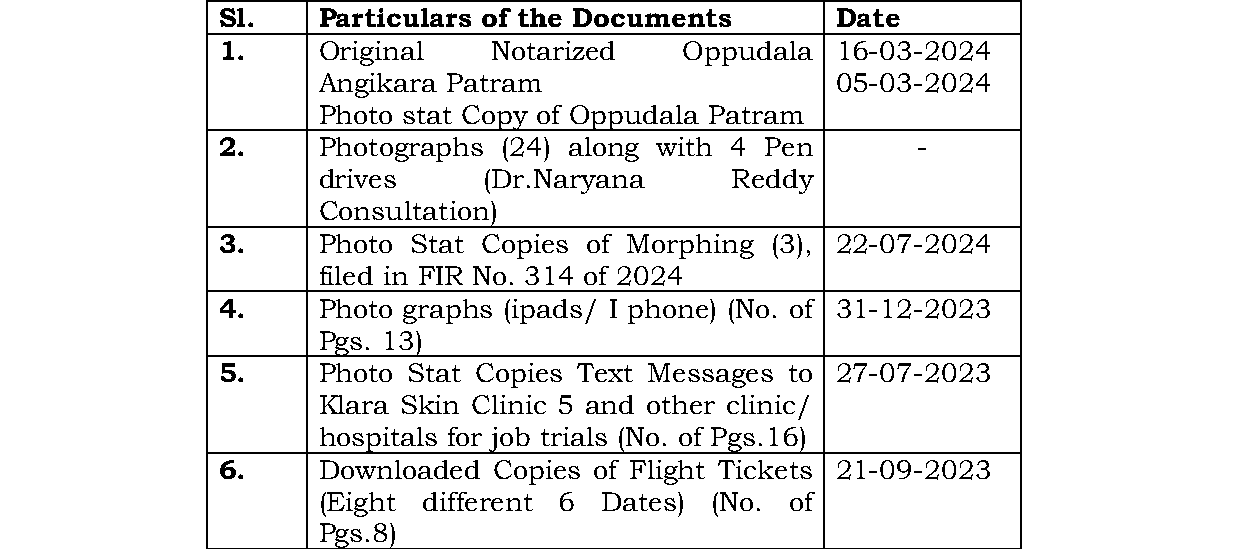
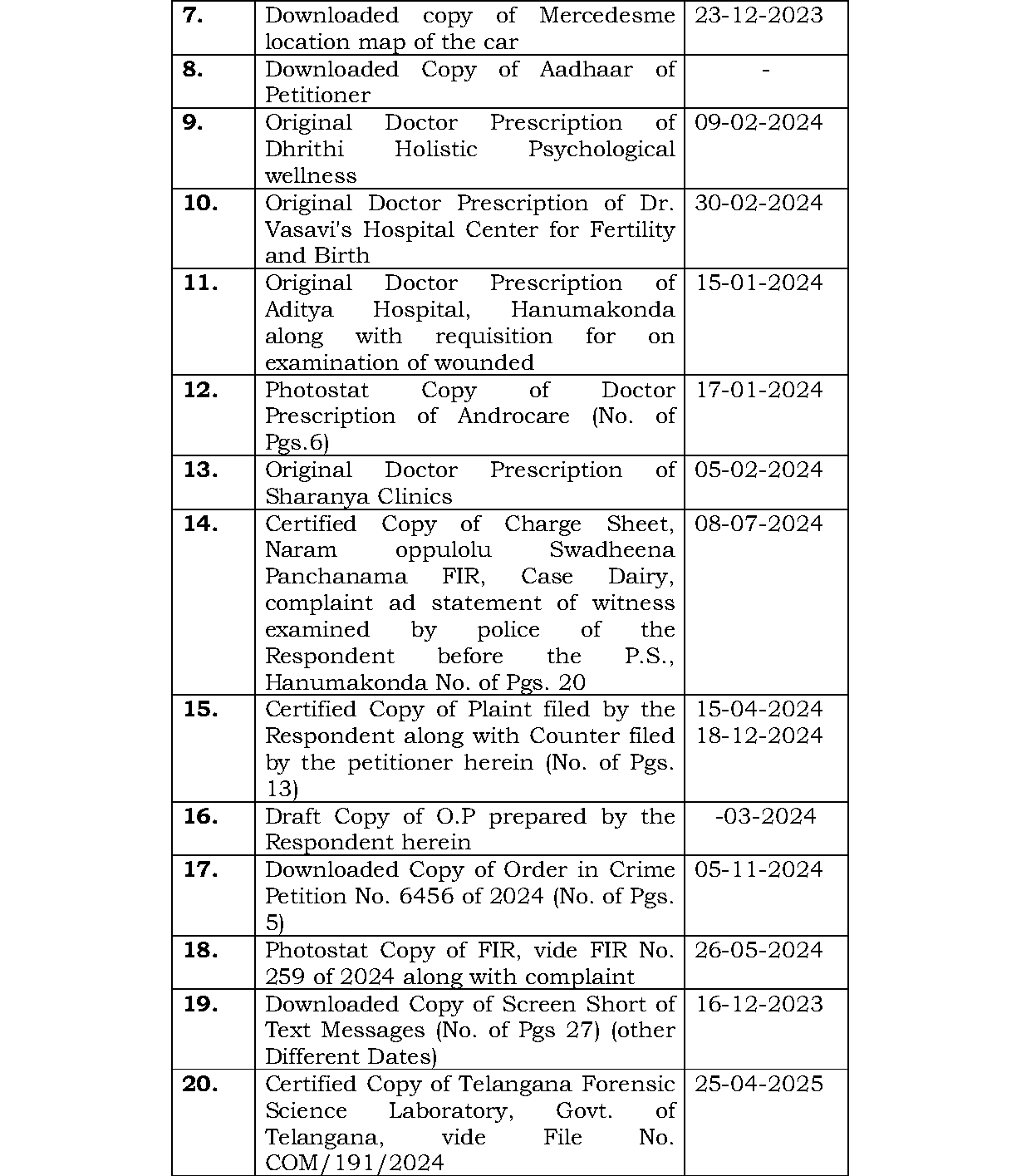
7. In the affidavit filed in support of said I.A., petitioner has specifically stated that said documents are relevant and non filing of the said documents along with FCOP is neither intentional nor willful.
8. Respondent has filed counter opposing the said application contending that petitioner has not mentioned the reasons for receiving the said applications and also in whose possession the said documents are, in terms of Order VII Rule 14 CPC and she has not mentioned the reasons for not filing the said documents along with the FCOP. Vide impugned order dated 26.05.2024, learned Family Court dismissed the said application holding that the trial Court has already dismissed I.A.No.104 of 2025. Therefore, no purpose will be served by allowing I.A.No.103 of 2025.
9. Perusal of the order dated 26.05.2025 in I.A.No.104 of 2025 would reveal that learned trial Court has dismissed the said application holding that petitioner herein failed to comply with Section 65-B of Indian Evidence Act. She sought permission to receive the electronic records i.e., photostat copies of text messages etc. To receive the said electronic records, she has to file certificate mentioned under Section 65-B (4) of Indian Evidence Act. In the absence of such certificate, secondary evidence of electronic records/computer output is inadmissible in evidence.
10. Learned counsel for the petitioner would submit that there is no need of submitting certificate along with the application under Section 65-B of the Indian Evidence Act. He has also placed reliance on several judgments of Hon’ble Supreme Court and different High Courts. However, he has to place reliance on the principle laid down in the said judgments while challenging the order dated 26.05.2025 in I.A No.104 of 2025.
11. As discussed supra, petitioner herein has filed the aforesaid I.A.No.103 of 2024 under Order VII Rule 14 of CPC. Order VII of CPC deals with the plaint and Rule 14 with production of relevant documents by a plaintiff.
12. The said provision is extracted below:
“Order 7, Rule 14 of the Code of Civil Procedure (CPC) mandates that a plaintiff suing on a document in their possession must produce it with the plaint and deliver it for filing, while plaintiffs relying on other documents as evidence must list them in a list annexed to the plaint. Any document that is not produced or listed without court leave cannot be used as evidence at the trial, emphasizing the importance of timely and pro












