
 Back
Back





IN THE HIGH COURT FOR THE STATE OF TELANGANA AT HYDERABAD
ABHINAND KUMAR SHAVILI, VAKITI RAMAKRISHNA REDDY, JJ.
The Special Officer and Competent Authority Urban Land Ceiling Nampally – Appellant
Versus
K. Jawahar Reddy and Others – Respondents
Writ Appeal Nos. 107, 111, 161 of 2018
Decided On : 07-10-2025
JUDGMENT :
VAKITI RAMAKRISHNA REDDY, J.
1. These three intra court appeals arise out of a common order dated 22.09.2017 passed by the learned Single Judge in W.P. Nos. 16605, 16927 and 17076 of 2008. Since the issues involved in all these appeals are substantially common, they were heard together and are being disposed of by this common judgment.
2. The appellants (State) assail the order of the learned Single Judge whereby the impugned proceedings initiated under the Urban Land (Ceiling and Regulation) Act, 1976 (“the Act”) were set aside on the ground of non-service of mandatory statutory notices and absence of lawful possession having been taken prior to the Urban Land (Ceiling and Regulation) Repeal Act 1999 (“Repeal Act”).
I. BRIEF FACTS
3. The facts, to the extent relevant, may be briefly recapitulated. The subject lands situated in Survey Nos. 284, 285 and 361/2 of Thumkunta Village, Shamirpet Mandal, Ranga Reddy District, are undisputedly agricultural lands. The respondents/writ petitioners claim ownership and possession through various registered sale deeds executed between 1989 and 2005 and their names were duly mutated in the revenue records.
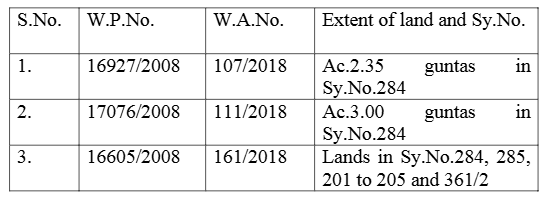
4. The details of the writ petitions filed by the petitioners and corresponding writ appeals filed by the State against the common order passed by the learned Single Judge and the details of the survey numbers and the subject lands are tabulated as under:
5. The appellants, however, contend that the subject lands constitute “vacant land” within the meaning of Sections 2(o) and 2(q) of the Act and were held in excess of the ceiling limit. Based on earlier proceedings initiated against the original declarants, the appellants assert that the land had vested in the Government under Section 10(3) of the Act.
6. The core issue before the learned Single Judge was whether the proceedings initiated under the Act could be sustained in the absence of:
(i) service of notice under Section 6(2) of the Act upon the respondents/writ petitioners or their predecessors-in-title.
(ii) lawful physical possession having been taken under Sections 10(5) or 10(6) of the Act prior to the enforcement of the Repeal Act, 1999.
7. The learned Single Judge, after an extensive analysis of statutory provisions and binding precedents, concluded that the proceedings suffered from fundamental jurisdictional defects and stood vitiated, resulting in their abatement under Section 3 of the Repeal Act.
8. The State has preferred these appeals contending that the learned Single Judge erred both in law and on facts in interfering with concluded proceedings and in accepting the respondents’ claim to title and possession.
9. We have heard the learned Government Pleader for the appellants and Sri E. Madanmohan Rao, the learned Senior Counsel appearing for the respondents/writ petitioners. We have also carefully examined the record and the findings of the learned Single Judge.
II. SUBMISSIONS OF THE PARTIES:
a) Submissions on behalf of the Appellants (State)
10. Learned Government Pleader for Assignment appearing for the appellants contended that the writ petitioners are subsequent purchasers of the lands in question and, by virtue of Section 5(3) of the Act, their sale deeds are void, as the transactions were effected after the appointed date under the Act. Consequently, it is urged that the writ petitioners are incompetent to question the proceedings initiated under the Act.
11. It is further contended that the expression “commencement of the Act” must be construed to mean the date on which the land became “vacant land” under the provisions of the Act, irrespective of its earlier classification as agricultural land. Hence, the plea of the writ petitioners that their lands are agricultural and therefore, their lands have to be excluded from the purview of the Act, is unsustainable.
12. The learned Government Pleader for Assignment further submitted that non-service of notice under Section 10(5) of the Act, does not ipso facto vitiate the pr

Mandatory compliance with statutory notice requirements is essential for valid proceedings under land regulation laws; non-compliance renders actions void and proceedings abated upon repeal.

The court held that statutory compliance under the Urban Land (Ceiling and Regulation) Act is mandatory for valid dispossession, emphasizing that mere vesting does not equate to possession.

Failure to issue notice under Section 10(5) of the ULC Act to possessors renders dispossession unlawful and results in the abatement of proceedings under Section 4 of the Repealing Act.

Serious disputed facts on Section 10(5) notice service and physical possession taking under ULC Act prevent writ determination of abatement under Repeal Act Section 4; relegation to civil suit approp....

Failure to issue mandatory notices under the Urban Land Act invalidates state claims of land possession, allowing petitioners to retain ownership rights based on ongoing lawful occupancy.
The court ruled that failure to serve mandatory notices to legal representatives in surplus land proceedings renders such proceedings void, violating principles of natural justice.



An indispensable Tool for Legal Professionals, Endorsed by Various High Court and Judicial Officers
Please visit our Training & Support
Center or Contact Us for assistance

Scan Me!
India’s Legal research and Law Firm App, Download now!


For Daily Legal Updates, Join us on :



 Back to top


