


1. Borrowers challenged arbitral awards for loan recoveries, contesting the appointment of a sole arbitrator and the validity of arbitral proceedings under the Arbitration and Conciliation Act, 1996. (Para 3 )
 Back
Next 





2026 Supreme(Telangana) 977
HIGH COURT FOR THE STATE OF TELANGANA AT HYDERABAD
VAKITI RAMAKRISHNA REDDY, J.
Duluganti Ravinder Reddy - Appellant
Versus
M/s. Shriram City Union Finance Limited and another - Respondents
CIVIL MISCELLANEOUS APPEAL Nos. 338, 365, 366, 368, 369, 370, 371, 373, 374 and 384 of 2020
Decided On : 21-07-2026
Important Points
Unilateral appointment of an arbitrator by an interested party vitiates the award. Under Section 13(5) and Section 34 of the Arbitration and Conciliation Act, 1996, courts must independently examine challenges to the tribunal's constitution, regardless of whether such challenges were previously rejected by the arbitrator.
Subject
Civil Law - Arbitration
Act Referred
Headnote
(A) Arbitration and Conciliation Act, 1996 - Sections 11, 12, 13, 16, 21 and 34 - Appointment of Arbitrator - Unilateral appointment - Legality of constitution of Arbitral Tribunal - Scope of judicial scrutiny under Section 34 - Independence and impartiality of the arbitrator are the hallmarks of any arbitration proceedings. A party having an interest in the outcome of the dispute cannot be permitted to exercise an exclusive or dominant role in the constitution of the Arbitral Tribunal (Paras 40, 41). Unilateral appointment in an arbitral proceeding is completely impermissible in law and is sufficient to vitiate the award (Para 42).
(B) Arbitration and Conciliation Act, 1996 - Section 13(5) - Challenge to Arbitrator - Where a challenge to the appointment of an arbitrator is not accepted, the statute expressly preserves the right of the aggrieved party to question such award by making an application under Section 34. The rejection of an application preferred under Sections 12 and 13 is not intended to foreclose judicial examination of the legality of the appointment or constitution of the Arbitral Tribunal (Paras 48-50).
(C) Arbitration and Conciliation Act, 1996 - Section 21 - Commencement of arbitral proceedings - This section is concerned primarily with determining the commencement of the dispute for the purpose of reckoning limitation. Failure to issue or serve a notice under Section 21 would not automatically invalidate the arbitral proceedings if the claim is otherwise valid and the disputes arbitrable (Paras 25-26).
(D) Arbitration and Conciliation Act, 1996 - Section 34 - Scope of interference - While the court does not function as a court of appeal over the merits, it is required to examine whether the arbitral proceedings were conducted in accordance with mandatory provisions. Objections relating to the inherent jurisdiction of the tribunal or the legality of its constitution are amenable to judicial scrutiny under Section 34, even if no such objection was raised before the tribunal under Section 16 (Paras 54-57).
Facts of the case:
Loan borrowers and guarantors defaulted on repayments, leading a finance company to initiate arbitration. The sole arbitrator was appointed by the company prior to the issuance of the demand-cum-invocation notice. The appellants challenged the appointment under Sections 12 and 13, which were dismissed by the arbitrator. Arbitral awards were subsequently passed. The appellants filed proceedings under Section 34, but the district court dismissed them, holding that the scope of interference was limited and that the dismissal of the earlier challenges to the arbitrator's appointment had not been separately challenged.
Findings of Court:
The court found that the appointment of the sole arbitrator was unilateral and occurred before the arthritis agreement was formally invoked. It held that the district court committed a manifest error by declining to independently examine these foundational objections under Section 34 on the erroneous premise that such objections were either no longer available or outside the permissible scope of the Act.
Issues: The main issues were whether the arbitral proceedings were initiated in accordance with the law, whether the unilateral appointment of the sole arbitrator was legally sustainable, and whether the court below failed to exercise its jurisdiction under Section 34 by not adjudicating objections regarding the constitution of the tribunal.
Ratio Decidendi: Unilateral appointment of an arbitrator by an interested party violates the fundamental requirements of neutrality and impartiality. Under Section 13(5), the right to challenge the appointment of an arbitrator is preserved at the post-award stage under Section 34, regardless of whether the Arbitral Tribunal had previously rejected such a challenge. Jurisdictional objections regarding the legality of the tribunal's constitution must be independently adjudicated by the court under Section 34.
Result: Civil Miscellaneous Appeals allowed; judgments and decrees of the court below set aside; respective arbitral awards set aside.
Legal Category Hierarchy
- arbitration law
- practice and procedure
Table of Contents
2. Appellants argued the arbitrator's appointment was unilateral, invalid, and lacked proper service of notice, while the respondent claimed valid appointment and limited scope for judicial interference. (Para 7 , 8 , 9 , 10 , 11 , 13 , 14 , 15 , 16 , 17 )
3. The court found the lower court failed to independently adjudicate foundational challenges regarding the tribunal's constitution and the legality of the arbitrator's appointment under Section 34 of the Act. (Para 60 , 61 , 62 , 67 )
4. An appellate court must independently adjudicate foundational challenges to an arbitrator's appointment and tribunal constitution, even if previous applications under Sections 12 and 13 were rejected. (Para 48 , 49 , 50 , 51 , 65 , 66 )
5. The High Court allowed the civil miscellaneous appeals, set aside the lower court's judgments, and quashed the respective arbitral awards. (Para 69 , 71 )
6. Must a court under Section 34 independently examine a challenge to the constitution of an arbitral tribunal if the tribunal already rejected a challenge under Section 13?
Yes, Section 13(5) of the Act expressly preserves the right of an aggrieved party to challenge the arbitral award based on the same objection. The prior rejection by the tribunal does not attain finality to foreclose judicial examination under Section 34. (Para 48 , 49 , 50 , 51 , 65 )
7. Can a plea of lack of jurisdiction be raised for the first time during Section 34 proceedings?
Yes, pleas touching upon the inherent jurisdiction of the arbitral tribunal or the legality of its constitution are not barred merely because no objection was raised earlier under Section 16 of the Act. (Para 56 , 66 )
8. Does the non-issuance of a Section 21 notice automatically invalidate arbitral proceedings?
No, Section 21 primarily determines the commencement of proceedings for limitation purposes. Failure to issue a notice under Section 21 is not fatal to the validity of the proceedings if the dispute is otherwise arbitrable. (Para 25 , 26 )
JUDGMENT :
VAKITI RAMAKRISHNA REDDY, J.
These Civil Miscellaneous Appeals, preferred under Section 37 of the Arbitration and Conciliation Act, 1996 (for short “the Act”) arise out of separate judgments and decrees all dated 10.03.2020, passed by the II Additional District Judge (FTC), Mancherial in the respective Arbitration O. P’s (renumbered on transfer from the Court of Principal District Judge, Adilabad), instituted under Section 34 of the Act. Since, the respondent, viz., Shriram City Union Finance Limited, is common to all the appeals, and the matters involve substantially similar facts, common questions of law and identical issues for determination, they were heard analogously and are being disposed of by this common Judgment.
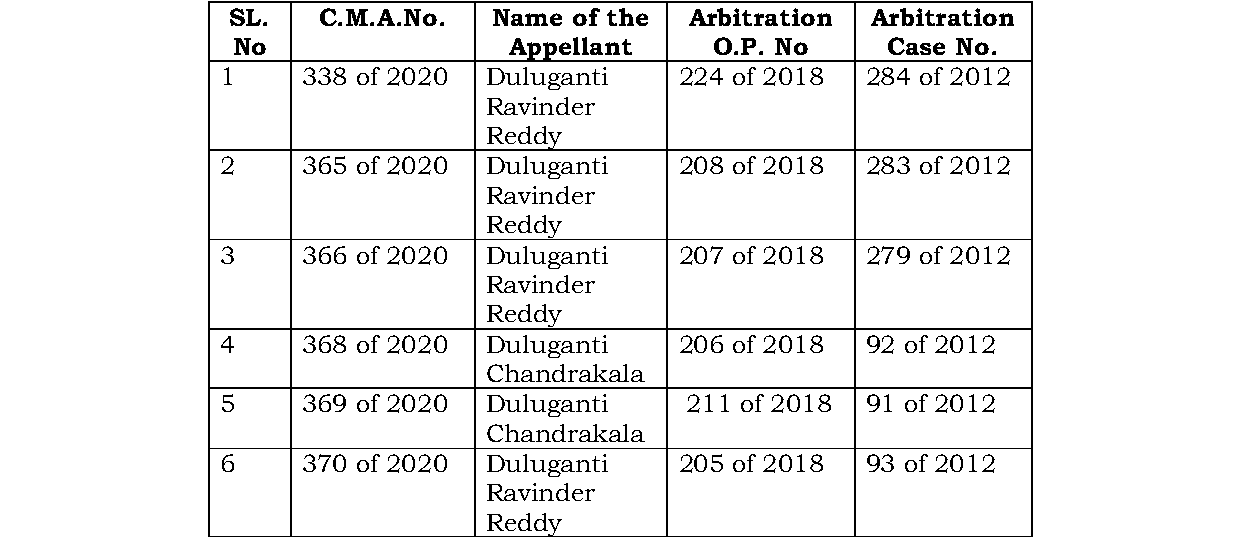
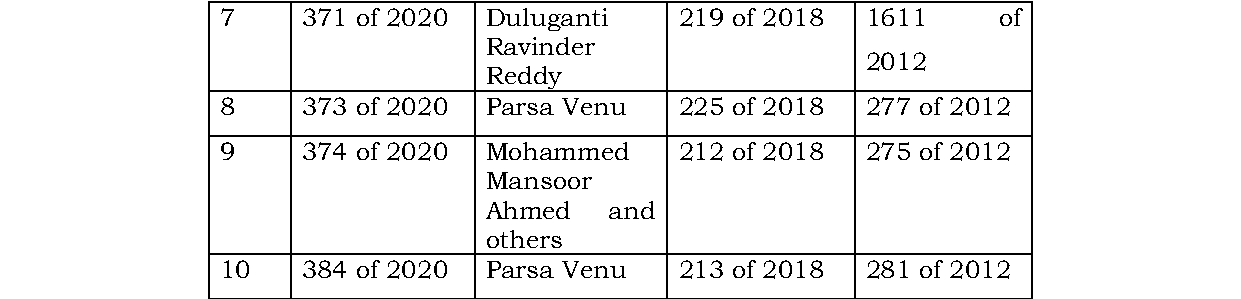
2. Having regard to the multiplicity of these Civil Miscellaneous Appeals, arising out of different Arbitration O. P’s pertaining to separate loan transactions, it is considered appropriate, for the sake of convenience, clarity and proper appreciation of the issues involved, to set out the particulars of the respective appellants, the arbitration case numbers and the corresponding Arbitration O.P numbers in the following tabular statement:
FACTUAL BACKGROUND:
3. The factual backdrop leading to the filing of the present Civil Miscellaneous Appeals is as follows:
a) The respondent, a finance company, sanctioned various loans in favour of the appellants, who figured as principal borrowers and guarantors as the case may be. On the very same day, the parties executed a Loan-cum-Hypothecation Agreements, Demand Promissory Notes and allied loan documents. Under the terms of the respective loan transactions, the appellants agreed to repay the loan amounts together with interest, in equated monthly instalments respectively.
b) According to the respondent, the appellants committed default in repayment of the loan instalments, resulting in accumulation of substantial arrears. Consequently, the respondent issued demand-cum-invocation notices dated 15.05.2012 calling upon the appellants to clear the outstanding dues and informing them that in the event of continued default, arbitration proceedings would be initiated in accordance with the terms of the loan agreements.
c) As the dues remained unpaid, the respondent invoked the arbitration clause contained in the respective loan agreements and initiated Arbitration proceedings as mentioned in the above table before the sole Arbitrator, Sri Sura Bhaskar, Mancherial, seeking recovery of the outstanding amounts together with future interest at 36% per annum and costs.
d) During the pendency of the arbitral proceedings, the appellants filed applications under Sections 12 and 13 of the Act, questioning the appointment of the sole Arbitrator and seeking suspension of the arbitral proceedings. The said applications came to be dismissed on 11.07.2013.
e) Thereafter, the respondent examined its authorized representative and marked the documents in support of its claim. Upon consideration of the evidence on record, the sole Arbitrator passed various awards dated 24.07.2013 directing appellants to jointly and severally pay the sum together with future interest at 12% per annum from the date of claim statement till realization and costs of the arbitral proceedings.
f) Aggrieved by the arbitral award, the appellants instituted proceedings under Section 34 of the Act, before the Principal District Judge, Adilabad, seeking to set aside the arbitral awards. The proceedings were initially registered and upon transfer on the point of jurisdiction, were renumbered on the file of the II Additional District Judge (FTC), Mancherial. By judgment dated 10.03.2020, the Arbitration O. Ps were dismissed with costs confirming the arbitral award dated 24.07.2013. Challenging the said judgment and decree, the present Civil Miscellaneous Appeals have been preferred.
POINT FOR CONSIDERATION BEFORE THE APPELLATE COURT:
4. The point that arose for consideration before the Appellate Court Was:
“Whether the Awa









