
 Back
Back





KARNATAKA HIGH COURT
M NAGAPRASANNA, J
X CORP – Appellant
Versus
UNION OF INDIA – Respondent
WP 7405 / 2025
(A) Information Technology Act, 2000 – Sections 69A and 79(3)(b) – Information Technology (Intermediary Guidelines and Digital Media Ethics Code) Rules, 2021 – Rule 3(1)(d) – Constitution of India – Articles 14, 19(1)(a), 19(2) and 226 – Challenge to constitutional validity of Rule 3(1)(d) and notifications designating nodal officers to issue takedown notices to intermediaries – Petitioner, a foreign social media intermediary, sought declaration that Section 79(3)(b) does not confer authority to issue blocking orders, that such orders can only be issued under Section 69A read with Blocking Rules, 2009, and that Rule 3(1)(d) is ultra vires – Held, Section 79 is a safe harbour provision hedged with conditions; non-compliance leads to loss of safe harbour – Rule 3(1)(d) operates within scope of Section 79 and refers to information already declared unlawful under existing laws – Words 'unlawful information' and 'under any law for the time being in force' refer to clearly defined and subsisting laws and are neither vague nor unbridled – Section 69A operates in distinct sphere with elaborate procedural safeguards for blocking, while Rule 3(1)(d) operates within statutory framework of intermediary due diligence – Provision is plain, unambiguous and not susceptible to reading down – Challenge repelled. (Paras 16.1-16.12)
(B) Constitution of India – Article 19 – Citizen-centric nature of fundamental rights – Whether foreign company can invoke Article 19(1)(a) – Held, fundamental rights guaranteed under Article 19 are available only to citizens and not to foreign companies or non-citizens – Articles 14 and 21 are available to all persons but cannot be invoked as a backdoor to claim rights under Article 19 – Foreign company having no registered office in India and being a faceless juristic entity cannot challenge constitutionality of statutes on the strength of Article 19 – Petitioner being a foreign incorporated company is not a citizen and cannot claim protection of Article 19(1)(a). (Paras 17.1-17.13)
(C) Constitution of India – Comparative constitutional jurisprudence – Whether American jurisprudential doctrines on free speech can be transplanted into Indian constitutional thought – Held, American doctrines cannot be imported wholesale into Indian Constitution – Fundamental rights under Article 19(1) are not absolute but subject to reasonable restrictions under Article 19(2) – Framework of Indian Constitution is materially different from American Constitution which contains no equivalent of clauses (2) to (6) of Article 19 – Constitution Benches consistently held that American precedents are inapplicable to interpretation of Indian fundamental rights. (Paras 13.1-13.13)
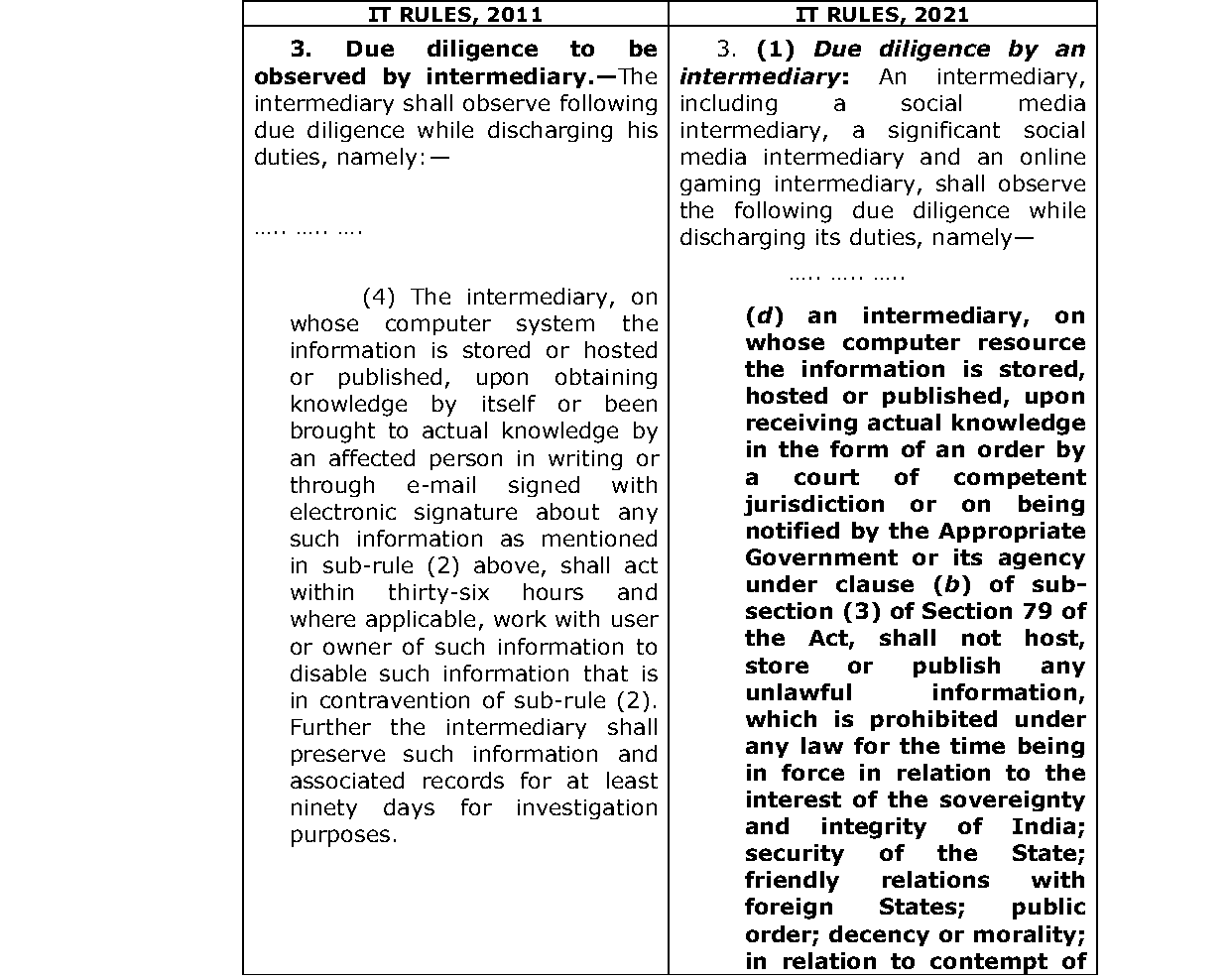
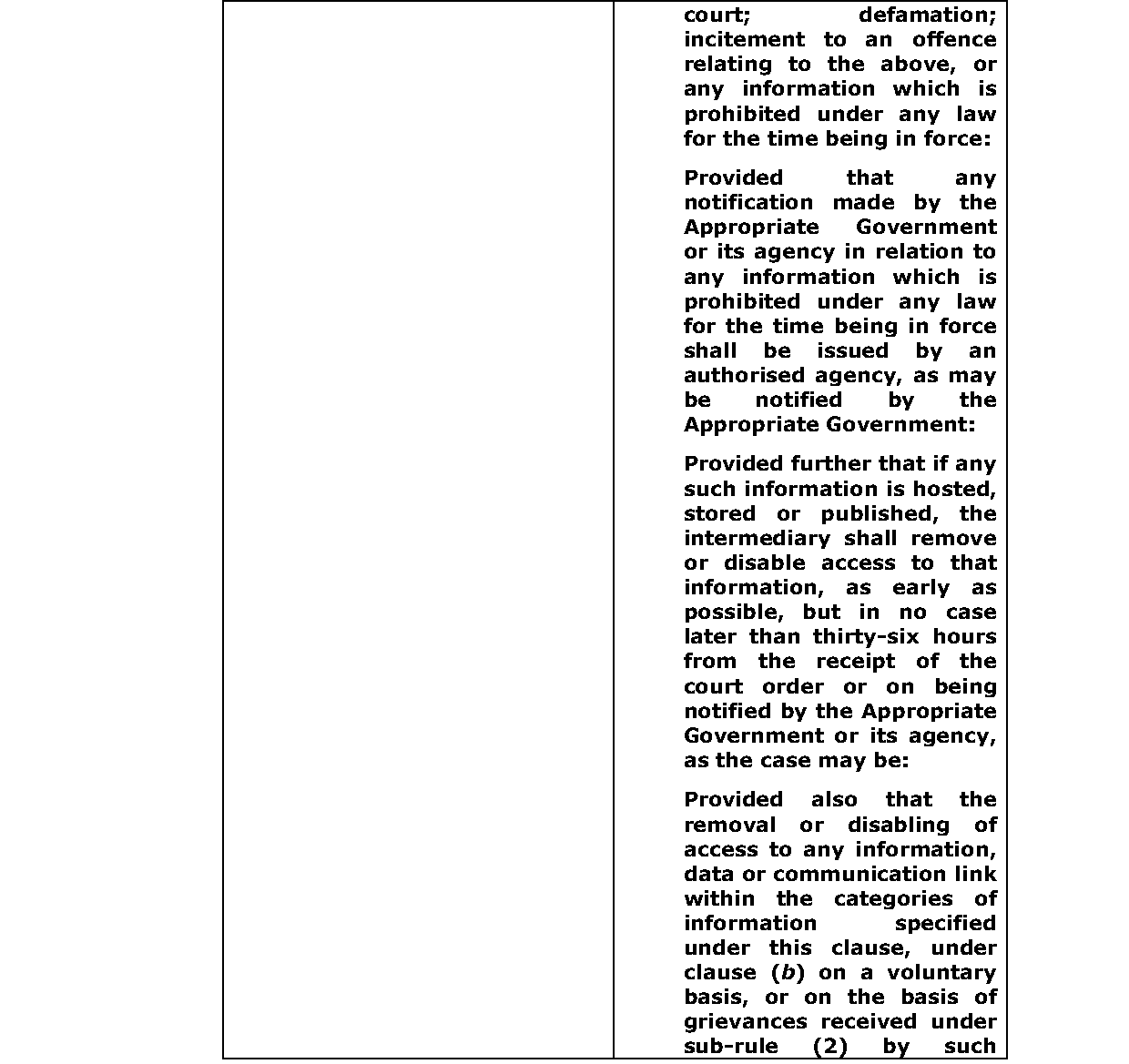
(D) Information Technology Act, 2000 – Information Technology (Intermediary Guidelines and Digital Media Ethics Code) Rules, 2021 – Rule 3(1)(d) – Distinction from earlier 2011 Rules – Earlier judicial pronouncement interpreted 2011 Rules which stand superseded – New Rules of 2021 are materially distinct and demand fresh interpretative lens – Earlier Rules required intermediary to act on complaint of any affected person whereas new Rules require actual knowledge through court order or notification by appropriate Government – Submission that earlier interpretation should be paraphrased to new Rules rejected. (Paras 15.1-15.5)
(E) Information Technology Act, 2000 – Sahyog Portal – Whether ultra vires parent enactment – Portal established under Section 79(3)(b) read with Rule 3(1)(d) of 2021 Rules to facilitate routing of takedown notices between authorized agencies and intermediaries – Held, portal is not an instrument of censorship but a facilitation mechanism aimed at streamlining communication, ensuring efficiency, traceability and accountability – Power to issue binding blocking directions remains exclusively under Section 69A and Blocking Rules, 2009 – Challenge characterizing portal as censorship portal is mischaracterization – Portal does not suffer from any constitutional infirmity. (Para 18)
(F) Freedom of speech and expression – Reasonable restrictions – Digital age – Algorithms and human agency – Submission that intermediary platform operates without human intervention through algorithms and artificial intelligence – Held, algorithms are conceived, designed, trained and operated by human beings; they are extensions of human judgment encoded in mathematical form – Element of control always remains with intermediary – Platform cannot escape regulatory framework on plea of technological neutrality – Power, whether human or digital, must remain accountable. (Paras 22.1-22.4)
(G) Social media regulation – Necessity – Menace of misinformation, cyberbullying, online violence against women, deepfakes and misuse of technology – Held, social media has become a fertile ground for unlawful content threatening public order, decency and dignity of citizens – Regulation is not a matter of choice but a solemn necessity – State carries obligation to align regulatory frameworks to protect citizens, particularly women, from online harm – Liberty must walk hand in hand with responsibility, freedom with accountability – Every platform operating within jurisdiction of the nation must accept that privilege of access carries solemn duty of accountability. (Paras 23.1-24.3)
Facts of the case:
The petitioner, a foreign incorporated social media intermediary headquartered in United States with no registered office in India, approached the Court challenging the constitutional validity of Rule 3(1)(d) of the Information Technology (Intermediary Guidelines and Digital Media Ethics Code) Rules, 2021, the Sahyog Portal, and various notifications issued by Central Ministries and State authorities designating nodal officers empowered to issue takedown notices under Section 79(3)(b) of the IT Act. The petitioner contended that Section 79(3)(b) was an exemption provision and not an empowering provision, that information blocking could only be done under Section 69A read with Blocking Rules of 2009, and that Rule 3(1)(d) was vague, unbridled and ultra vires the Act and Article 19(2). The Union of India contended that the petitioner being a foreign entity could not invoke Article 19, that the Rules were a regulatory necessity in light of the exponential growth of internet users and the menace of social media, and that the Sahyog Portal was merely a facilitation mechanism.
Findings of Court:
The Court held that information and communication have always been regulated across history and jurisdictions; American jurisprudence cannot be transplanted into Indian constitutional thought; freedom of speech under Article 19(1)(a) is not unbridled but hedged by reasonable restrictions under Article 19(2); Article 19 is citizen-centric and unavailable to foreign companies; Rule 3(1)(d) is neither vague nor arbitrary as it refers to laws already in force; the Sahyog Portal is a legitimate facilitation mechanism; algorithms are extensions of human agency and cannot escape regulation; and social media menace, particularly affecting women, necessitates regulation. The Court found the petitioner's selective compliance with similar laws in its homeland while challenging Indian regulations untenable.
Issues: Whether Rule 3(1)(d) of the 2021 Rules is ultra vires the parent Act and unconstitutional; whether Section 79(3)(b) confers authority to issue blocking orders; whether the Sahyog Portal is unconstitutional; whether a foreign company can invoke fundamental rights under Article 19; whether American jurisprudence can be transplanted into Indian constitutional thought; whether earlier judicial pronouncement on superseded Rules applies to new Rules; whether social media requires regulation.
Ratio Decidendi: A foreign incorporated juristic entity which is neither a citizen nor a natural person cannot invoke the protective umbrella of Article 19 to challenge the constitutional validity of statutes regulating intermediaries; safe harbour protection is conditional and subject to compliance with statutory due diligence obligations; reasonable restrictions in interest of sovereignty, public order, decency and morality form an integral part of the constitutional scheme and cannot be diluted by importation of foreign doctrines; algorithms operated by intermediaries embody human agency and cannot escape regulatory accountability; regulation of digital platforms is a constitutional and democratic necessity to balance liberty with order.
Result: Petition rejected. Applications of interveners also rejected.
CAV ORDER
PROLOGUE:
In the ever-evolving landscape of technology and communication, the law is constantly tested against new frontiers of information exchange. What once began with postal riders and the printing press, has through centuries of innovation, culminated in the boundless digital world of today. At the heart of this transformation lies the tension, as old as the governance itself. The balance between liberty and regulation, between freedom to speak and authority to restrain, is what this Court is called upon to answer in its sharpest form.
The present petition does not merely pit a Corporation against the State, it raises questions that go to the very heart of our Constitutional democracy in this digital age. The internet, once a novelty, the great amplifier of voices, has become an echo chamber of discord, as misinformation, incitement and instability has found unbridled passage. The law, therefore, must walk a delicate tight rope. The liberty and restraint must go hand in hand between innovation and regulation, stance the present writ petition.
The petitioner/X Corp, erstwhile twitter, is at the doors of this Court seeking –
(a) a declaration that Section 79(3)(b) of the Information Technology Act, 2000 (‘IT Act’ for short) does not confer authority to issue information blocking orders under the IT Act and further declaration that information blocking orders can only be issued under Section 69A of the IT Act read with rules framed thereunder.
(b) a declaration that Rule 3(1)(d) of the Information Technology (Intermediary Guidelines and Digital Media Ethics Code) Rules, 2021 is ultra vires the IT Act or unconstitutional. In the alternative it also seeks a prayer to read down Rule 3(1)(d) by declaring that Rule 3(1)(d) does not independently authorize the respondents to issue information blocking orders.
(c) a declaration that censorship portal ((Sahyog Portal) is ultra vires the IT Act and thereby unconstitutional.
All other incidental prayers are sought for quashment of following notifications:
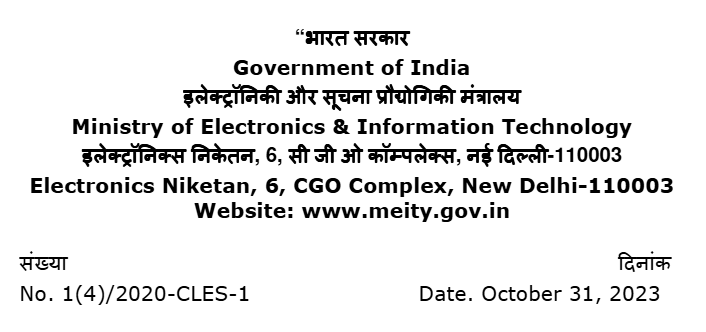
i. Respondent No. 2 - Ministry of Electronics and Information Technology’s Office Memorandum dated 31.10.2023 bearing No. 1(4)/2020-CLES-1.
(Annexure-C)
ii. Respondent No. 3 - Ministry of Home Affairs’ notification dated 13.03.2024 bearing F. No. 22003/21/2019-I4C.
(Annexure-D)
iii. Respondent No. 5 - Ministry of Defence’s notification dated 24.10.2024 bearing F. No. A/34514/MI-10.
(Annexure-E)
iv. Respondent No. 6 - Ministry of Railways’ notification dated 24.12.2024 bearing F. No. 2024/PR/13/63.
(Annexure-F)
v. Respondent No. 4 - Ministry of Finance’s notification dated 06.01.2025 bearing F. No. N-24015/3/2024-Computer Cell.
(Annexure-G)
vi. Respondent No. 7 - Ministry of Heavy Industries’ office order dated 09.11.2023 bearing No. 11-B-12025/28/2014-IT CELL.
(Annexure-G1)
vii. Respondent No. 8 - Ministry of Rural Development’s draft notification dated 05.03.2025.
(Annexure-G2)
viii. any actions taken pursuant thereto.”
2. Sans details, facts in brief, germane are as follows:
2.1. The petitioner, X Corp, formerly known to the world as Twitter, now reconstituted under a new appellation, is a social media Company based out of United States of America having headquarters in Texas. Twitter was founded in 2006 and becomes a popular platform for microblogging and real time information sharing. In April, 2022 twitter was acquired, by a another Company and re-christened as ‘X Corp’. It is claimed to be having a physical contact address in India, at Bengaluru. It is before the Court seeking the afore-noted/quoted prayers.
2.2. On 09-06-2000 the Indian Parliament enacts the Information Technology Act, 2000 (‘IT Act’ for short). In terms of Section 79 of the said Act, certain network service providers had exemption, a safe harbour from liability for third party content. In 2009, the Parliament enacts Information Technology (Amendment) Act, 2008 (‘IT Amendment Act, 2008’ for short), which added Section 69A to the original enactment of 2000, and substituted Sec




An indispensable Tool for Legal Professionals, Endorsed by Various High Court and Judicial Officers
Please visit our Training & Support
Center or Contact Us for assistance

Scan Me!
India’s Legal research and Law Firm App, Download now!


For Daily Legal Updates, Join us on :



 Back to top


