1. Dispute over entitlement to statutory retrenchment benefits under the Employment (Termination and Lay-off Benefits) Regulations 1980 following employer-initiated termination due to financial distress. (Para 3 , 10 , 12 , 14 , 17 , 20 , 21 )
 Back
Next 



2026 MarsdenLR 531
HIGH COURT MALAYA MELAKA
SURIA KUMAR DJ PAUL, J
DURATION ENGINEERING SDN BHD – Appellant
Versus
MOHD FAZDLI MOHD RADZI & ORS & ANOTHER CASE – Respondent
[Civil Appeal Nos: MA-16-8-05/2024 & MA-16-21-08/2024]
Important Points
Signing an employer-initiated termination notice does not constitute voluntary resignation under the Employment (Termination and Lay-off Benefits) Regulations 1980. Employees engaged in manual labour are entitled to statutory retrenchment benefits regardless of whether they are paid monthly or the specific amount of their wages.
Subject
Employment Law - Retrenchment and Termination Benefits
Act Referred
Employment Act 1955: S.69, S.2(1), S.7, S.7A, S.13(2), S.14(3)
Employment (Termination and Lay-off Benefits) Regulations 1980: R.3, R.4, R.6, R.5, R.3(2), R.4(1)(c)
Employment (Termination and Lay-off Benefits) Regulations 1980: R.3, R.4, R.6, R.5, R.3(2), R.4(1)(c)
Headnote
(A) Employment Act 1955 - Sections 2(1), 7, and 69 - Employment (Termination and Lay-off Benefits) Regulations 1980 - Regulations 3, 4, and 6 - Claim for retrenchment benefits - Whether employees who signed acceptance of termination notices and received partial payments are precluded from claiming statutory termination benefits - Regulation 4(1)(c) excludes employees who voluntarily terminate their employment; however, where the employer initiates termination due to financial constraints, signing the notice does not constitute voluntary resignation (Paras 41-44) - Distinction between termination benefits under Regulation 4 and lay-off benefits under Regulation 5; monthly-rated employees remain entitled to termination benefits (Paras 53-56) - Voluntary Separation Scheme (VSS) requires a structured process including prior notice and employee application; termination simpliciter cloaked as a VSS does not preclude statutory claims (Paras 68-71) - Entitlement to benefits under Regulation 3(2) provided employment was for not less than twelve months (Para 82) - Definition of "employee" under the 1st Schedule of the Act - Determination of "manual labour" involves a flexible approach based on actual job functions rather than wage levels (Paras 97-98).
(B) Appeal - Scope of intervention - Appellate Court should not disturb a trial court's finding unless the decision is "plainly wrong" or perverse, meaning no reasonable judge could have reached such a conclusion based on the evidence (Para 25).
Facts of the case:
An employer facing severe financial distress terminated several employees by issuing termination notices following a town hall meeting. The employees signed the notices, accepting the termination and the offered final payments. Subsequently, the employees claimed that the payments were less than the statutory retrenchment benefits due under the Employment (Termination and Lay-off Benefits) Regulations 1980. The Labour Court awarded the difference in benefits. The employer appealed the award on several grounds, including that the employees had voluntarily accepted the termination and were not manual labourers.
Findings of Court:
The court found that the termination was initiated by the employer, not the employees, and thus did not fall under the exception of voluntary resignation. The exercise did not meet the criteria of a Voluntary Separation Scheme. The evidence did not prove the business had closed entirely, only that operations ceased due to financial difficulty. Furthermore, the respondents' job functions involved manual labour, qualifying them as "employees" under the 1st Schedule of the Employment Act 1955.
Issues: Whether the respondents were precluded from claiming benefits by signing the termination notices; whether monthly-paid employees are entitled to termination benefits; whether the termination constituted a VSS; and whether the respondents qualified as employees engaged in manual labour.
Ratio Decidendi: The court ruled that signing an employer-issued termination notice is not a voluntary resignation under Regulation 4(1)(c). Statutory termination benefits are distinct from lay-off benefits and apply to monthly-rated employees. A VSS must be a genuine voluntary process, not a forced termination. The status of an employee engaged in manual labour is determined by the nature of the work performed, not the salary amount.
Result: Appeals dismissed with costs.
Legal Category Hierarchy
Petitioner Advocates:Allen Miranda Emmanuel,Suraiya Mohd Arif Suraiya Arif ,Respondent Advocate: Mathan Anandaram
Table of Contents
2. Whether employees are precluded from benefits by signing termination acceptance, their status as monthly-paid staff, the nature of the scheme as VSS, business closure, or manual labor status. (Para 34 , 35 , 49 , 58 , 74 , 85 , 86 )
3. The court found the termination was employer-initiated, the scheme was not a valid VSS, and the employees' roles constituted manual labor under the Act. (Para 41 , 42 , 43 , 44 , 53 , 56 , 65 , 66 , 68 , 69 , 70 , 83 , 89 , 90 , 91 , 92 , 93 , 94 , 98 )
4. Statutory termination benefits apply when employment is terminated by the employer, provided the employee meets the statutory definition of an employee, regardless of signed acceptance of lower payments. (Para 41 , 70 , 95 , 98 )
6. Does an employee's signature on a termination notice accepting the offered payment constitute a voluntary termination under Regulation 4(1)(c)?
No. Regulation 4(1)(c) applies only when an employee chooses to resign. If the employer initiates termination due to financial constraints and issues the notice, it is not a voluntary termination, even if the employee signs the notice to signify acceptance. (Para 41 , 42 , 43 , 44 )
7. When does a termination exercise constitute a Voluntary Separation Scheme (VSS) that precludes further claims for statutory benefits?
A VSS requires a proper process, including prior notice of the intended scheme, an invitation for employees to apply, and adequate briefing. A town hall meeting followed by termination notices is merely termination simpliciter cloaked as a VSS. (Para 65 , 66 , 68 , 69 , 70 )
8. How is the term manual labour interpreted to determine if a person is an employee under the Employment Act 1955?
The court adopts a flexible, non-rigid approach. If the evidence of the job scope demonstrates the performance of manual tasks, the person qualifies as an employee engaged in manual labour, regardless of their wage level. (Para 88 , 89 , 90 , 91 , 92 , 93 , 94 , 97 , 98 )
9. Does the cessation of operations due to financial difficulty exempt an employer from paying statutory termination benefits?
No. To preclude benefits based on business closure, the employer must prove the business has closed down entirely. Ceasing operations due to financial difficulty does not necessarily equate to a total closure of the business. (Para 83 )
JUDGMENT
Introduction
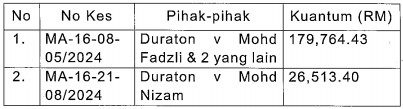
[1] There are two (2) appeals before me arising from the awards made by the Labour Court in each of these appeals.
[2] The appellant company was the employer of all the respondents in both the appeals.
[3] Both appeals concern the respondent/employees of the appellant company's claim for retrenchment benefits.
[4] The issues raised in both appeals are similar.
[5] Given such circumstances, the parties agreed that both appeals would be heard together.
[6] Parties will be referred to as the appellant and respondents hereinafter.
Background Facts
[7] The appellant company is part of the KNM Group of Companies and is listed on the Bursa Malaysia.
[8] The KNM Group experienced a serious financial problem. It was issued with a Practice Note 17 (PN17) by Bursa Malaysia. However, it is not clear from the evidence adduced by the appellant when it started experiencing financial problems
[9] According to the appellant company, it was in debt in the sum of RM1,200,000,000.00 owed to some 400 creditors and Court proceedings were commenced against them by the creditors.
[10] The appellant further contended that their business was so bad that it had to cease business and carry out a redundancy exercise for its employees. The exercise was termed by the appellant as a "tawaran pemberhentian kerja".
[11] What transpired next was that the representatives of the appellant company, including the Chief Executive Officer, held an online town hall meeting with the respondents on 23 November 2023 using "Microsoft Teams". During the meeting, the appellant explained to the respondents that they were in a dire financial situation.
[12] Subsequently, on 29 November 2023, each of the respondents received a Termination Notice from Sivaraj a/l Manikam, who is in charge of the appellant's Human Resources and Internal Audit, explaining that their services would be terminated and detailing the amounts they would receive from the retrenchment exercise.
[13] These termination notices to all the respondents were in a standard format.
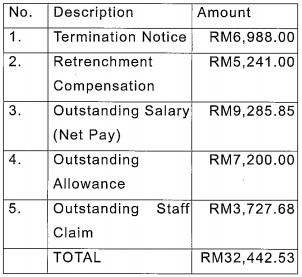
[14] The sums of money to be paid to each of the respondents in respect of the Termination Notice (No 1), Retrenchment Compensation (No 2), Outstanding Salary (No 3), Outstanding Allowance (No 4), and Outstanding Staff claims (No 5) stated in the notice differed. This notice also stated that the employee's employment would be terminated with effect from 30 November 2023.
[15] It must be noted that the termination notices to all the respondents were dated on 30 November 2023, but they were handed over to them a day earlier on 29 November 2023. For easy reference, a sample of this termination notice issued to the 1st Respondent in Appeal No 8 is produced below:
"Ref No: DESB/HR/1123-038
Date: 30 November 2023
DEAR MR MOHD FADZLI BIN MOHD RADZI,
DE294
The KNM Group of companies (Group) has been facing severe financial distress since November 2021 when the Group defaulted in payment for the Thai Bond guaranteed by Asia Development Bank. The Group is unable to secure any new orders for business continuity since 31 October 2022 due to the company's PN17 status by Bursa Malaysia Securities and has a Restraining Order (RO) from High Court to allow the Group to have a moratorium from creditors' actions.
The Company have explored many options and initiatives to keep the company on-going. Unfortunately, all efforts have been unsuccessful and finally we have no other alternative but to reduce the workforce to ensure the financial stability of the company in the long run.
After reviewing all our options, we have concluded that we must eliminate almost all positions in the Melaka Fabrication Shop (MFS). It is with deepest regret that we wish to inform you that your position as NDT HEAD will be officially terminated with effect from 30 November 2023.
Your severance Termination Notice (No 1) and Retrenchment Compensation (No 2) amounting RM12,229.00 will be paid immediately within the next 7 days. However due to financial constrain