FORM I do hereby certify that I have examined A B, a candidate for employment in the ................... Department, and cannot discover that he has any disease, constitutional affection or bodily infirmity except...........I do not consider this a disqualification for employment in the Office of............. A B's age is according to his own statement X years and by appearance Y years. A B has been re-vaccinated/
S.1[Rule 13A New recruits shall produce a form for Service and Payroll Administrative Repository for Kerala (SPARK) in Form No. 15, duly filled up at the time of joining duty for registering their details.]
S.Rule 14 Unless in any case it be otherwise distinctly provided, the whole-time of an officer is at the disposal of the Government which pays him and he may be employed in any manner required by proper authority, without claim for additional remuneration, whether the services required of him are such as would ordinarily be remunerated from the General Revenues of India or of the States or the Revenues of a Local Fund or from the funds of a body, incorporated or not, which is wholly or substantially owned or controlled by the Government.
1[Note 1.- Every officer must attend the office punctually. For every three days' late attendance without permission, an officer will forfeit a day's casual leave for which he is eligible. The computation of the forfeiture of a day's casual leave will be with respect to the calendar year and late attendance without permission for less than three days at the end of a calendar year will be ignored.
Note 2.- No other kind of leave exc
S.1[Rule 14A The period of unauthorised absence of an officer on account of participation in strike shall be treated as "dies-non". During the period of "dies-non", he shall not be eligible for pay and allowances and the period shall not be counted for admissibility of earned leave. However, such period shall be counted for the purposes of increment and half pay leave, notwithstanding anything contained in any other rules in this part.]
S.Rule 15 (a) Two or more Officers cannot be appointed substantively to the same permanent post at the same time.
(b) An Officer cannot be appointed substantively, except as a temporary measure, to two or more permanent posts at the same time.
(c) An Officer cannot be appointed substantively to a post on which another Officer holds a lien.
S.Rule 16 Unless in any case it be otherwise provided in these rules, an officer on substantive appointment to any permanent post acquires a lien on that post and ceases to hold any lien previously acquired on any other post.
S.Rule 17 Unless his lien is suspended under rule 18 or transferred under Rule 20 an officer holding substantively a permanent post retains a lien on that post--
(a) while performing the duties of that post;
(b) while on foreign service or holding a temporary post, or officiating in another post;
(c) during joining time on transfer to another post, unless he is transferred substantively to a post on lower pay, in which case his lien is transferred to the new post from the date on which he is relieved of his duties in the old post;
(d) while on leave;
(e) while under suspension; and
(f) while under training.
S.Rule 18 (a) The Government shall suspend the lien of an officer on a permanent post which he holds substantively if he is appointed in a substantive capacity--
(1) to a permanent post outside the cadre on which he is borne, or
(2) provisionally to a post on which another officer would hold a lien had his lien not been suspended under this rule.
(b) The Government may, at their option, suspend the lien of an Officer on a permanent post which he holds substantively, if he is transferred to foreign service or in circumstances not covered by clause (a) of the rule, is transferred, whether in a substantive or officiating capacity to a post in another cadre, and if in any of these cases there is reason to believe that he will remain absent from the original post on which he holds a lien for a period of not less than three years.
1[RULING
The lien of an Officer on a permanent post should not be suspended when he is appointed to a higher post i
S.Rule 19 (a) An Officer's lien on a post may in no circumstances be terminated, even with his consent, if the result will be to leave him without a lien or a suspended lien upon a permanent post.
(b) In a case covered by sub-clause (2) of clause (a) of Rule 18, the suspended lien may not, except on the written request of the Officer concerned, be terminated while the officer remains in Government service; provided that it shall be open to the Competent Authority to refuse consent for the confirmation or retention of an Officer in a permanent post outside the cadre on which he is borne unless he makes a written request that his lien on the permanent post in his parent office should be terminated.
S.Rule 20 Subject to the provisions of rule 21 the Government may transfer to another permanent post in the same cadre the lien of an Officer who is not performing the duties of the post to which the lien relates, even if that lien has been suspended.
S.Rule 21 (a) The Government may transfer an officer from one post to another; provided that, except--
(1) on account of inefficiency or misbehavior, or
(2) on his written request,
an Officer shall not be transferred substantively to, or, except in a case covered by Rule 53, appointed to officiate in a post carrying less pay than the pay of the permanent post on which he holds a lien, or would hold a lien had his lien not been suspended under Rule 18.
(b) Nothing contained in clause (a) of this rule or in clause (18) of Rule 12 shall operate to prevent the transfer of an Officer to the post on which he would hold a lien, had it not been suspended in accordance with the provisions of clause (a) of Rule 18.
Note.- Permanent transfers from a higher to lower scale in anticipation of the abolition of a post are not transfers within the meaning of the above rule.
S.Rule 22 An officer may be required to subscribe to a Provident Fund, a Family-Pension Fund or similar fund in accordance with such rules as the Government may by order prescribe.
Note 1.- An Officer 1[who has entered service before the 19th August, 1976] may, however, opt to subscribe for a policy in the Official Branch of the State Life Insurance instead of the Provident Fund.
2[Note 2.- Officers who are subscribers to the Family Benefit Scheme, going on deputation/foreign service shall continue to subscribe to the Family Benefit Scheme and they themselves shall arrange for effecting recovery and remittance of the amount from their pay.]
S.1[Rule 22A Any person who enters Government service on or after the 19th August 1976 and has not crossed the age of 50 years, shall within a period of 2[one month] from the date of such entry in Government service, subscribe to a policy in the official branch of the State Life Insurance at such rate as may be determined by the Government from time to time and shall continue to subscribe till he ceases to be in Government service.]
Note.- When an employee crosses one pay range to the next higher range, he shall take additional policy within 2 years of his coming to the next higher pay range. But this condition shall not apply to an employee who has attained the age of 45 years at the time of crossing over to the next higher range.
S.1[Rule 22B Any person who enters Government service on or after the 1st day of September, 1984 and has not crossed the age of 50 years, shall within a period of one year from the date of entry in service enrol as a member of Group Insurance Scheme and subscribe to the scheme at such rate as may be determined by Government from time to time and shall continue to subscribe till he ceases to be in Government service.]
2[Note.- Officers who are subscribers to the Group Insurance Scheme going on deputation/foreign service shall continue to subscribe to the Scheme and they shall arrange for effecting recovery and remittance of the amount from their pay.]
S.1[Rule 22C An officer, who wishes to get his prior service, whether provisional or regular, in any department/institution, counted for any service benefit on entering Government service, shall apply for the same before the Competent Authority/Government within a period of five years of the date of his entry in Government service. Under no circumstances, such orders shall be issued by the Competent Authority/Head of Department/Government within a period less than five years before the date of retirement on superannuation:
Provided that an Officer who is already in service, shall be entitled to prefer such claim within two years from the date of effect of this rule, and in which case, the concerned Head of Department and Appointing Authority shall take a decision on the above claim within a period of three years from the date of receipt of the claim or within a period of two years before the date of retirement on superannuation of the officer, whichever is later:
Provided further t
S.Rule 23 (a) Subject to any exceptions specifically made in these rules, an Officer shall begin to draw the pay and allowances attached to his tenure of a post with effect from the date he assumes the duties of that post, and shall cease to draw them as soon as he ceases to discharge those duties. If the charge is transferred afternoon, the transfer does not affect pay and allowances until the next day.
1[Exception.- An Officer deputed for a course of instruction or training which is ordered to be treated as duty, if promoted to a higher post in the regular line during such course of instruction or training may draw the pay thereof, without joining it, the benefit of promotion being given from the date his junior assumes charge of the higher post.]
(b) If, however, the substantive appointment of an officer is changed while he is officiating in an appointment, or if, while so officiating, an Officer is appointed for the first time, to some substantive office, then, provid
S.Rule 24 1[24. Unless the Government in view of the special circumstances of the case, otherwise determine, after five years' continuous absence from duty, an Officer shall be removed from service after following the procedure laid down in the Kerala Civil Services (Classification, Control and Appeal) Rules, 1960] 2[except in cases covered by Rule 24A].
S.1[Rule 24A Notwithstanding anything contained in these rules, if an Officer who availed himself of leave without allowances to take up employment abroad or within the country 2[or for joining spouse] for a total period of 4[five years], whether continuously or in broken periods, does not return to duty immediately on the expiry of the leave, his service shall be terminated after following the procedure laid down in the Kerala Civil Services (Classification, Control and Appeal) Rules, 1960.
Note.- This rule shall have effect from the 16th day of December, 1983 and shall apply to all cases of grant of leave without allowances on or after that date, for taking up employment abroad or within the country, in extension of the, leave already granted or otherwise, and such leave granted before that date shall be reckoned for applying the 3[4[five years] limit.]
S.Rule 25 Except in the case of Personal Pay granted in the circumstances defined in Rule 12(26)(a), the pay of an Officer shall not be so increased as to exceed the pay sanctioned for his post without the sanction of Government.
S.Rule 26 When an officer is treated as on duty under Rule 12(7)(iii), the Government may, at their option, authorise payment to him of the pay of his substantive appointment or of any lower rate of pay which they may consider suitable, provided that the pay admissible may, if the Government so direct, be instead of either of the rates just specified, the pay of any officiating appointment which the Officer would have drawn but for undergoing such training, subject however to the condition that this rate of pay shall not be allowed for a period longer than that for which the Officer would have held the officiating appointment had he not been placed on such a course of training.
Note 1.- A reservist of the Defence Services in the employment of the State Government, when called up for periodical training, receives the pay and allowances to which he is entitled under the Defence Services. He will also receive the excess, if any, of his pay under the Government over the pay under De
S.Rule 27 Rules 28 to 37 apply to time-scales of pay generally. They do not, however, apply to any time-scale sanctioned by the Government in so far as they are inconsistent with terms specially so sanctioned for such time-scale.
S.Rule 28 The initial substantive pay of an Officer who is appointed substantively to a post on a time-scale of pay is regulated as follows:--
If he holds a lien on a permanent post or would hold a lien on such a post had his lien not been suspended, he will draw as initial pay the stage of the time-scale next above his substantive pay in respect of the old post:
1[Provided that except in cases of re-employment after resignation or removal or dismissal from public service, if he either has previously held substantively or officiated in (i) the same post, or (ii) a permanent or temporary post on the same time-scale, or (iii) a permanent post on an identical time-scale or a temporary post (including a post in a body, incorporated or not, which is wholly or substantially owned or controlled by the Government) on an identical time-scale then the initial pay shall not, except in cases of reversion to the parent cadre governed by item (iii) above be less than th
S.1[Rule 28A Notwithstanding anything contained in these rules, where an Officer holding a post in a substantive, temporary or officiating capacity is promoted or appointed in a substantive, temporary or officiating capacity to another post carrying a higher time- scale of pay, his initial pay in the higher time-scale of pay shall be fixed at the stage next above the pay notionally arrived at in the lower time-scale of pay by increasing the actual pay, drawn by him in the lower time-scale by one increment. 2[8[A refixation of pay will be allowed whenever there is a change of pay in the lower time-scale.]
The competent authority shall incorporate in the promotion order a provision to the effect that the officer shall exercise option within one month from the date of order of promotion or of taking charge in the promoted post whichever is later. The option under this rule shall be in 9[Form No. 18]]:
Provided that the provisions of this rule sha
S.Rule 29 The initial substantive pay of an Officer who is appointed substantively to a post on a time-scale of pay which has been reduced for reasons other than a diminution in the duties or responsibilities attached to posts thereon and who is not entitled to draw pay on the time-scale as it stood prior to reduction, is regulated by Rule 28.
S.Rule 30 The holder of a post, the pay of which is changed, shall be treated as if he were transferred to a new post on the new pay; provided that he may at his option retain his old pay until the date on which he has earned his next or any subsequent increment in the old scale, or until he vacates his post or ceases to draw pay in that time-scale. The option once exercised is final.
Note 1.- This rule applies to an officiating holder of a post as well. But any break in the officiating period such as that due to transfer to another post, or non-employment would operate as vacating of the post and the pay during a subsequent officiating period in the same post will be fixed only as if the officer was then appointed to the new scale of pay. 'The holder of a post' occurring in this rule applies also to a person who is not actually holding the post, the pay of which is changed, provided he has a lien or a suspended lien on that post.
The words 'his old pay' in the proviso of
S.Rule 31 An increment shall ordinarily be drawn as a matter of course unless it is withheld. An increment may be withheld from an officer by the Government or by any authority to whom the Government may delegate this power under rule 9 if his conduct has not been good or his work has not been satisfactory. In ordering the withholding of the increment, the withholding authority shall state the period for which it is withheld and whether the postponement shall have the effect of postponing future increments.
[Note 1.- An officer shall not be eligible for an increment unless he has acquired the obligatory departmental test qualifications, if any, prescribed by Government from time to time to earn the increment.]
This amendment shall be deemed to have come to force with effect from 1st November, 1959. [G.O. (P) 518/63/Fin., dated 6th September 1963].
[Note 2.- A Competent Authority may order the deferring of the increment of an officer, pending investigat
S.Rule 32 Where an efficiency bar is prescribed in a time-scale, the increment next above the bar shall not be given to an officer without the specific sanction of the authority empowered to withhold increments.
Note 1.- On each occasion on which an officer is allowed to pass an efficiency bar which had previously been enforced against him, he should come over to the time-scale at such stage as the authority competent to declare the bar removed, may fix for him, subject to the pay admissible according to his length of service.
Note 2.- The cases of all officers held up at an efficiency bar should be reviewed annually with a view to determine whether the quality of their work has improved and generally, whether the defects for which they were stopped at the bar have been remedied, to an extent sufficient to warrant the removal of the bar.
S.Rule 33 The following provisions prescribe the conditions on which service counts for increments in time-scale:--
(a) All duty in a post on a time-scale counts for increments in that time-scale.
RULING
Periods of service in a post on a time-scale at the same stage of pay only will count for increment in that time-scale.
The above ruling will be deemed to have come into force with effect from 1st November 1959. ([G.O. (P) 235/80/Fin., dated 7th April 1980]).
[(b) (1) Service in another post other than a post carrying less pay referred to in clause (a) of Rule 21, whether in a substantive or officiating capacity, service on deputation and 1[leave except leave without allowances taken otherwise than on Medical Certificate] shall count for increments in the time-scale applicable to the post on which the officer holds a lien as well as in the time-scale applicable to the post or posts, if any, on whi
S.1[Rule 33A The candidates appointed against supernumerary posts created under G O (Ms) No. 174/2012/GAD dated 6th July 2012 for appointment under the Compassionate Employment Scheme shall be granted annual increments, with effect from the first day of the month in which they complete one year duty reckoned with effect from the date of joining in the supernumerary post, subject to satisfaction of the conditions under rule 33. Their pay on regularisation shall be fixed at the same stage as drawn immediately before regularisation. Their subsequent increments shall be regulated as follows:
(i) Where the period of probation is two years, the next two increments after regularisation shall be drawn on the normal increment date and the third increment shall also be drawn on the normal date provided that probation is declared before that date. In the event of declaration of probation after the normal date of increment, the third increment shall be drawn only with effect from the date of effect o
S.Rule 34 The Government may grant a premature increment to an officer on a time-scale of pay.
Note.- In the case of increments granted in advance, it is usually the intention that the officer should be entitled to increments in the same manner as if he had reached his position in the scale in the ordinary course and in the absence of special orders to the contrary he should be placed on exactly the same footing, as regards future increments as an officer who has so risen.
GOVERNMENT DECISION NO. 1
In rule 34 of Kerala Service Rules, Part I, it is laid down that Government may grant a premature increment to an officer on a time-scale of pay without prejudice to his normal increment. At present there is no ruling or Government decision as to the circumstances under which the rule regarding the grant of advance increments could be invoked in individual cases.
2. Good Service Entries and Incentive Awards are possible variants to advance incr
S.Rule 35 The authority which orders the transfer of an officer as a penalty from a higher to a lower grade or post may allow him to draw any pay, not exceeding the maximum of the lower grade or post which it may think proper:
1[Provided that the pay allowed under this rule shall not exceed the pay which he would have drawn under Rule 28 read with clause (b) or clause (c) as the case may be, of Rule 33.]
S.Rule 36 If an officer is, on account of misconduct or inefficiency, reduced to a lower grade or post or to a lower stage in his time-scale, the authority ordering such reduction shall state the period for which it shall be effective and whether on restoration, it shall operate to postpone future increments, and, if so, to what extent.
RULING
1. Every order passed by a competent authority imposing on a Government servant the penalty of reduction to a lower stage in a time-scale should indicate:--
(i) The date from which it will take effect and the period (in terms of years and months) for which the penalty shall be operative.
(ii) The stage in the time-scale (in terms of rupees) to which the Government servant is reduced, in the following form:--
"The.....................................has decided that Sri.........................should be reduced to a pay of Rs.................for a period of........
S.Rule 37 (a) Subject to the provisions of Rules 33(c) and 39, an officer holding a permanent or officiating post, if appointed to officiate on a higher time-scale of pay, will draw as initial pay the stage next above his pay in the lower time-scale irrespective of whether the pay in the lower time-scale is a stage in the higher time-scale or not. 1[A refixation will be allowed whenever there is a change of pay in the lower time-scale, i.e., when his pay therein becomes equal to or greater than the pay which he draws in the higher time-scale.]
This amendment shall be deemed to have come into force with effect from 16th June, 1966.
6[(b) In the case of officiating appointments from a higher time scale of pay to a lower time scale of pay, by direct recruitment, the officer's officiating pay in the lower time scale shall be fixed at the minimum of the scale of pay of the new post without considering his pay in the higher time scale except in the ca
S.1[Rule 37A Notwithstanding the provisions contained in these rules, the pay of a Government servant whose promotion or appointment to a post is found to be or to have been erroneous, shall be regulated in accordance with any general or special orders issued by the Government in this behalf.]
GOVERNMENT DECISION
The following provisions shall govern the pay and increments of a Government servant whose promotion or appointment in a substantive or officiating capacity to a post is later found to be erroneous on the basis of facts:--
1. The orders of promotion or appointment of a Government servant should be cancelled as soon as it is brought to the notice of the appointing authority that such a promotion or appointment has resulted from a factual error and the Government servant concerned should, immediately on such cancellation, be brought to the position which he would have held but for the incorrect order of promotion or appointment.
S.1[Rule 37B (a) A Probationer in any service shall draw initial pay as follows:--
(i) while undergoing a course of instruction or training the pay, if any, specified in the 'Special Rules' in that behalf or by special orders of Government, and the time-scale of the probation post.
(ii) after completion of the course of instruction or training and when there is no course of instruction or training, the minimum of the time-scale of the probation post.
(b) (i) A probationer whose period of probation is two years and whose increment is annual shall be entitled to draw the first increment in the time-scale of the probation post after putting in the service required to earn an increment. The second increment shall be drawn only with effect from the date from which he is declared (ii) after completion of the course of instruction or training and when there is no course of instruction or training, the minimum of to have completed his probat
S.Rule 38 When an officer officiates in a post, the pay of which has been fixed at a rate personal to another officer the Government may permit him to draw pay at any rate not exceeding the rate so fixed or, if the rate so fixed be a time-scale, may grant him initial pay not exceeding the lowest stage of that time-scale and future increments not exceeding those of the sanctioned scale.
S.Rule 39 The Government may in individual cases fix by special order the pay of an officiating officer at an amount less than that admissible under these rules.
S.Rule 40 The Government may issue general or special orders allowing acting promotions to be made in place of officers who are treated as on duty under Rule 12(7)(iii).
Note.- Acting arrangements may be allowed by Competent Authority if the period of training of an officer is one month or more. If it is less than a month, no arrangements can be made except under the special sanction of Government.
GOVERNMENT DECISION
In the case of deputation of a Government servant for training or a course of instruction which is treated as duty under rule 12 (7) (iii). Part I, Kerala Service Rules it is not necessary to create a new post in order to accommodate him during such training or course of instruction, since the very order sanctioning the deputation for training would be a sanction in this behalf.
This Government Decision shall be deemed to have take with effect from 2nd September 1964. ([G.O. (P) 632/64/Fin., dated 2nd September 1964]).
S.Rule 41 Personal Pay.--Except when otherwise ordered by Government personal pay shall be reduced by any amount by which the recipient's pay may be increased and shall cease as soon as his pay is increased by an amount equal to his personal pay.
S.Rule 42 Pay of temporary posts.--When a temporary post is created which may have to be filled by a person not already in Government service, the pay of the post shall be fixed with reference to the minimum that is necessary to secure the services of a person capable of discharging efficiently the duties of the post.
S.Rule 43 When a temporary post is created which will probably be filled by a person who is already in the service of Government its pay should be fixed with due regard to --
(a) the character and responsibility of the work to be performed, and
(b) the existing pay of officers of a status sufficient to warrant their selection for the post.
Note.- Temporary posts which by this criterion should be considered as temporary additions to the cadre of a service should be created in the time-scale of the service ordinarily without extra-remuneration. Incumbents of these posts will therefore draw their ordinary time-scale of pay. If the posts involve decided increases in work and responsibility in comparison with the duties of the parent cadre generally, it may be necessary to sanction a special pay in addition.
S.Rule 44 Compensatory Allowances.--Subject to the general rule that the amount of a compensatory allowances should be so regulated that the allowance is not on the whole a source of profit to the recipient the Government may grant such allowances to any officer under its control and may make rules prescribing their amounts and the conditions under which they may be drawn. (For rules made under the above rule see Appendix IV).
1[I. Unless otherwise ordered by Government, a compensatory allowance shall ordinarily, be drawn only by a Government servant actually on duty, but the Authority Competent to sanction leave may in writing permit it to be drawn by the officer on earned leave, if the whole or a considerable part of the expense to meet which the allowance was granted continues to be incurred by him during the leave :
Provided the Government servant certifies that, he continued for the period for which the allowance is claimed, to incur the whole or a considerable part of the expense for w
S.Rule 45 The Government may make rules or issue orders laying down the principles governing the allotment to officers, for use by them as residences, of such buildings owned or leased by it, or such portions thereof, as the Government may make available for the purpose. Such rules or orders may lay down different principles for observance in different localities or in respect of different classes or residence, and may prescribe the circumstances in which such an officer shall be considered to be in occupation of a residence.
S.Rule 46 Fees.--The Government may permit an officer, if it be satisfied that this can be done without detriment to his official duties or responsibilities, to perform a specified service or series of services for a private person or body or for a public body including a body administering a local fund or for another Government and to receive as remuneration therefor, if the service be material, a non-recurring or recurring fee.
Note.- This rule does not apply to the acceptance of fees from private persons by Medical Officers in Government employ for professional attendance which is regulated by separate orders of Government.
S.Rule 47 No officer may undertake work for another Government, or a private or public body or a private person, or accept a fee therefor, without the sanction of the Government.
Note.- Heads of Departments, while forwarding their recommendations in such cases shall unless, the officer is on leave, specifically state whether the work can be undertaken by the officer concerned, without detriment to his official duties and responsibilities.
GOVERNMENT DECISION
In respect of examinations conducted by the Education Department, the Public Service Commission, the University, etc., it is not necessary to accord individual sanction for acceptance of remuneration in every case of Government servant undertaking such work. Any officer of Government, who is called upon to undertake work in connection with the examination, conducted by the following examining bodies, will be permitted to accept such assignment and the remuneration therefor with effect from 1st November
S.1[Rule 48 Unless the Government by special order otherwise direct, one-third of any non-recurring fee exceeding *[Rs.2,000] or one third of any recurring fee exceeding *[Rs.1,250] a year, paid to an officer, shall be credited to the General Revenues.
Note 1.- If any fee to which this rule applies exceeds *[Rs.2,000] non-recurring or *[Rs.1,250] a year recurring one-third of the total amount payable should be credited to the General Revenues, provided that the amount retained by the officer concerned will not, merely owing to the operation of this rule, be reduced below *[Rs.2,000], if non-recurring or *[Rs.1,250] a year if recurring.
Non-recurring and recurring fees should be dealt with separately and should not be added for the purpose of crediting one-third to General Revenues under this rule. In the case of the former, the limit of *[Rs.2,000] prescribed in this rule should be applied in
S.Rule 49 Honoraria.--as remuneration for work performed which is occasional in chThe Government may grant or permit an officer to receive an honorarium aracter and either so laborious or of such special merit as to justify a special reward. Except when special reasons, which should be recorded in writing exist, for a departure from this provision, sanction to the grant or acceptance of an honorarium should not be given unless the work has been undertaken with the prior consent of the Government and its amount has been settled in advance.
GOVERNMENT DECISION NO. 1
The following allowances will be classified as honoraria under this rule:--
1. Overtime Allowance.
2. Allowance given to Wardens and Assistant Wardens of Hostels. ([G.O. (P) 576/63/Fin., dt. 7th November 1963]).
GOVERNMENT DECISION NO. 2
When State Government Officers required to attend the meetings of the Interview Board of the Kerala Public Service Co
S.Rule 50 Fees and Honoraria.--In the case of both fees and honoraria the Sanctioning Authority shall record in writing that due regard has been paid to the general principle enunciated in rule 14 and shall record also the reasons which in his opinion justify the grant of the extra remuneration.
S.Rule 51 Any officer is eligible to receive without special permission.--
(a) the premium awarded for ah essay or plan in public competition;
(b) any reward offered for the arrest of a criminal or for information or special service in connection with the administration of justice;
(c) any reward payable in accordance with the provisions of any Act or Regulation or Rules framed thereunder;
(d) any reward sanctioned for services in connection with the administration of the Customs and Excise Laws;
(e) any fees payable to an officer for the duties which he is required to perform in his official capacity under any special law or by order of Government; and
(f) any remuneration paid by the All India Radio for professional performances in its programmes, such as music drama and the like.
Note.- Sanction of the authorities mentioned below is, however, necessary for a
S.Rule 52 An officer whose duties involve the carrying out of scientific or technical research shall not apply for or obtain, or cause or permit any other person to apply for or obtain, a patent for an invention made by such officer save with the permission of the Government and in accordance with such conditions as the Government may impose.
S.Rule 53 (a) A Competent Authority may appoint an officer to hold substantively or to officiate in two or more independent posts at one time.
**(b) The Competent Authority who appoints an officer to hold or officiate in a second post in addition to his own, will declare whether he officiates in or holds full charge of the additional post or is appointed merely to discharge the current duties. It should also specify in each case the amount of 1[special allowances], if any, to be granted, the amount being subject to the following limits:--
**(1) If an officer is appointed to officiate in a second post and to hold in addition full charge of his own post, he may be allowed to draw the highest pay to which he would be entitled if his appointment to one of the posts stood alone and in addition special allowance which should not exceed 2[[4 per cent of the minimum of the scale of pay of other post with effect from 1st day of February, 2016.]. Th
S.1[Rule 53A The posts in respect of which additional charge arrangements may be ordered shall be as classified below:--
(I) Posts not in the same office, establishment or line of promotion or cadre.-- Where the duties and responsibilities are clearly independent and are eligible for 4[special allowance], e.g., Labour Commissioner, holding charge of the post of Registrar of Co-operative Societies and Joint Secretary to Government holding charge of the post of a Head of Department.
(II) Posts in the same office, establishment or line of promotion or cadre.-- Cases of this nature shall further be divided as follows:--
(a) When the additional post is subordinate to the regular post, 4[special allowance] shall not be admissible, e.g., Superintendent of Police holding charge of the post of Assistant Superintendent of Police or Deputy Superintendent of Police and District Collector holding the charge of the post of Revenue Divisional
S.Rule 54 The pay and allowances of an officer who is dismissed or removed from service cease from the date of such dismissal or removal.
S.1[Rule 55 An Officer under suspension or deemed to have been placed under suspension by an order of the Appointing Authority is entitled to the following payments:--]
2[x x x x] subsistence allowance at an amount equal to 3[the leave salary which the officer would have drawn had he been on leave on half-pay] on the date of suspension; but the benefit of any increase in pay due to increment falling due during the period of suspension will not be admissible during the period, and
2[x x x x].
In addition, he may be granted to such extent and subject to such conditions as the authority ordering his suspension may direct--
(i) Dearness Allowance and Dearness Pay not exceeding the amount admissible as such had he been on leave on leave salary equal to the rate of Subsistence Allowance payable from time to time.
(ii) Any other Compensatory Allowance to which he was in receipt on the date of suspension.
S.Rule 55A 1[x x x x]
S.1[Rule 55B (i). Notwithstanding anything contained in Rule 55, when an officer is placed under suspension while on leave without allowances, he shall not be eligible for any Subsistence Allowance during the period of the leave. On the expiry of the leave if he continues to be on suspension, he shall be entitled to the subsistence allowance. If he is re-instated before the expiry of the leave, he shall continue to be on leave till its expiry, unless the officer otherwise desires.
(ii). In the case of an officer on leave with allowances, the orders of suspension shall have the effect of cancelling the leave for the period of suspension. He shall be entitled to Subsistence Allowance.]
S.Rule 56 (1) When an officer who has been dismissed, removed or compulsorily retired including an officer who has been compulsorily retired under rule 60A, is reinstated as a result of appeal or review or would have been so re-instated, but for his retirement on superannuation while under suspension or not, the authority competent to order reinstatement shall consider and make a specific order--
(a) regarding the pay and allowances to be paid to the officer for the period of his absence from duty including the period of suspension preceding his dismissal, removal, or compulsory retirement, as the case may be,
(b) whether or not the said period shall be treated as a period spent on duty; and
(c) in the case of an officer who was compulsorily retired under Rule 60A and subsequently reinstated, for the recovery of the relevant benefits, if any, already paid to him.
(2) Where the authority competent to order reinstatemen
S.1[Rule 56A (1) Where the dismissal, removal or compulsory retirement of an officer is set aside by a Court of Law and such officer is reinstated without holding any further inquiry the period of absence from duty shall be regularised and the officer shall be paid pay and allowances in accordance with the provisions of sub-rule (2) or sub-rule (3) subject to the directions, if any, of the Court.
(2) Where the dismissal, removal or compulsory retirement of an officer is set aside by the court solely on the ground of non-compliance with the requirements of clause (2) of Article 311 of the Constitution, and where he is not exonerated on merits, the pay and allowances to be paid to the officer for the period intervening between the date of dismissal, removal or compulsory retirement including the period of suspension preceding such dismissal, removal or compulsory retirement, as the case may be, and the date of reinstatement shall be determined by the Competent Authority and the said p
S.Rule 56B (1) When an officer who has been suspended is reinstated or would have been so reinstated but for his retirement on superannuation while under suspension, or has retired from service on superannuation before the conclusion of the disciplinary proceedings against him the Authority Competent to order reinstatement shall consider and make a specific order.
(a) regarding the pay. and allowances to be paid to the officer for the period of suspension ending with reinstatement or the date of his retirement on superannuation, as the case may be; and
(b) whether or not the said period shall be treated as a period spent on duty.
(2) Notwithstanding anything contained in rule 55, where an officer under suspension dies before the disciplinary, or court proceedings instituted against him are concluded, the period between the date of suspension and the date of death shall be treated as duty for all purposes and his family shall be paid the full pay and allow
S.Rule 57 An officer who is detained in custody, whether on a criminal charge or otherwise, for a period exceeding forty-eight hours, or is undergoing imprisonment, shall be deemed to be under suspension with effect from the date of commencement of the detention or imprisonment, as the case may be, and shall not be allowed to draw any pay and allowances during such period of suspension other than any subsistence allowance and other allowances that may be granted in accordance with Rule 55, until he is reinstated in service. An adjustment of his pay and allowances for such periods should thereafter be made according to the circumstances of the case, the full amount being given only in the event of the officer being acquitted of blame or (if the proceedings taken against him were for his arrest for debt) of its being provided that the officer's liability arose from circumstances beyond his control.
This amendment shall take effect from 4th May 1967. [G. O. (P) 266/67/Fin., dated 6t
S.Rule 58 [An officer against whom a criminal charge or a proceeding for arrest for debt is [pending in a court of law] should also be placed under suspension by the issue of specific orders to this effect during periods when he is not actually detained in custody or imprisoned (e.g., whilst released on bail) if the charge made or proceeding taken against him is connected with his position as an officer or is likely to embarrass him in the discharge of his duties as such or [involves moral turpitude unless there are exceptional reasons for not adopting this course.] In regard to his pay and allowances the provisions of the rules above shall apply. [G. O. (P) 266/67/Fin., dated 6th July 1967].
S.Rule 59 Leave may not be granted to an officer under suspension.
S.Rule 60 1[(a) Except as otherwise provided in these rules the date of compulsory retirement of an officer shall take effect from the afternoon of the last day of the month in which he attains the age of 55 years. He may be retained after this date only with the sanction of Government on public grounds which must be recorded in writing, but he must not be retained after the age of 60 years except in very special circumstances.]
2[aa) An Officer in Kerala Judicial Service or the Kerala State Higher Judicial Service shall ordinarily retire when he attains the age of 60 years; but he shall have the option to retire when he attains the age of 58 years. His continuance in service beyond the age of 58 years shall however be subject to review by the High Court as per the provisions of the Kerala Judicial Service Rules and the Kerala State Higher Judicial Service Rules.]
18[(ab) A person appointed as Industrial Tribunal shall retire on supe
S.Rule 60A 1[60A. x x x x]*]
S.SECTION II GENERAL CONDITIONS
S.SECTION III GRANT OF LEAVE
S.SECTION IV COMMUTATION OF LEAVE WITH RETROSPECTIVE EFFECT
S.SECTION V LEAVE SALARY
S.SECTION VI OVERSTAYAL
S.SECTION VII SPECIAL DISABILITY LEAVE
S.SECTION VIII STUDY LEAVE
S.SECTION IX MATERNITY LEAVE
S.1[SECTION IX A CHILD ADOPTION LEAVE
S.1[SECTION IX B PATERNITY LEAVE
S.1[SECTION IX C LEAVE CONNECTED TO INQUIRY INTO SEXUAL HARASSMENT
S.SECTION X HOSPITAL LEAVE
S.SECTION XI LEAVE TO PART-TIME OFFICERS
S.1[SECTION XIA LEAVE TO RADIATION WORKERS
S.1[SECTION XIB LEAVE FOR TAKING UP EMPLOYMENT ABROAD OR WITHIN INDIA
S.1[SECTION XIC LEAVE FOR THE PURPOSE OF STUDY FOR THOSE INELIGIBLE FOR LEAVE UNDER RULE 88 OR RULE 91 OF PART I
S.1[SECTION XID LEAVE FOR JOINING SPOUSE
S.SECTION XII CASUAL LEAVE
S.SECTION XIII PROCEDURE RELATING TO LEAVE
S.Rule 125 Joining time may be granted to an officer to enable him --
(a) to join a new post to which he is appointed while on duty in his old post; or
(b) to join a new post,--
(i) on return from earned leave;
(ii) when he has not had sufficient notice of his appointment to the new post, on return from leave other than that specified in sub-clause (i).
Note 1.- An officer deputed for training will be allowed for the onward and return journeys, the time actually required for the journeys, by the usual mode of conveyance, between the place of training and the station from/to which he proceeds, and the time so taken will be treated as part of deputation period for training.
1[Note 2.- Probationers and approved probationers in one service (including other officiating officers for whom no probation has been prescribed) when appointed to the same or another service by direct recruitment shall be allowed the minimum joining time (i.e., actual j
S.Rule 126 Not more than one day is allowed to an officer in order to join a new post when the appointment to such post does not necessarily involve a change of residence from one station to another. A holiday or Sunday counts as a day for the purpose of this rule. No joining time is admissible in cases where the change of post does not involve an actual change of office.
Note.- A transfer shall be held to involve a change of station only if the distance between the two places is not less than eight kilometres.
S.1[Rule 126A When holiday(s) follow(s) joining time, the normal Joining time may be deemed to have been extended to cover such holiday(s).]
RULING
When officers are transferred while on leave, joining time need be reckoned only from the date following the holiday(s), if any, suffixed to leave with the permission of the leave sanctioning authority unless otherwise directed in the transfer order. [G. O. (P) 38/73/Fin., dated 5th February 1973].
S.Rule 127 The joining time of an officer, in cases involving a transfer from one station to another, is subject to a maximum of 30 days. Six days are allowed for preparation and, in addition, a period to cover the actual journey calculated as follows:--
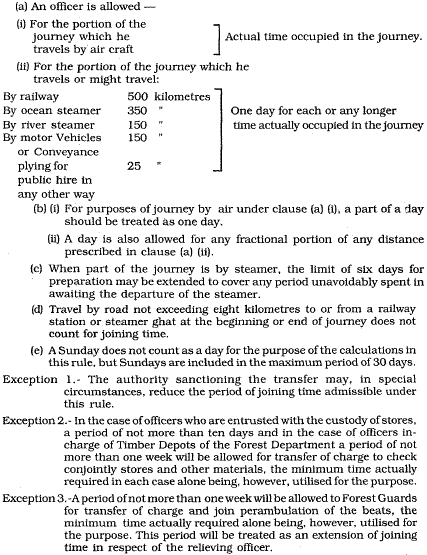
S.Rule 128 Except in the case of a journey performed by air, by whatever route an officer actually travels, his joining time shall, unless a competent authority for special reasons otherwise orders, be calculated by the route which travellers ordinarily use.
GOVERNMENT DECISION
Except in cases of journeys performed by air, which will be covered by the provisions in sub-rule (a) of rule 127, the entitlement to joining time of a Government servant, in cases where his old headquarters and new headquarters are connected by railway, should be calculated as admissible for a journey by railway. [G.O. (P) 52/66/Fin., dated 14th February, 1966].
S.Rule 129 If an officer is authorised to make over charge of a post elsewhere than at its headquarters, his joining time shall be calculated from the place at which he makes over charge.
S.Rule 130 If an officer is appointed to a new post while in transit from one post to another, his joining time begins on the day following that on which he receives the order of appointment.
Note. - A second period of 6 days for preparation should not be allowed in calculating the joining time of an officer who is appointed to a new post, while in transit from one post to another.
GOVERNMENT DECISION
In the case of a Government servant who is transferred from one post to another but whose transfer is subsequently cancelled after he has handed over charge of his old post but before he could take charge of the new post, the period intervening between the date of handing over charge of the old post and taking over the same later on account of cancellation of transfer orders, should be treated as joining time, subject to the provisions of rule 130 and the Note thereunder. [G.O. (P) 461/68/Fin., dated 24th August 1968].
S.Rule 131 If a Government servant takes leave while in transit from one post to another, the period which has elapsed since he handed over charge of his old post must be included in his leave. On the expiry of the leave, the Government servant may be allowed normal joining time.
S.Rule 132 If an officer is appointed to a new post while on earned leave he is entitled to joining time calculated from his old station in addition to the earned leave. Should the officer join the new appointment before the expiry of leave plus joining time admissible, the period short taken should be considered as leave not enjoyed and a corresponding portion of the leave sanctioned should be cancelled without any reference to the authority which granted the leave. When vacation or holidays immediately preceding vacation begin, during or immediately after the expiry of joining time admissible to an officer or when an officer is transferred during vacation, he may be allowed to join at the end of the vacation.
S.Rule 133 The Government may in any case extend the joining time admissible under these rules, provided that the general spirit of the rules, is observed.
S.Rule 134 Within the prescribed maximum of 30 days, the Government may, on such conditions as it thinks fit, grant to an officer a longer period of joining time than is admissible under the rules in the following circumstances:--
(a) when the officer has been unable to use the ordinary mode of travelling or, notwithstanding due diligence on his part, has spent more time on the journey than is allowed by the rules; or
(b) when such extension is considered necessary for the public convenience or for the saving of such public expenditure as is caused by unnecessary or purely formal transfers; or
(c) when the rules have in any particular case operated harshly; as for example, when an officer has, through no fault on his part missed a steamer or fallen sick on the journey.
S.1[Rule 136 A Government servant on joining time shall be regarded as on duty during that period and shall be entitled to be paid joining time pay equal to the pay which was drawn before relinquishment of charge in the old post. He shall also be entitled to Dearness Allowance, if any, appropriate to the joining time pay. In addition, he can also draw compensatory allowances, and house rent allowance as applicable to the old station from which he was transferred. He shall not be allowed Conveyance Allowance or Permanent Travelling Allowance.
Note.- An Officer on transfer is not entitled for joining time unless his transfer is made in the public interest. However, in cases of transfers on request, an Officer shall be paid joining time pay and allowances at the rate admissible under this rule for the period spent in travelling to join the new post and if he could not take charge of the new post on the day on which he is to join consequent on that day being declared a holiday, then, f
S.Rule 137 An officer who does not join his post within his joining time, is entitled to no pay or leave salary after the end of the joining time. Wilful absence from duty after the expiry of joining time may be treated as misbehaviour for the purpose of rule 21.
GOVERNMENT DECISION
The period of overstayal of joining time of an officer may be regularised by granting eligible leave under rule 131, Part I, Kerala Service Rules and the joining time pay regulated under rule 136 (b) ibid.
S.Rule 138 A person, in employment other than Government service or on leave granted from such employment, if in the interests of Government, is appointed to a post under the Government may, at the discretion of Government, be treated as on joining time while he prepares for and makes the journey to join the post under Government and while he prepares for and makes the journey on reversion from the post under Government to return to his original employment. During such joining time he shall receive pay equal to the pay, or in the case of joining time immediately following leave granted from the private employment, to the leave salary paid to him by his private employer prior to appointment to Government service, or pay equal to the pay of the post in Government service, whichever is less.
S.FOREIGN SERVICE
S.SERVICE UNDER LOCAL FUNDS
S.1 Explanatory Note | (This does not form part of the notification, but is intended to indicate its general purport.) | As per G.O. (P) No. 70/2019/Fin dated 20th June, 2019, Government have decided to grant annual increments to the candidates appointed against supernumerary posts created under G.O. (Ms) No. 174/2012/GAD dated 6th July 2012 for appointment under the Compassionate Employment Scheme. In order to give statutory validity to the above said Government order, the Government have decided to amend Part I of the Kerala Service Rules suitably.
The notification is intended to achieve the above object. |
S.Kerala Service (Sixth Amendment) Rules, 2023 All Amendments Incorporated at Appropriate place GOVERNMENT OF KERALA | Finance (Rules-B) Department | NOTIFICATION | G.O. (P) No. 79/2023/Fin Dated, 27th July, 2023 S. R. O. No. 835/2023 Thiruvananthapuram In exercise of the powers conferred by sub - section (1) of section 2 of the Kerala Public Services Act, 1968 (19 of 1968), read with section 3 thereof, the Government of Kerala hereby make the following rules further to amend the Kerala Service Rules, namely:-- RULES
1. Short title and commencement.--(1) These rules may be called the Kerala Service (Sixth Amendment) Rules, 2023.
(2) They shall be deemed to have co
S.Kerala Service (Seventh Amendment) Rules, 2023 All Amendments Incorporated at Appropriate place GOVERNMENT OF KERALA | Finance (Rules-A) Department | NOTIFICATION | G.O. (P) No. 111/2023/FIN Dated, 8th November, 2023
Thiruvananthapuram S. R. O. No. 1194/2023 | | In exercise of the powers conferred by sub–section(1) of section 2 of the Kerala Public Services Act,1968 (19 of 1968), read with section 3 thereof, the Government of Kerala hereby make the following rules further to amend the Kerala Service Rules, namely:-- | RULES | 1. Short title and commencement– (1) These rules may be called the Kerala Service (Seventh Amendment) Rules, 2023.
<
S.Kerala Service (Eighth Amendment) Rules, 2023 All Amendments Incorporated at Appropriate place GOVERNMENT OF KERALA Finance (Rules-B) Department NOTIFICATION | | G.O. (P) No. 113/2023/Fin | Dated, 22nd November, 2023, Thiruvananthapuram | S. R. O. No. 1271/2023 In exercise of the powers conferred by sub- section (1) of section 2 of the Kerala Public Services Act, 1968 (19 of 1968), read with section 3 thereof, the Government of Kerala hereby make the following rules further to amend the Kerala Service Rules, namely:-- RULES 1. Short title and commencement.-- (1) These rules may be called the Kerala Service (Eighth Amendment) Rules, 2023. (2) They shall come into for
S.Kerala Service (Fourth Amendment) Rules, 2025 All Amendments Incorporated at Appropriate place GOVERNMENT OF KERALA FINANCE (RULES B) DEPARTMENT NOTIFICATION | | G. O. (P) No.87/2025/Fin. | Dated, 08th July, 2025 Thiruvananthapuram | S. R. O. No. 823/2025 In exercise of the powers conferred by sub-section (1) of section 2 of the Kerala Public Services Act, 1968 (19 of 1968), read with section 3 thereof, the Government of Kerala, hereby make the following rules further to amend the Kerala Service Rules, namely:-- Rules 1. Short title and commencement.- (1) Thes
S.Rule 3 (i) These rules shall not apply to,--
(a) persons for whose appointment and conditions of employment special provision is made by or under any law for the time being in force;
(b) persons in respect of whose conditions of service, pay and allowances, pension, leave or any of them, special provision has been made by agreement entered into before these rules were made or entered into thereafter in pursuance of the provisions of rule 8:
Provided that in respect of any matter not covered by the provisions special to him, his service or his post, these rules shall apply to any person coming within the scope of clauses (a) and (b) above, to whom but for those clauses the rules would otherwise apply.
(ii) Notwithstanding anything contained in Rule 2 the Government may, by notification in the Gazette, exclude wholly or in part from the operation of these rules any Officer or any class of such Officers to whom the Government shall declare that the rules cannot sui
S.Rule 4 If any doubt arises as to whether these rules apply to any person, the matter shall be referred to the Government and the decision of the Government shall be final.
S.Rule 5 Nothing in these rules or in any rule made thereunder shall operate to deprive any person of any right or privilege to which he is entitled,--
(a) by or under any law, or
(b) by the terms of any contract or agreement subsisting between such person and Government on the date these rules come into force.
S.Rule 6 Subject to the provisions of rule 5, nothing in these rules or any rule made under these rules shall operate to affect to the disadvantage of any person holding a substantive post under Government to whom these rules apply, the conditions of service in respect of pay, leave, allowances, pension or any other matter which are applicable to him,--
(a) on the date these rules came into force, or
(b) by virtue of any order or rule made by the Government, unless such person gives his consent.
S.Rule 7 Where Government are satisfied that the operation of any rule under these rules causes undue hardship in any particular case, the Government may dispense with or relax the requirements of that rule to such extent and subject to such conditions as they may consider necessary for dealing with the case in a just and equitable manner.
S.Rule 8 When in the opinion of the Government, special provisions inconsistent with any of these rules or of any rules made thereunder are required in respect of conditions of service, pay and allowances, leave and pension or any of them, with reference to any particular post, it shall be open to the Government, notwithstanding anything contained in these rules, to provide by agreement with the person appointed to such post for any of the matters in respect of which in the opinion of the Government special provisions are required to be made, and to the extent to which such provisions are made in the agreement, nothing in these rules or in any rules made thereunder shall apply to any person so appointed in respect of any matter for which provision is made in the agreement:
Provided that in every agreement made it shall further be provided that in respect of any matter in respect of which no provision has been made in the agreement, the provisions of these rules or of rules made thereu
S.Rule 9 The Government may delegate to any of its Officers subject to any conditions which it may think fit to impose any power conferred upon it by these rules with the following exceptions:--
(a) power to make rules;
(b) [Deleted];
(c) power to regulate the terms and conditions for grant of Compensatory Allowances;
(d) to determine the standard rent of buildings and the rent recoverable from an Officer occupying the residence;
(e) to remit leave and pension contributions in respect of an officer transferred on foreign service; and
(f) to permit an Officer on foreign service to receive pension or gratuity from foreign employer.
S.Rule 10 No powers may be exercised or delegated under these rules except after consultation with the Finance Department. It shall be open to that Department to prescribe, by general or special order, cases in which its consent may be presumed to have been given.
S.Rule 11 The Government reserve to themselves the power to modify these rules as may from time to time seem expedient and to interpret them in case of doubt.
1[RULING
An Officer's claim to pay and allowances is regulated by the rules in force at the time in respect of which the pay and allowances are earned; to leave, by the rules in force at the time the leave is applied for and granted; and to pension, by the rules in force at the time when the Officer resigns or is discharged from the service of the State.
Persons governed by the Kerala Service Rules who were on leave on the crucial date, i.e., 1st November 1959, the leave having been sanctioned in good faith and availed of from a date prior to 1st November 1959 will be treated to have come over to the leave rules in the Kerala Service Rules on the expiry of the first spell of leave originally sanctioned. Any further extension of such leave after 1st November 1959 should be regulated only in terms of the rules in
S.Rule 12 Unless there be something repugnant in the subject or context, the terms defined in this Chapter are used in the rules in the sense here explained:--
S.Rule 2 Subject to the provisions of Rule 3,--
(i) the rules in Part II relating to Travelling Allowance shall apply to every person in the whole-time employment of the Government (other than a person so employed in the contingent or work establishment);
(ii) the remaining rules shall apply to every person in the whole-time employment of the Government (other than a person so employed in the contingent or work establishment),--
(a) who was not in the service of the Government of Travancore-Cochin or the Government of Madras on 31st October 1956; or
(b) who was in the service of the Government of Travancore-Cochin or the Government of Madras on 31st October 1956 and who continued to be in the service of the Government of Kerala, but has opted to be governed by these rules in accordance with such conditions as may be laid down by the Government in this behalf; or
(c) who was absorbed to Government service on or after 1st November 1956, but who prior to such
S.Rule 1 (i) These rules may be called the Kerala Service Rules.
(ii) The rules in Parts I and II shall be deemed to have come into force with effect from 1st November, 1959 and those in Part III shall be deemed to have come into force from 1st November, 1956.
S.SECTION I EXTENT OF APPLICATION
Legal Commentary on Kerala Service Rules, 1959 Part I (KSR - Part I)IntroductionKerala Service Rules (KSR) Part I (1959) lays down the fundamental conditions of service for government employees in Kerala, including rules on appointment, pay, leave, retirement, and disciplinary proceedings. It forms the foundational legal framework governing service conditions, with provisions that are often supplemented or modified by government orders, statutes, or specific rules applicable to various categories of employees. What does Section SaysSection (or Rule) references in Part I cover a broad spectrum, including:- Definitions and scope of service (Rule 12)- Appointment procedures (Rules 125 onwards)- Leave rules (Rules 125, 126, 128)- Age of superannuation and retirement (Rules 60, 60B)- Disciplinary proceedings and penalties (Rules 15, 16, 17)- Pension and retirement benefits (Rules 26, 62, 68)- Power of the government to relax or modify rules (Rule 7)- Conditions for re-employment and reappointment (Rules 100, 102)- Rules on suspension, recovery, and liability (Rules 3, 3A, 116, 117, 118) Essential Ingredients- Scope and applicability: Rules apply to all government employees unless explicitly excluded.
- Definitions: Clear definitions of terms like 'appointment', 'service', 'pension', 'emoluments'.
- Procedural safeguards: Fair opportunity in disciplinary proceedings, proper notice, and adherence to rules.
- Retirement and pension: Conditions for age of superannuation, counting of qualifying service, and rules for pension calculation.
- Disciplinary and penalty provisions: Fair disciplinary procedures, opportunity to defend, and penalties including withholding or recovery.
- Government powers: Authority to relax, modify, or extend rules under Rule 7.
- Service benefits: Rules on leave, re-employment, and counting of past service for pension.
Scope of SectionThe rules govern:- Appointment, promotion, and seniority- Leave entitlements and conditions- Disciplinary actions and penalties- Retirement, pension, and gratuity- Re-employment of pensioners- Liability and recovery from pension or gratuity- Powers of the government to modify or relax rulesThe scope extends across all categories of government employees, with specific provisions for different service groups, including teachers, judicial officers, and technical staff. Punishment for SectionViolations or non-compliance with these rules can lead to:- Disciplinary action including censure, suspension, removal, or dismissal- Withholding or recovery of pension or gratuity under specific circumstances- Penalties for unauthorized absence or misconduct- Legal consequences for breach of procedural safeguards- Administrative penalties such as reversion or re-employment restrictions Legal Comments"Scope and applicability" - Rules in Part I govern all government employees unless explicitly excluded or overridden by specific statutes or orders. [Note on Rules, Part I, Rule 12; See also sources discussing general applicability] "Fair disciplinary process" - Disciplinary proceedings must follow principles of natural justice, including full opportunity to discredit evidence, especially under Rules 15 and 16 of Kerala Civil Services (CC&A) Rules, 1960. [State of Kerala, Represented By Secretary to Government, Agriculture Department VS P. K. Radhakrishnan] "Retirement age and superannuation" - The rules prescribe 55 years as the default age of retirement, with certain categories eligible for extension up to 60 years, provided they continue in last grade service as per Rule 60B and Rule 12(16A). [01500048472, 01500004872] "Counting of service for pension" - Only qualifying service, as defined by Rules 26, 62, and 12(23), including regular, officiating, or sanctioned service, can be counted for pension; service in leave vacancies or in private institutions generally excluded unless specifically covered. [State of Kerala VS Suresh Bose S. , P. Geetha Padminiaged W/o Shri K. Chandranathan Nair VS State Of Kerala] "Power of government to relax rules" - Rule 7 confers authority on the government to relax or modify rules in cases of undue hardship, which can be exercised with discretion but must be based on proper considerations. [C. K. Subramanian VS State of Kerala, Represented by the Chief Secretary] "Re-employment and reappointment" - Re-employment of pensioners or reappointment to higher posts is governed by specific rules (e.g., Rule 100), and such appointments are usually treated as re-employment, not re-appointment, affecting pension rights. [M. Abdul Salam VS State of Kerala, Represented By Its Principal Secretary to Government, Department of Higher Education, 01500048472] "Liability and recovery" - The authority to fix liability and recover dues from pensioners or employees is vested in the government, but such recovery must adhere to prescribed procedures, including time limits (e.g., Note 3 to Rule 3). [P. Geetha Padminiaged W/o Shri K. Chandranathan Nair VS State Of Kerala, Sainubabeevi. M vs State Of Kerala] "Withholding or reduction of pension" - Pension can be withheld or reduced only under specific circumstances, such as departmental or judicial proceedings, and within time limits (generally three years from retirement). [Balakrishna Pillai VS Asst. Executive Engineer, State of Kerala VS R. Radhakrishnan S/o Late R. Balakrishnan] "Disciplinary proceedings post-retirement" - Proceedings initiated before retirement can impact pension only if they are judicial or departmental and ongoing at the time of retirement; otherwise, they cannot be continued to withhold pension. [Joseph VS State of Kerala, State of Kerala VS R. Radhakrishnan S/o Late R. Balakrishnan] "Service in aided institutions" - Service rendered in aided colleges or schools prior to government service can be reckoned for pension if rules like Rule 14E are satisfied, but only if such service is recognized as qualifying under the relevant rules and statutes. [A. J. JOSEPH, S/O JOSEPH VS STATE OF KERALA, REPRESENTED BY THE PRINCIPAL SECRETARY, FINANCE (EXPENDITURE), State of Kerala, rep. by its Secretary To Government VS T. J. Sarada] "Leave and service counting" - Leave without allowances, especially on medical grounds or for employment abroad, may or may not count towards pension depending on the rules applicable at the time, amendments, and whether such leave was on medical certificate or otherwise. [State Of Kerala VS Sumayamma George, W/o Tomichen P. A, Kaithaparambil, 01500002613] "Vires and constitutionality" - Rules like Rule 29A(A) in Part III KSR denying pension to resigned employees have been challenged as unconstitutional, but courts uphold the rules unless arbitrary or violative of fundamental rights. [E. K. Varghese, Thrissur VS State of Kerala, K. R. Leela Bhai VS Indian Overseas Bank] "Vested rights and amendments" - Amendments to pension rules or service conditions, such as changes in Rule 14E, cannot be retrospective unless explicitly stated, and prior service benefits are governed by the rules in force at the time of service or retirement. [State Of Kerala VS Sumayamma George, W/o Tomichen P. A, Kaithaparambil, N. K. Jayakumar VS National University Of Advanced Legal Studies Represented By Its Registrar] "Service in other states or private institutions" - Service in other states or private aided colleges may be reckoned for pension if specifically included in rules or statutes; otherwise, such service is generally excluded unless recognized by government orders or statutes. [N. K. Jayakumar VS National University Of Advanced Legal Studies Represented By Its Registrar, State of Kerala, rep. by its Secretary To Government VS T. J. Sarada] "Legal principles on delay and limitation" - Challenges to orders like recovery notices or pension reductions after long delay (e.g., 15 years) are barred by principles of delay and laches; courts may refuse to entertain stale claims. [State of Kerala VS Suresh Bose S. , Balakrishna Pillai VS Asst. Executive Engineer] "Role of government orders" - Government orders issued under powers conferred by statutes (e.g., Section 34 of the Road Transport Corporation Act) or rules are binding only if they are within the scope of the powers and comply with procedural requirements. [U. Mohammed, Malappuram District VS State of Kerala, Represented by its Secretary, Thiruvananthapuram, State of Kerala, Represented by the Principal Secretary To Government, High Education Department VS Devayani C. C. , W/o Mohanda Mackenchery] "Vires of rules and statutory orders" - Rules that are inconsistent with constitutional provisions or enacted without proper authority can be challenged as ultra vires, but courts generally uphold rules unless clearly arbitrary or unconstitutional. [K. R. Leela Bhai VS Indian Overseas Bank, Balakrishna Pillai VS Asst. Executive Engineer] "Legal effect of appointment types" - Temporary or provisional appointments, even if on a fixed term, do not automatically confer pension rights unless rules explicitly provide for such benefits; service in such appointments may not be counted unless specifically recognized. [01500048472, N. K. Jayakumar VS National University Of Advanced Legal Studies Represented By Its Registrar] "Protection of service benefits" - Employees who have contributed to and discharged duties in higher or sanctioned posts without misrepresentation are generally entitled to the benefits of such service unless rules specify otherwise. [Rajesh C. S/o. M. Chellan VS Kerala State Road Transport Corporation, rep. by its Chairman and Managing Director, State of Kerala, rep. by its Secretary To Government VS T. J. Sarada] "Vesting of pension rights" - Pension rights are considered vested once the employee completes qualifying service and reaches the age of superannuation, subject to rules and amendments applicable at the time of retirement. [Bini John VS Regional Deputy Director of Collegiate Education, P. Geetha Padminiaged W/o Shri K. Chandranathan Nair VS State Of Kerala] "Judicial review of service rules" - Courts have jurisdiction to examine the vires, reasonableness, and consistency of rules and government orders affecting pension and service benefits, but only within constitutional limits. [Balakrishna Pillai VS Asst. Executive Engineer, N. K. Jayakumar VS National University Of Advanced Legal Studies Represented By Its Registrar]
Note: The references in brackets correspond to the source citations provided, indicating the origin of the legal principles or case law summarized. S.Rule 135 When an officer under the administrative control of the Government is transferred to the control of another Government which has made rules prescribing amounts of joining time, his joining time for the journey to join his post under the Government, and for the return journey will be governed by those rules.
Legal Comments "Scope" - KSR Part I covers general conditions of service, pay fixation, leave, joining time; Part III covers pension; framework applicable across government service and aided institutions with mutatis mutandis application in many cases [Project Officer, Irdp VS P. D. Chacko]. "Disciplinary proceedings" - When retirement precedes or ends investigation, proceedings for recovery must align with Rule 3 Part III KSR; CC&A Rules procedures (Rule 15-16) redirected to Rule 3 Part III for proper governance; ensures natural justice and full opportunity to contradict materials [State of Kerala, Represented By Secretary to Government, Agriculture Department VS P. K. Radhakrishnan]. "Pension admissibility" - Pension rights are protected as property under Article 300A; withholding or recovering pension must follow Rule 3 Part III KSR and Note 3 restrictions; cannot be arbitrary and must follow statutory procedure within three-year horizon for liability fixation post-retirement (Note 3 to Rule 3, Rule 136 interplay) [State of Kerala Represented by Principal Secretary to Government, Finance (Pension-B) Department VS P. V. Pappan, S/o. Vava], [STATE OF KERALA REPRESENTED BY THE ADDITIONAL CHIEF SECRETARY TO GOVERNMENT, HEALTH AND FAMILY WELFARE DEPARTMENT, GOVERNMENT SECRETARIAT, THIRUVANANTHAPURAM VS AJITHA. S W/O. SANTHOSH KUMAR]. "Past service reckoning" - Rule 14E Part III KSR governs counting of pre-entry service in aided schools/colleges; judgments harmonize R.14A/R.2 Part I KSR to count eligible prior service for pension, subject to six conditions and overriding statutory orders; amendments in 2009-2016 have prospective and retrospective implications depending on case and court interpretation [K. Raghavan Nair VS State], [01500052418] (and related 2016/2017 orders in 14E cases). "Aided school/college service" - Whether prior aided school service can count for pension depends on Rule 14E and Statute 5(1) of Kerala University Statutes; courts have allowed counting in many scenarios but with caveats about mobility between aided institutions and seniority in universities; decisions in Joseph/Aid cases set backdrop for subsequent orders [P. GOPALAKRISHNAN NAIR VS KERALA STATE ELECTRICITY BOARD], [K. K. Krishnan Assistant Teacher VS State of Kerala, represented by Secretary To Government], [Jisha P. Jayan VS Sree Sankaracharya University of Sanskrit represented by its Registrar]. "Breaks in service" - For pension qualification, interruptions count if regular service would qualify; amendments to Rule 26 Part III KSR (2009) clarified counting rules for LWA and medical leaves; cases stress that LWA on medical grounds may count, while other LWA may not, depending on Rule 26 and Rule 88/91A interplay [State Of Kerala VS A. Sreelatha, D/o. Dr. C. Sukumaran Nair]. "DCRG vs pension" - Death Cum Retirement Gratuity (DCRG) is treated separately from pension; Rule 3 Part III KSR and Note 3 set timelines for liability fixation; recovery from DCRG post-retirement requires compliance with Rule 3 and ordinary civil remedies; cases hold DCRG can be recovered only through proper process and within three-year window; tribunals modulate based on facts [P. Geetha Padminiaged W/o Shri K. Chandranathan Nair VS State Of Kerala], [STATE OF KERALA VS A. N. SOJAN S/O KESAVAN NARAYANAN], [K. Rajendra Prasad, Regional State Engineer (RETD), Kerala State Housing Board VS State Of Kerala, represented by The Chief Secretary]. "Withholding pension post-retirement" - Rule 3 Part III KSR prohibits continuing disciplinary actions post-retirement that would withhold pension unless proceedings are pending; courts quash post-retirement withholdings if not properly grounded in ongoing proceeding; emphasis on fair process and timely action [Joseph VS State of Kerala], [State of Kerala Represented by Principal Secretary to Government, Finance (Pension-B) Department VS P. V. Pappan, S/o. Vava]. "Senior pay protection and 'sit back' theory" - Promotions/promotions-related seniority disputes in long-tenured promotions are governed by Rule 37A and Appendix XIIA, with sit-back theory allowing protection where delay laches unfairly disturbs settled seniority; decisions uphold stability of long-standing promotions but require careful application of rules to avoid retroactive harms [KERALA STATE ELECTRICITY BOARD REPRESENTED BY ITS SECRETARY, VYDHUTHI BHAVANAM VS P SASIDHARAN ASSISTANT ENGINEER (RETIRED) KERALA STATE ELECTRICITY BOARD]. "Rule 7 relaxations" - Rule 7 Part I KSR grants Government/boards discretion to relax rules in undue hardship cases; Kerala State Electricity Board and similar bodies have exercised this to balance hard cases, subject to due enquiry and hearing; courts require such relaxations be exercised properly and not as arbitrary executive fiat [01300022712]. "Temporary appointments and pension eligibility" - Temporary posts (Rule 9 Part II/III KSR, Rule 62 Part III KSR) can impact pension calculations; courts have held temporary-adjunct appointments can count toward pension if linked to substantive emoluments and continuity rules are satisfied; pension fixation may be allowed on basis of last drawn scale and temporary pay when warranted [State of Kerala VS Suresh Bose S. ]. "Bar service / legal practice" - Sub-rule (a) of Rule 25 Part III KSR allows counting Bar Service for pension in certain cases; Government/orders extended benefits (e.g., G.O. 296/1990) but later judicial clarifications required consistency; disputes illustrate divergence between statutory rule changes and executive orders; final outcomes depend on dates and eligibility criteria [K. K. Krishnan Assistant Teacher VS State of Kerala, represented by Secretary To Government], [Vipin VS State of Kerala]. "Family pension eligibility" - Family pension benefits cannot be arbitrarily withdrawn; Rule 90 Part III KSR provides for family pension and related conditions; courts have held that rights to family pension are protected when eligibility criteria are met and executive orders cannot arbitrarily deny them [C. K. Subramanian VS State of Kerala, Represented by the Chief Secretary], [Shameer Ali. E. , S/o. Ibrahimkutty. A VS Deputy Director of Collegiate Education]. "Pension disbursement delays and interest" - Courts have directed timely disbursement of pension and gratuity, with interest where delayed; constitutional considerations (Article 21, Article 300A) frame the duty to ensure prompt payment; delays may attract interest at court-prescribed rates [State of Kerala Represented by Principal Secretary to Government, Finance (Pension-B) Department VS P. V. Pappan, S/o. Vava], [Vijayan VS Kerala State Electricity Board Ltd. ]. "Recovery from pension/compensation disputes" - Government can seek recovery of pecuniary losses from pension only under Rule 3 Part III KSR; beyond three years, recovery requires civil action or statutory basis; precedents emphasize limitation periods (three years for liability notice post-retirement; 30-year Limitation Act for civil actions) and mandatory opportunities to prove losses in Tribunal/CC&A frameworks [P. Geetha Padminiaged W/o Shri K. Chandranathan Nair VS State Of Kerala], [E. K. Varghese, Thrissur VS State of Kerala]. "Writs and vires challenges" - Kerala courts frequently analyze vires of amendments to Rule 14E, Rule 3, Rule 26; where amendments create prospective implications, courts split on retroactivity; some judgments strike down amendments or parts thereof as ultra vires, while others uphold government orders as consistent with Rule 11 and Rule 20 frameworks [State Of Kerala VS Sumayamma George, W/o Tomichen P. A, Kaithaparambil], [01500053223], [K. K. Baby, S/o Late Mathai Kurian VS Additional Chief Secretary(Finance) Mahatma Gandhi Road]. "Special leave and University overrides" - In cases involving teachers/academia under universities, statutory overrides (UGC norms, Mahatma Gandhi University statutes) may pre-empt certain KSR protections; courts recognize overriding statutes can limit KSR applicability in specific educational contexts [Saji Chacko, S/o. Chacko vs State Of Kerala, Represented By Its Principal Secretary, Higher Education Department], [Jayakumar G VS Kerala Agricultural University]. "Arrears of pension" - Rule 136 Part III KSR and related Treasury guidelines permit relief for arrears beyond three years in deserving cases, but require discretion and careful minding of prior orders, audits, and statutory limitations; justiciability depends on whether the arrears are within permissible discretionary scope and supported by law and prior orders [K. K. Baby, S/o Late Mathai Kurian VS Additional Chief Secretary(Finance) Mahatma Gandhi Road], [STATE OF KERALA REPRESENTED BY THE ADDITIONAL CHIEF SECRETARY TO GOVERNMENT, HEALTH AND FAMILY WELFARE DEPARTMENT, GOVERNMENT SECRETARIAT, THIRUVANANTHAPURAM VS AJITHA. S W/O. SANTHOSH KUMAR]. "Delay defeats equity" - Courts repeatedly emphasize that delays in approaching courts undermine reliefs for pension benefits, especially where substantial delays implicate constitutional protections; timely petitions and reasoned explanations for delay are crucial in pension-related writs [E. K. Varghese, Thrissur VS State of Kerala], [Joseph VS State of Kerala]. "Rule 90(7)(a) / family pension to widows" - Courts have addressed complexities around family pension for Mohammedan widower cases and multi-widow scenarios; while family pension is a statutory benefit, eligibility must satisfy statutory conditions; petitioners who fail to meet conditions face dismissal of claims [Moidu VS State of Kerala ]. "Arrears/pension nexus with private bodies" - For autonomous bodies or universities, Part III KSR provisions are often mutatis mutandis adopted, but overriding statutes and specific statutes for universities or boards may alter pension rights; courts require careful reading of Rules and statutes to determine if KSR or other statutes govern pension parity [Jayakumar S. , S/o. Sreedharan Nair VS State of Kerala, Represented by Its Chief Secretary], [Babu P K VS Chief Engineer Kseb]. "Rule 60(b) – age of superannuation exceptions" - Rule 60(b) grants extended retirement age for officers in last grade service as on 7.4.1970; the benefit is restricted to those still in last grade service; aided-school service may or may not qualify under 60(b) depending on last grade status; strict interpretation often upheld [Project Officer, Irdp VS P. D. Chacko]. "Rule 14E vs 14E(b) amendments" - Amendments to Rule 14E(b) (2009) aimed to regulate counting of past service in private aided colleges; courts have struck down or restricted application prospectively, ensuring that prior service counting aligns with statutory intent and provides fair treatment to pensioners [State Of Kerala VS Sumayamma George, W/o Tomichen P. A, Kaithaparambil], [K. K. Krishnan Assistant Teacher VS State of Kerala, represented by Secretary To Government]. "Rule 3A and post-retirement proceedings" - Rule 3A deals with withholding of pension in criminal/departmental contexts; courts reject post-retirement withholding unless proceedings are pending; need to distinguish DCRG vs pension; decisions emphasize proper sequencing and due process in post-retirement actions [Madhusudhanan S/O. Gopalan VS Kerala State Electricity Board Ltd Vydyuthi Bhavanam, Pattom, Thiruvananthapuram], [K. Chandran VS Secretary, Local Self Government Department]. "Rule 60(b) ambiguity and exceptions" - Courts scrutinize exception clauses (strict interpretation) and avoid reading provisos as broad as to defeat clear eligibility; coherent interpretation ensures neither overreach nor unintended deprivation of pension rights [Project Officer, Irdp VS P. D. Chacko]. "Reliance on statutory orders" - Government orders implementing pension-related benefits (or their denial) must be read consistent with KSR rules; reliance on executive orders without statutory backing can be struck down; tribunals often require reconsideration with due process when orders appear to counter established rules [Sabu Mathew, Headmaster, St. Augustine's High School VS State of Kerala], [E. K. Varghese, Thrissur VS State of Kerala].
Note: The above bullets synthesize core themes and rulings drawn from the listed sources. Where a point could not be supported directly by the provided references, it has been omitted. References are included in square brackets after each bullet as requested.
| | | | |













 AI Assistant





