


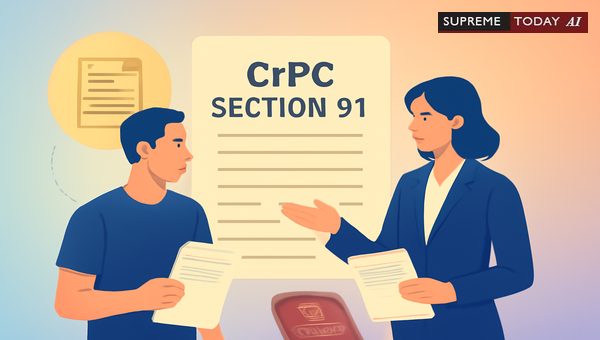
Can an Accused Request Complainant's Passport Copy Under CrPC Section 91?
In criminal trials, access to key evidence can make or break a defense. Imagine you're an accused facing serious charges, and you suspect the complainant's travel history—revealed through their passport—could prove your innocence or challenge their credibility. But can you simply demand a copy of the complainant's passport? The answer hinges on , which empowers courts to summon documents but doesn't grant blanket rights to the accused.
This blog post dives deep into whether an accused can ask for the complainant's passport copy under (often referred to in shorthand), unpacking legal precedents, court discretion, and practical steps. We'll also touch on timing considerations and related passport issues in criminal cases. Note: This is general information based on legal interpretations and should not be taken as specific legal advice. Consult a qualified lawyer for your case.
Overview of : Summoning Documents
allows a court to issue summons for producing any document or thing necessary for investigation, inquiry, trial, or proceedings. However, it's not an unrestricted tool for the accused. Key points include:
- The provision targets documents necessary or desirable for justice. 2016 0 Supreme(HP) 599
- Accused lack an absolute right; they must prove relevance and necessity. Vague or are typically rejected. 2016 0 Supreme(HP) 599 2021 0 Supreme(Mad) 456
- Courts summon only documents in the possessor's control, like a complainant's personal passport. 2021 0 Supreme(Mad) 456 2014 0 Supreme(MP) 1560
As one precedent notes, the accused cannot ask for the production of documents as a matter of right. They must specify the document and show its relevance to the case. 2016 0 Supreme(HP) 599
Legal Precedents: When Courts Grant or Deny Requests
Indian courts have clarified Section 91 through numerous rulings, emphasizing :
- No Right Without Justification: Requests must be specific. Courts reject roving and fishing inquiries. 2016 0 Supreme(HP) 599
- Court's Discretion: Even if relevant, the judge decides based on whether it's essential for a just decision. Failure to demonstrate necessity leads to denial. 2021 0 Supreme(Mad) 456 2013 0 Supreme(MP) 302
- Stage of Proceedings Matters: Critically, applications under Section 91 by the accused are often maintainable only at the defense stage, post-charge framing. The right to seek document production under Section 91 of CrPC arises only at the defense stage, not during pre-charge proceedings. 2024 Supreme(Online)(Del) 30576 In pre-charge scenarios, like framing charges, such requests may be dismissed as premature. 2024 Supreme(Online)(Del) 30576
For instance, in a corruption case involving CBI, the set aside orders for document disclosure under Section 91 before charges, holding it inapplicable at that juncture. 2024 Supreme(Online)(Del) 30576
These principles ensure trials aren't derailed by irrelevant demands while protecting fair access to evidence.
Applying Section 91 to a Complainant's Passport
A passport isn't just travel proof—it's evidentiary gold for residency, alibis, or identity verification. Can an accused invoke Section 91 for it?
- Potential Relevance: If it establishes travel contradicting the complaint (e.g., complainant abroad during alleged incident), it's arguable. The accused must file an application detailing why it's needed for defense. 2016 0 Supreme(HP) 599 2021 0 Supreme(Mad) 456
- Justification Required: A bare request fails. Articulate links, like passport stamps disprove presence at crime scene. Mere curiosity isn't enough. 2016 0 Supreme(HP) 599
However, passports intersect criminal law beyond Section 91:
- or Surrender: Courts often condition bail on surrendering passports to prevent . 2024 Supreme(Online)(KER) 7653 2024 Supreme(Online)(Ker) 67999 In one case, petitioners had to surrender passports or file affidavits confirming none existed. 2024 Supreme(Online)(KER) 7653
- : Adverse PVRs can lead to , but if proceedings haven't reached charge-sheet stage, may be illegal. 2018 0 Supreme(Ker) 743 2018 0 Supreme(Ker) 842
These cases highlight passports' sensitivity, reinforcing why courts scrutinize Section 91 requests closely.
Practical Steps and Recommendations for Accused
To maximize success:
- File a Detailed Application: Specify the passport, its custodian (complainant), and precise relevance. Support with case facts or preliminary evidence.
- Timing is Key: Wait for the defense evidence stage post-charges. Pre-charge applications risk dismissal. 2024 Supreme(Online)(Del) 30576
- Anticipate Objections: Complainant may claim privacy; counter with public interest in justice.
- Prepare Alternatives: If denied, explore for court summoning or .
Be ready for denial if justification falters—courts prioritize efficient trials. 2021 0 Supreme(Mad) 456
Related Contexts: Passports in Criminal Proceedings
Passports frequently appear in bail, discharge, and discharge applications:
- : Bail is the rule, and jail is the exception; conditions for bail must ensure cooperation. Courts mandate passport surrender. 2024 Supreme(Online)(Ker) 67999
- Discharge Stages: At , courts avoid mini-trials, focusing on cases without deep evidence dives. 2023 0 Supreme(All) 165 2022 0 Supreme(Del) 1728
- Certified Copies: Accused have rights to copies of orders, aiding Section 91 prep. 2016 0 Supreme(Mad) 1220
These underscore holistic defense strategies beyond single documents.
Conclusion and Key Takeaways
Under CrPC Section 91, an accused may request the complainant's passport copy, but success demands:- Clear specification and proven relevance. 2016 0 Supreme(HP) 599- Demonstration of necessity for just decision. 2021 0 Supreme(Mad) 456- Appropriate trial stage (defense evidence). 2024 Supreme(Online)(Del) 30576
Courts hold discretion, balancing rights with trial integrity. While passports can be pivotal, vague bids fail.
Key Takeaways:- No absolute right—justify rigorously.- Time applications post-charges.- Use precedents to strengthen pleas.
Disclaimer: Legal outcomes vary by facts and jurisdiction. This overview draws from reported cases like 2016 0 Supreme(HP) 599, 2021 0 Supreme(Mad) 456, 2014 0 Supreme(MP) 1560, and others. Always seek professional legal counsel tailored to your situation.
For more on CrPC procedures, stay tuned to our blog.
#CrPC91 #AccusedRights #IndianLaw












