


at CrPC : What You Need to Know
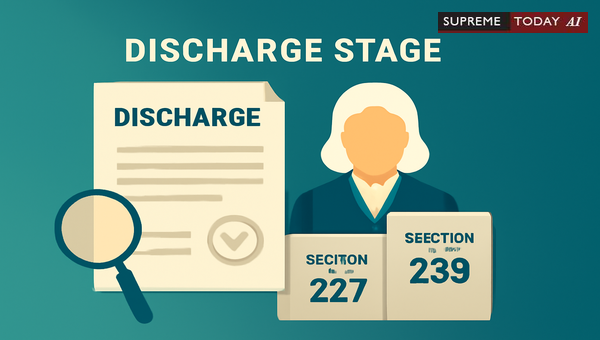
In criminal proceedings, the stage of discharge is a critical juncture where the accused may seek relief if the prosecution's case appears groundless. A common question arises: Whether can be Seen at Stage of Discharge? This query often stems from the defense's desire to introduce public records, such as those obtained via RTI or official entries, to challenge the charges early on. However, Indian courts, guided by the , impose strict limitations to prevent turning this preliminary stage into a full trial.
This blog post delves into the legal framework, judicial precedents, and practical implications, helping you understand when and how factor into discharge applications. Note that this is general information based on established principles and should not be taken as specific legal advice—consult a qualified lawyer for your case.
Legal Framework Governing Discharge
The CrPC outlines clear procedures for discharge, emphasizing a assessment without deep evidentiary scrutiny.
Key Provisions
: In sessions cases, the judge may discharge the accused if, after considering the and documents submitted therewith, there are no sufficient grounds for proceeding. The court hears both parties but assumes the prosecution materials are true 2013 0 Supreme(Del) 840 2021 0 Supreme(Ker) 257.
: For warrant cases on , the magistrate discharges the accused if the charge appears groundless upon reviewing the same materials 2023 0 Supreme(All) 165.
At this stage, the court does not conduct a or assess the of evidence. Instead, it evaluates whether the prosecution's case discloses all ingredients of the offense 2019 0 Supreme(Mad) 460 2018 0 Supreme(Mad) 326.
Defining
hold significant under Indian law. states: any entry made by a public servant in discharge of his official duty or any entry made by a person in discharge of his duties as required under any law in a public register or an official book or a record or electronic record shall be a relevant fact 2022 0 Supreme(Telangana) 723.
This includes certified copies from public records, RTI-obtained documents, and official communications. Courts determine if a document qualifies under , covering records maintained by public authorities 2022 0 Supreme(Telangana) 723. For instance, entries in official registers or electronic records prepared in discharge of public duties are presumed relevant.
However, relevance alone does not guarantee consideration at discharge.
Can Be Considered at ?
Prosecution's Materials Only
The documents reviewed are strictly limited to those submitted by the prosecution with the . The defense cannot introduce new documents, including public ones, to prove innocence 2013 0 Supreme(Del) 840 2016 0 Supreme(Mad) 1724.
In , the clarified: evidence and documents produced by the accused cannot be considered at the stage of charge or summoning, a principle extending to discharge
R. P. G. Transmission Ltd. VS Sakura Seimitsu (I) Ltd. - Dishonour Of Cheque
2018 0 Supreme(Mad) 326. The court focuses solely on whether the prosecution's case, taken at face value, warrants trial.Evaluation
Courts assess only if a case exists—meaning materials reasonably connect the accused to the offense without proving it beyond reasonable doubt 2023 0 Supreme(Ker) 571. Only case is to be seen. Whether case is beyond reasonable doubt is not to be seen at the stage of discharge. of materials on record cannot be gone into 2023 0 Supreme(Ker) 571.
No or weighing of defense evidence occurs. If two views are possible and suspicion is grave but not grave enough, discharge may be granted 2024 Supreme(Online)(Mad) 60208.
Role of from Other Sources
like RTI copies or official letters may qualify if part of the prosecution's record. But the accused lacks the right to summon or submit new ones at this stage 2000 3 Supreme 745 2016 0 Supreme(Mad) 1724. For example, in cases involving public witnesses, courts note what was seen in prosecution statements but ignore defense rebuttals 2022 Supreme(Online)(DEL) 5326.
is deferred: Whether these documents are of relevance or not, will be seen at the time of final hearing and not at the stage when the Court is considering whether to admit the documents or not 2022 0 Supreme(Jhk) 971.
Judicial Precedents and Principles
rulings reinforce these boundaries:- : Bars defense evidence at charge/discharge, preventing mini-trials
R. P. G. Transmission Ltd. VS Sakura Seimitsu (I) Ltd. - Dishonour Of Cheque
.- Discharge applications succeed only if prosecution materials are patently insufficient 2023 0 Supreme(All) 96 2019 0 Supreme(Mad) 460.Lower courts echo this: prepared by officers in discharge of duties (e.g., certified final reports) support prosecution pleas if already on record, with contents presumed correct absent contrary materials 2016 0 Supreme(Ori) 874. Additional evidence applications under are scrutinized similarly, not freely allowed early 2018 0 Supreme(P&H) 3715.
In appeals or joint trials, new documents' relevance is assessed later: Whether these documents are relevant or not, it is not to be seen at this stage 2015 0 Supreme(P&H) 2007.
Practical Implications for the Accused
- Arguments for Discharge: Base them on weaknesses in prosecution documents, not new public records 2023 0 Supreme(All) 96.
- Limitations: No summoning documents to disprove guilt; focus on groundlessness of charges.
- Strategy: Prepare for trial by gathering (e.g., RTI) for later stages, where their full can be argued.
If contradict prosecution claims but aren't on record, raise them post-charge during evidence recording.
Key Takeaways
- Prosecution-Centric: Only and accompanying documents (potentially including public ones) are seen 2013 0 Supreme(Del) 840.
- No Defense Evidence: Accused cannot file new at discharge 2016 0 Supreme(Mad) 1724.
- Standard: Assume prosecution materials true; no 2018 0 Supreme(Mad) 326.
- Scope: Relevant if official/official duty-based, but timing matters 2022 0 Supreme(Telangana) 723.
Conclusion
At the , can be seen only if submitted by the prosecution. This safeguards the process from premature full-scale litigation, ensuring trials proceed on sufficient grounds. While frustrating for the defense, it aligns with CrPC's efficiency goals.
Recommendations:- Anchor discharge pleas in prosecution flaws.- Use RTI/public records strategically for trial.
This overview draws from precedents like and CrPC sections. For tailored advice, engage a criminal lawyer. Stay informed—legal stages matter!
References:
R. P. G. Transmission Ltd. VS Sakura Seimitsu (I) Ltd. - Dishonour Of Cheque
2013 0 Supreme(Del) 840 2023 0 Supreme(All) 96 2019 0 Supreme(Mad) 460 2000 3 Supreme 745 2016 0 Supreme(Mad) 1724 2022 0 Supreme(Telangana) 723 2023 0 Supreme(Ker) 571 2022 0 Supreme(Jhk) 971 #CrPCDischarge #PublicDocumentsLaw #LegalDischargeStage















