Searching Case Laws & Precedent on Legal Query.....!
Analysing the retrieved Case Laws
Scanned Judgements…!



Searching Case Laws & Precedent on Legal Query.....!
Analysing the retrieved Case Laws
Scanned Judgements…!
The court's decision to permit marking the Xerox copy is subject to relevancy and proof at the trial stage, and objections regarding the copy's admissibility can be raised during arguments (see ["2025 Supreme(Online)(KAR) 1153"], ["2022 Supreme(Online)(Kar) 50373"]).
Main Points & Insights
Courts generally permit Xerox copies to be marked as evidence, provided objections are raised and addressed during trial, and the copy is proven to be a true copy made from the original or from a source that establishes its authenticity.
Analysis and Conclusion
References:- ["2022 0 Supreme(AP) 665"]- ["2024 Supreme(Online)(AP) 11052"]- ["2024 0 Supreme(Telangana) 596"]- ["2021 Supreme(Online)(MAD) 12234"]- ["2025 Supreme(Online)(KAR) 1153"]- ["2022 Supreme(Online)(Kar) 50373"]
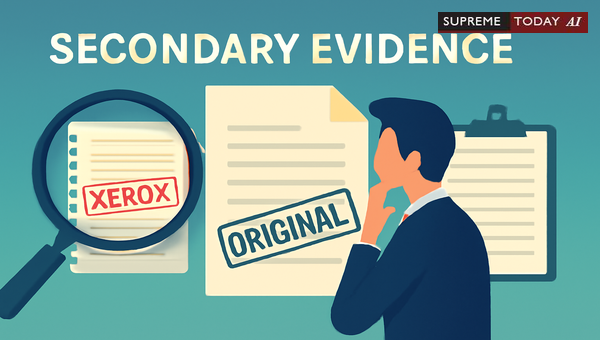
In legal proceedings, documents are the backbone of evidence. But what happens when the is in the possession of the defendant, who flatly denies its existence? Can you rely on a Xerox copy? This is a common dilemma in , governed by the , particularly on . If you're facing this issue—When the is with the Defendant and he is Denying the Existence of the Same, what is the Procedure to be Followed to Mark the Xerox Copy for the Said Document?—this guide breaks it down step by step.
We'll explore the legal foundation, required procedures, key judgments, and practical tips. Remember, this is general information based on established case law and should not replace professional legal advice.
, such as a Xerox or photocopy, is only under specific conditions outlined in of the Indian Evidence Act. The provision allows it when the original is:- Proved to be lost, destroyed, or unavailable.- In the possession of a person legally bound to produce it but who fails to do so after notice.- Not easily movable, or its production is opposed by safety concerns.
Crucially, the party seeking to introduce the Xerox must lay a proper foundation. Mere possession of the copy and the defendant's denial aren't enough. As held in a key judgment, relating to the contents of a document is inadmissible unless the non-production of the original is properly accounted for, such as destruction or loss 2012 8 Supreme 707.
When the defendant holds the original and denies it exists, courts apply strict scrutiny. You can't simply wave a Xerox copy; you must prove:1. Unavailability of the original: Not due to your neglect.2. No fault on your part: The non-production isn't your default.3. Authenticity of the copy: It's a true reproduction.
Failure here leads to rejection. For instance, in one case, the dismissed an application because the respondent/plaintiff is denying the existence of such documents and it is open for the petitioner to mark xerox but without foundation
.
Follow these steps to build a strong case:
Immediately file an application under , supported by affidavits or evidence showing unavailability (e.g., fire, theft, or official reports). State circumstances clearly 2012 8 Supreme 707.
Demonstrate the original is lost, destroyed, or inaccessible beyond your control. The party must show that the is not available in court for reasons beyond their control, such as destruction or loss 2012 8 Supreme 707.
In a , plaintiffs sought to mark a Xerox sale agreement held by defendants, who denied it. The court allowed the application to proceed, noting could be decided later, but emphasized foundation 2015 0 Supreme(Kar) 1231.
Prove it's a true copy via:- Witness testimony on how it was made.- Comparison with original (if possible before loss).- Affidavits or certification.
The Xerox copy must be authenticated as a true copy of the original... showing that the copy was made properly, compared with the original, and that it accurately reflects its contents 2012 8 Supreme 707 2010 0 Supreme(SC) 783. A case clarified: Xerox or photo copy of Memorandum of Understanding will not become , unless it is shown that it is accurate copy of original 2009 0 Supreme(Kar) 617.
Issue notice to produce the original. If denied, use this to argue , but denial alone isn't sufficient without proof of loss. The stressed: cannot be admitted unless the conditions of are satisfied, including proof of loss or destruction and proper authentication 2015 0 Supreme(SC) 688.
The court marks the Xerox as an exhibit subject to proof. Objections can be raised later during evidence. In a , plaintiffs marked a photocopy since the original was with the defendant and attestors deceased, relying on 2023 0 Supreme(Mad) 3044.
Courts consistently reinforce these principles:- Foundation Essential: Mere possession of the Xerox copy and the defendant's denial of the document's existence are insufficient; a proper foundation must be laid 2012 8 Supreme 707 2010 0 Supreme(SC) 783.- Denial Without Admission: When a respondent denies a Will's existence without written admission, xerox copy of said document cannot be marked as as the conditions laid down in ... are not met 2025 Supreme(Online)(Tel) 15765.- Premature Rejection Avoided: Applications shouldn't be dismissed outright; decide on merits 2015 0 Supreme(Kar) 1231.- Proof of Signatures: For documents like Wills, prove attestors' signatures even via photocopy if foundation laid 2023 0 Supreme(Mad) 3044.- Original Signatures Matter: A document with original signatures isn't mere Xerox; treat as original 2022 0 Supreme(Kar) 343.
In another instance, a court rejected a photocopy mark sheet as because the prosecution has not accounted for the original mark sheet nor assigned any reason for non production 2021 0 Supreme(Mad) 2818.
Courts advise: The party intending to mark a Xerox copy should immediately file an application... supported by affidavits, official reports, or other credible evidence 2012 8 Supreme 707.
Marking a Xerox copy when the defendant holds and denies the original demands rigorous compliance with . Success hinges on proving unavailability, no default, and authenticity—backed by solid evidence and case law like 2012 8 Supreme 707 2015 0 Supreme(SC) 688
Key Takeaways:- Lay proper foundation before marking.- Use affidavits and notices effectively.- Authenticate rigorously.- Consult a lawyer for case-specific strategy.
This overview draws from judicial precedents; outcomes vary by facts. Always seek tailored legal counsel.
Disclaimer: This is for informational purposes only and not legal advice.
#SecondaryEvidence, #EvidenceActIndia, #LegalProcedure


Therefore, petitioner/plaintiff filed petition to mark Photostat copy of partition list, dated 01.09.1985 as secondary evidence on his behalf. For which respondent/defendant filed counter before trial Court denying averments in the affidavit of the petitioner. ... Bachu Kistaiah and others 2015 (5) ALT 795, which relied on by learned trial Judge wherein this Court held that question of adducing secondary evidence by produc....

Therefore, the accused-the petitioner herein prayed to dismiss the said Criminal Miscellaneous Petition filed to mark the xerox copy of the original document as secondary evidence. 5. ... the xerox copy as additional evidence does not arise. ... The accused, who is the respondent in the Criminal Miscellaneous Petition, filed counter denying#H....

the Indian Evidence Act and where the document in question appears to be a Photostat copy of its original assessment order, there should be some evidence that this copy was made from its original by the Photostat machine and where no such material is available on the file of the case, the same cannot ... to establish, the loss of the original document, beyond all reason....

Hence, to prove the signature of the attestors, through the phto copy of the Will, they prayed to mark the said document. 7. ... The sum and substance of the submissions of the learned counsel for the defendant is that unless the original Will produced, the proof of the Will can't be decided and that, the question of producing xerox copy does not arise....
sought to be produced by plaintiff, allegedly in possession of Defendant-- Defendant served with notice to produce document -- Defendant denying existence of document – In such circumstances, marking of secondary evidence of said document by plaintiff permissible and within contours of law. ... The Court below dismissed the petition o....

On the other hand, the respondent/plaintiff herein denies the existence of such document. Xerox copy of the said documents is available with his petitioner. ... The trial Court has dismissed the application stating that the respondent/plaintiff is denying the existence of such documents and it is open for the petitioner to mark xerox#....

When there is denial, since there is no admission in writing by respondent No.1 with respect to existence of the Will Deed as well as its contents, xerox copy of said document cannot be marked as secondary evidence as the conditions laid down in Section 65 of Indian ... Bal Reddy and others in CRP No.1846 of 2012 {2017 (1) ALD 624 (TS)} wherein, it is held that when a document #HL_STA....

Permitting the defendant No.1 to mark xerox copy of rectified affidavit dated 21.04.2008, is subject to the objection. The plaintiffs may raise all their objections, including the admissibility of the document, at the time of arguments. ... Since that is the Xerox copy, the plaintiffs have objected the same on the ground that, without comparing the xerox#HL_EN....

Petitioner/defendant No.1 filed a written statement denying the averments made in the suit. ... the said documents. ... to grant permission to mark the said documents. ... , condition or contents of the original. ... No.1/petitioner has produced the xerox copy of the p style="position:absolute;white-space:pre;margin:0;padding:0;top:202pt;left:
the said documents. ... to grant permission to mark the said (f) when the original is a document ... The Trial Court on perusal of the said document expressed opinion p style="position:absolute;white-space:pre;margin:0;padding:0;top

The Trial Court while appreciating the said document wrongly understood the same as a Xerox copy, ignoring the law that any document containing original signature by itself should be treated as original. Coelho was no more alive and she was having custody of the original of Ex.D1, hence nothing could have been done by Defendant No.5 to procure the same as its whereabouts were not known and these facts were conveniently ignored by the Trial Court which resulted in miscarriage ....
At this juncture, it is necessary to refer the judgment of Division Bench of Sikkim High Court in State of Sikkim vs. As righlty pointed out by the learned counsel for the defence, Ex.P.17 is not a down loaded copy and is only a Xerox Copy. But in the case on hand, the prosecution has not accounted for the original mark sheet nor assigned any reason for non production of the original and in that scenario, Xerox copy cannot be received as secondary evidence. The learned trial Judge ha....
The original copy of the agreement of sale is with the second defendant and the plaintiffs have got only Xerox copy of the said document. It is the contention of the plaintiffs that they had also contributed for purchase of the suit schedule property and hence all the children of late K.A. Somaiah are entitled to their respective share in the suit schedule property. In the plaint, it was contended that the mother of the plaintiffs got the suit schedule property as per the agr....
He further submitted that, when the existence of document itself is not proved by the complainant, question of marking of xerox copy as secondary evidence is per se illegal. 7. The learned senior counsel submitted that, such observation was also not warranted.
In view thereof, merely because the Xerox copy of the suit promissory note produced by the revision petitioners may not be containing the signatures of the attestors, it cannot positively be said that the signatures of the attestors were obtained therein subsequently, so unless the person who took the Xerox copy is examined and is subjected to cross-examination by the other side or unless the other side admits that the Xerox copy of a document is the exact replica of the original, it....


An indispensable Tool for Legal Professionals, Endorsed by Various High Court and Judicial Officers
Please visit our Training & Support
Center or Contact Us for assistance

Scan Me!
India’s Legal research and Law Firm App, Download now!


For Daily Legal Updates, Join us on :



 Back to top


