Searching Case Laws & Precedent on Legal Query.....!
Analysing the retrieved Case Laws
Scanned Judgements…!



Searching Case Laws & Precedent on Legal Query.....!
Analysing the retrieved Case Laws
Scanned Judgements…!
Unregistered and unstamped documents - Generally inadmissible in evidence for any purpose, including collateral purposes, unless specific conditions are met ["2016 Supreme(Online)(Mad) 25"], ["2024 0 Supreme(Mad) 2518"], ["2023 0 Supreme(Raj) 1462"].
Collateral purpose - Such documents can sometimes be looked into for collateral purposes like establishing possession, boundaries, or severance, provided the necessary stamp duty is paid and the document is not inherently inadmissible under law ["2016 Supreme(Online)(Mad) 25"], ["2024 0 Supreme(Mad) 2598"], ["2025 0 Supreme(Mad) 5108"], ["2022 0 Supreme(AP) 392"], ["2007 0 Supreme(Mad) 2204"], ["2017 Supreme(Online)(Chh) 403"].
Legal position on collateral purpose - The law permits reliance on unregistered or unstamped documents for collateral purposes if the document is duly stamped or if the provisos of the Stamp Act are satisfied. The Supreme Court and various High Courts have clarified that while such documents are generally inadmissible for primary purposes, they can be used to demonstrate collateral facts such as possession, boundary, or severance ["2016 Supreme(Online)(Mad) 25"], ["2024 0 Supreme(Mad) 2518"], ["2023 0 Supreme(Raj) 1462"], ["2024 0 Supreme(Mad) 2598"], ["2025 0 Supreme(Mad) 5108"], ["2019 0 Supreme(Mad) 130"], ["2007 0 Supreme(Mad) 83"], ["2022 0 Supreme(AP) 392"], ["2007 0 Supreme(Mad) 1955"], ["2007 0 Supreme(Mad) 2073"], ["2007 0 Supreme(Mad) 2070"], ["2006 0 Supreme(Mad) 3243"].
Payment of stamp duty and registration - For a document to be looked into for collateral purposes, it must either be properly stamped or the conditions under the Stamp Act's provisos are satisfied. Mere observation that a document can be looked into for collateral purposes without addressing stamp duty or penalties is insufficient to justify its admissibility ["2016 Supreme(Online)(Mad) 25"], ["2007 0 Supreme(Mad) 83"], ["2007 0 Supreme(Mad) 1955"].
Specific case law - Courts have consistently held that unregistered documents can be used for collateral purposes such as establishing possession or boundaries, but not for primary rights or title, especially if the document is unregistered and unstamped. The purpose must be fact-specific, and the collateral purpose must be clearly established ["2024 0 Supreme(Mad) 2598"], ["2019 0 Supreme(Mad) 130"], ["2025 0 Supreme(Mad) 5108"], ["2007 0 Supreme(Mad) 2204"].
Analysis and Conclusion:Unregistered, unstamped documents generally cannot be used as evidence for any purpose. However, they may be looked into for collateral purposes—such as determining possession, boundaries, or severance—if the document is duly stamped or the conditions of the Stamp Act are met. The legal framework, clarified by Supreme Court and High Court rulings, emphasizes that such documents are admissible for collateral purposes only and not for establishing primary rights or titles, provided the necessary procedural requirements are fulfilled.
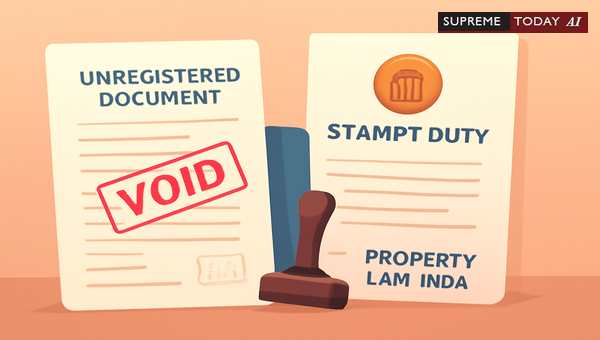
In property disputes, documents like sale deeds or agreements often play a pivotal role. But what happens when a document is unregistered or insufficiently stamped? A common question arises: Can an unregistered sealed document be looked into for in an injection suit? (Note: This likely refers to suits involving property rights, such as ejection or possession disputes.) The short answer is nuanced—generally, no, unless specific conditions like proper stamping and impounding are met. This blog explores the legal principles under Indian law, drawing from key precedents to help you understand admissibility rules.
This is general information based on established case law and statutes like the , and the . It is not specific legal advice—consult a qualified lawyer for your situation.
'' refer to using a document for secondary matters not directly affecting title or rights in immovable property. For instance:- Proving possession or nature of possession.- Establishing the without claiming rights under it.- Showing under .
The proviso to allows unregistered documents (required to be registered under Section 17) to be used for such purposes, but only if they are admissible in evidence. However, admissibility hinges on stamping requirements. As held in 2008 4 Supreme 360, an unregistered document can be used for provided it is properly and the paid. A collateral transaction must be independent or divisible from the main transaction.
Main Legal Finding: An unregistered document, including an unstamped or insufficiently stamped , generally cannot be looked into for unless it is properly and the requisite paid. Simply put, unless duly stamped and registered (if required), it is even for , except in limited cases where is allowed after compliance. 2019 0 Supreme(Raj) 2995 2008 4 Supreme 360 2010 3 Supreme 162
Key precedents emphasize this:- Unregistered documents are for primary purposes (e.g., transferring title), but may be admissible for collateral ones if and stamped. 2008 4 Supreme 360- An unstamped or insufficiently stamped document cannot be admitted even for unless is paid and . 2023 0 Supreme(Raj) 1462 1990 0 Supreme(SC) 723
In 2019 0 Supreme(Raj) 2995, the court clarified: if a document is in evidence for want of registration, none of its terms can be admitted in evidence and that to use a document for the purpose of proving an important clause would not be using it as a collateral purpose. Unless and stamped, it remains .
Several rulings reinforce these principles, particularly in possession disputes:
In 2025 Supreme(Online)(Mad) 69836, the allowed an unregistered sale deed for proving possession, relying on precedents like Bondar Singh. The court noted: an unregistered and unstamped document can be looked into for collateral purpose viz., for finding out nature of possession. However, the petitioner must pay deficit . The order was set aside, emphasizing collateral use without establishing rights.
2026 Supreme(Online)(Mad) 8686 states: an empty formality, since it cannot be looked into, even for establishing a collateral transaction... the document cannot be looked into even for establishing a collateral transaction as available under proviso .
2022 0 Supreme(Telangana) 217 affirms: Proviso appended to this Section carves out an exception. It contemplates that an unregistered document can be looked into for collateral purpose.
Conversely, 2016 0 Supreme(Mad) 10 holds: This document being an unregistered one can be looked into for collateral purpose only. If the document is both unstamped and unregistered... it cannot be looked into for collateral purpose also. It stresses adequate stamping under the Stamp Act.
Rent and eviction cases like 2015 0 Supreme(All) 1416, 2015 0 Supreme(All) 1296, and 2015 0 Supreme(All) 1361 define collateral purpose as such which is not required to be evidenced or affected by a registered document. Unregistered documents may be used collaterally if admissible, but courts remanded or dismissed where stamping was ignored. For example, in 2015 0 Supreme(All) 1416, reliance on an unregistered document vitiated findings on rent default.
These cases illustrate that while collateral use is possible (e.g., possession in suits), unstamped documents are barred under .
Impounding is key: A court or authority seizes the document, assesses /penalties, and marks it admissible post-payment. Without this:- No admission for any purpose, primary or collateral. 2023 0 Supreme(Raj) 1462- Photocopies of unstamped/unregistered originals are generally , as '' under Stamp Act means originals. 2006 0 Supreme(Raj) 1033
In 1990 0 Supreme(SC) 723, courts reiterated the absolute bar until compliance.
Limited exceptions exist:- under TP Act Section 53A, but still needs stamping.- Proving possession/nature of possession without title claims, post-stamping. 2025 Supreme(Online)(Mad) 69836
Limitations:- Cannot prove core transaction terms. 2019 0 Supreme(Raj) 2995- Unstamped docs entirely. 2023 0 Supreme(Raj) 1462 1990 0 Supreme(SC) 723- Photocopies invalid. 2006 0 Supreme(Raj) 1033
In injunction suits like 2022 0 Supreme(Telangana) 217, unregistered agreements don't confer title but may support possession pleas if compliant.
To avoid evidentiary pitfalls:- Stamp and register documents upfront if required.- For unregistered/unstamped ones, seek impounding early and pay duties/penalties.- Use originals only; post-compliance.- Argue collateral purpose clearly (e.g., possession only, not title).- In possession suits, cite precedents like 2025 Supreme(Online)(Mad) 69836 for support.
Unregistered documents may be looked into for under Section 49 proviso, but only if properly stamped and . Unstamped ones are across the board, as affirmed in 2019 0 Supreme(Raj) 2995, 2023 0 Supreme(Raj) 1462, and others. Cases like 2025 Supreme(Online)(Mad) 69836 show flexibility for possession proofs post-compliance, but courts strictly enforce stamping.
Property litigation demands precision—non-compliance can doom your case. While these rules provide clarity, outcomes depend on facts. Always seek professional legal counsel to navigate these complexities effectively.
References:1. 2008 4 Supreme 360 – with impounding.2. 2019 0 Supreme(Raj) 2995 – Inadmissibility without stamping.3. 2023 0 Supreme(Raj) 1462 – Unstamped bar for collateral use.4. 1990 0 Supreme(SC) 723 – Need for duty payment.5. 2025 Supreme(Online)(Mad) 69836 – Possession via unregistered deed post-stamping.
Stay informed, stay compliant.
#UnregisteredDocuments #CollateralPurposes #PropertyLaw


This document being an unregistered one can be looked into for collateral purpose only. It is well settled that even an unregistered document is admissible in evidence for collateral purpose provided it is adequately stamped under the Stamp act. ... If the document is both unstamped and unregistered, as the document in question here, it is no doubt true that it cannot be looked into for ....

At the time of trial, the respondent/plaintiff wanted to mark the said unregistered Sale deed and the same was objected, since it was unregistered document. The said document cannot be looked into for collateral purpose. ... If a document is inherently bad for non- registration, it cannot be cured by paying deficit stamp duty and penalty. It is even a settled position of law that such documents cannot be looked into even for collateral#HL_E....

be looked into in evidence for collateral purpose, an unstamped/insufficiently stamped document cannot be accepted in evidence even for collateral purpose unless the same is subjected to payment of stamp duty and penalty. ... A perusal of the judgments cited by learned counsel for the respondents show that they relate to the document(s), which were unregistered and the Hon'ble Supreme Court while considering the proviso to Section 49 of the Registration of Act, held such docu....

in evidence, it can still be looked into for collateral purposes. ... an empty formality, since it cannot be looked into, even for establishing a collateral transaction. ... In such view of the matter, the document cannot be looked into even for establishing a collateral transaction as available under proviso Section 49 of the Registration Act. ... In fact, the Honourable Supreme Court further held that when a document cannot be adm....
A person can not claim a right or title to a property under the said document, which is being looked into only for collateral purposes. ... (VII) If the family arrangement is stamped but not registered, it can be looked into for collateral purposes. (VIII) Whether the purpose is a collateral purpose, is a question of fact depends upon facts and circumstances of each case. ... We hold that the document in question is being an unstam....
A.M.Chakrapani Reddiar and fiver others reported in 2001 (1) CTC 112 to substantiate the point that when a family arrangement which is compulsorily registerable is not registered, the same can be looked into by the Court for collateral purposes. ... By a clever usage of terms “collateral purpose”, the petitioners cannot use this unregistered document to indirectly defeat the relief sought for by the first respondent herein. ... When the petitioners in CRP.No.455 of 2017 had attempted t....
Deeraj, learned counsel for the petitioner that the purpose for which the unregistered document is sought to be marked is only for collateral purpose. ... In Mayilu Ammal's case, as well, this Court relying on ratio laid down in Bondar Singh's case held that an unregistered and unstamped document can be looked into for collateral purpose viz., for finding out nature of possession of the suit property. ... The Hon'ble Supreme Court in Bondar Singh's case has categorica....
Deeraj, learned counsel for the petitioner that the purpose for which the unregistered document is sought to be marked is only for collateral purpose. ... In Mayilu Ammal's case, as well, this Court relying on ratio laid down in Bondar Singh's case held that an unregistered and unstamped document can be looked into for collateral purpose viz., for finding out nature of possession of the suit property. ... The Hon'ble Supreme Court in Bondar Singh's case has categorica....
No doubt, it is true, a document, which is unregistered or unstamped can be looked into for collateral purpose, provided, provisos to Sec.35 of the Stamp Act are complied with, and not otherwise. ... However, legal position is clear law that a document like the sale deed in the present case, even though not admissible in evidence, can be looked into for collateral purposes." ... .15. ... In the case involved in the above decision also, the document....

iii) If the object in putting the document in evidence does not fall within the two purposes mentioned in (ii) supra, the document cannot be excluded from evidence altogether. ... Chinnappareddigari Venkatareddy and others … Respondents AIR 1969 Andhra Pradesh 242 Full Bench wherein it is held unregistered partition deed though cannot be looked into for terms of partition, can be looked into for establishing severance in status. 4) K.Ramamoorthi Vs. ... A document re....

Proviso appended to this Section carves out an exception. It contemplates that an unregistered document can be looked into for collateral purpose.
This document being an unregistered one can be looked into for collateral purpose only. If the document is both unstamped and unregistered, as the document in question here, it is no doubt true that it cannot be looked into for collateral purpose also. It is well settled that even an unregistered document is admissible in evidence for collateral purpose provided it is adequately stamped under the Stamp act. No where it discloses that there was a partition previously and the same was being by the Trial Court, it requires registration.

A collateral purpose is such which is not required to be evidenced or affected by a registered document. It is, thus, evident that an unregistered document can be looked into for collateral purposes, though, otherwise, it is inadmissible in evidence.
It is, thus, evident that an unregistered document can be looked into for collateral purposes, though, otherwise, it is inadmissible in evidence. A collateral purpose is such which is not required to be evidenced or affected by a registered document.

A “collateral purpose” is such which is not required to be evidenced or affected by a registered document. It is, thus, evident that an unregistered document can be looked into for collateral purposes, though, otherwise, it is inadmissible in evidence.


An indispensable Tool for Legal Professionals, Endorsed by Various High Court and Judicial Officers
Please visit our Training & Support
Center or Contact Us for assistance

Scan Me!
India’s Legal research and Law Firm App, Download now!


For Daily Legal Updates, Join us on :



 Back to top


