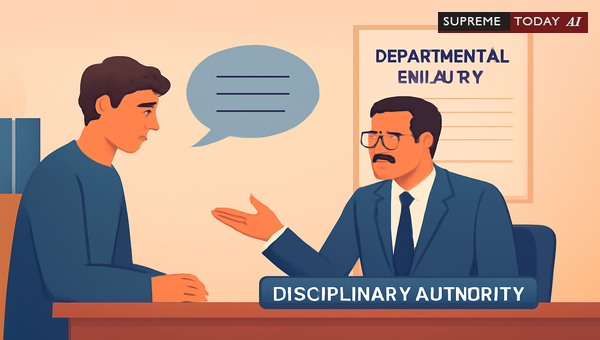
When Can an Advocate Assist in CCS Departmental Enquiry?
Facing a departmental enquiry as a government servant can be daunting. Under the Central Civil Services (Classification, Control and Appeal) Rules, 1965—commonly known as CCS (CCA) Rules—you have certain rights to defend yourself. But when can an advocate be used as a defense assistant in a departmental enquiry under CCS Rules? This question arises frequently, as employees seek legal expertise to navigate complex charges.
This blog post breaks down the legal framework, conditions, judicial precedents, and practical recommendations. Note: This is general information based on rules and cases; it is not specific legal advice. Consult a qualified professional for your situation.
Legal Framework Under CCS (CCA) Rules
The CCS (CCA) Rules govern disciplinary proceedings against central government employees. Rule 14 outlines the procedure for major penalty enquiries, including the right to assistance.
Right to Defense Assistance
Under Rule 14(8)(a), a charged government servant may take assistance from another government servant to present their case. However, engaging a legal practitioner (advocate) is not an absolute right unless specific conditions are met:- If the Presenting Officer is a legal practitioner, the employee can engage a lawyer as of right without permission. The Posts and Telegraphs Board, New Delhi VS M. A. Hanumanthan - Madras (1976)- If the Presenting Officer is not a legal practitioner, the employee must seek permission from the Disciplinary Authority, which is granted at its discretion. The Posts and Telegraphs Board, New Delhi VS M. A. Hanumanthan - Madras (1976)
This distinction ensures fairness: legal representation levels the playing field when the department employs a lawyer. The Disciplinary Authority's discretion must be exercised reasonably and fairly, considering case complexity. Lanjewar Alok Kumar Udaychand VS Union of India - Gauhati (2022)Brij Bhushan vs Union of India - Delhi (2022)
Eligibility and Limitations for Defense Assistants
The rules prioritize government servants as defense assistants. Rule 14(8)(a) and (b) explicitly allow a Government Servant approved by the Disciplinary Authority. An advocate, unless also a government servant approved for this role, is generally not permissible without authorization. Biswajit Roy vs Education - Central Administrative TribunalTaizuddin Laskar S/o Late Basir Uddin Laskar VS State Of Assam - Gauhati
For instance, procedural lapses like appointing an unapproved defense assistant (including advocates) can lead to challenges. Courts have noted that the defense assistant must participate in cross-examining witnesses and submitting evidence, but only if properly approved. M Mathiyazhagan vs D/o Post - Central Administrative Tribunal
In sexual harassment enquiries under related guidelines, it is clarified: There may not be any Presenting Officer but a Defence Assistant shall be provided during the course of enquiry and rest of the enquiry shall be completed as per the provisions provided in CCS (CCA) Rules 1965 or as per the provisions of any other Rules.Dilip Paul VS Union of India - 2019 Supreme(Gau) 265 - 2019 0 Supreme(Gau) 265
Conditions for Engaging an Advocate
To engage an advocate:1. Presenting Officer is a Lawyer: Automatic right—no permission needed.2. Permission from Disciplinary Authority: Request formally, justifying needs like case complexity or intricate legal issues. Denial must be reasoned; arbitrary refusal may violate principles of natural justice. C. K. Rajanandam VS Director of Postal Services, A. P. , Hyderabad - Andhra Pradesh (1970)
The absence of a legal practitioner as Presenting Officer does not automatically entitle the employee to a lawyer; permission is key. The Posts and Telegraphs Board, New Delhi VS M. A. Hanumanthan - Madras (1976)
Rule 14(14) empowers the Enquiry Officer to examine witnesses, but defense participation remains crucial. Rule 14 (14) of the CCS (CCA) Rules, 1965 only speaks of the Enquiry Officer having full authority to examine the defense witnesses and prosecution witnesses.N. CHAKHAI VS STATE OF MIZORAM - 2018 Supreme(Gau) 329 - 2018 0 Supreme(Gau) 329
Key Judicial Precedents and Case Insights
Courts have shaped these rules through precedents:- Right Not Absolute: Representation by an advocate is contingent on rules. Denial is valid if rules don't provide for it. Dev Prakash Tewari VS U. P. Cooperative Institutional Service Board, Lucknow - Supreme Court (2014)Mallikarjuna Sharma and others VS State of Andhra Pradesh, represented by K. V. L. Narasimha Rao, Special Public Prosecutor and others - Madras (1978)- Natural Justice Violations: Improper denial of defense assistance (including advocates) can prejudice the employee, leading to de novo enquiry (fresh start). MANAGEMENT OF JHABBAN LAL DAV SENIOR SECONDARY PUBLIC SCHOOL VS K. M. YADAV - Delhi (2018)- Complexity Matters: Authorities must assess if the case involves intricate facts or legal questions warranting a lawyer. C. K. Rajanandam VS Director of Postal Services, A. P. , Hyderabad - Andhra Pradesh (1970)
In various cases, enquiries under Rule 14 were upheld when full opportunities were given, but lapses in defense rights invited scrutiny. For example, The departmental Enquiry (domestic enquiry) is different from criminal proceedings and that the technical rules of evidence... are not applicable in domestic enquiry. Yet, procedural fairness, including defense assistance, is mandatory. B S Jaya Kumar vs Comptroller And Auditor General Of India - 2024 Supreme(Online)(CAT) 13049 - 2024 Supreme(Online)(CAT) 13049
Another observation: It is true that strict rules of evidence are not applicable to departmental enquiry proceedings. But full opportunity to defend is essential. Shri Shamjibhai Balubhai Maiya vs The Union of India - 2025 Supreme(Online)(CAT) 8165 - 2025 Supreme(Online)(CAT) 8165
Pending enquiries can impact pensions, as seen where DCRG was not granted... following Rule 8(4)(C) of the CCS(Pension) Rules, 2021 due to ongoing proceedings under Rule 14. P V Velayudhan vs Msme - 2024 Supreme(Online)(CAT) 14945 - 2024 Supreme(Online)(CAT) 14945
Procedural Requirements in Enquiry
During enquiry:- Submit a formal written request for advocate permission, stating reasons.- Defense assistant (if approved) gets case documents, cross-examines witnesses, and argues. Taizuddin Laskar S/o Late Basir Uddin Laskar VS State Of Assam - Gauhati- Document everything: Communications on requests prevent unfair treatment claims.
Failure to follow can invalidate proceedings. The opportunity to engage a defense assistant is a statutory right under CCS Rules, and failure to provide this can be grounds for quashing departmental proceedings.Biswajit Roy vs Education - Central Administrative TribunalM Mathiyazhagan vs D/o Post - Central Administrative Tribunal
Practical Recommendations
- Request Early: File a formal application to the Disciplinary Authority, highlighting why an advocate is needed (e.g., legal complexities).
- If Denied: Review grounds; appeal if arbitrary. Assess prejudice for judicial challenge.
- Choose Wisely: Ensure any assistant is approved; prefer fellow government servants unless advocate permitted.
- Prepare Thoroughly: Even without a lawyer, leverage Rule 14 rights for witnesses and evidence.
Conclusion and Key Takeaways
In summary, an advocate can assist in CCS departmental enquiries if the Presenting Officer is a lawyer (as of right) or with Disciplinary Authority permission (discretionary). The default is a government servant assistant, emphasizing procedural fairness over courtroom technicalities.
Key Takeaways:- Right to assistance: Yes, but limited to approved government servants; advocates under conditions.- Seek permission formally; discretion must be fair.- Violations may quash enquiry—protect your rights.
Stay informed on CCS rules to safeguard your career. For tailored advice, contact a legal expert.
References: The Posts and Telegraphs Board, New Delhi VS M. A. Hanumanthan - Madras (1976)Lanjewar Alok Kumar Udaychand VS Union of India - Gauhati (2022)Brij Bhushan vs Union of India - Delhi (2022)Dev Prakash Tewari VS U. P. Cooperative Institutional Service Board, Lucknow - Supreme Court (2014)Mallikarjuna Sharma and others VS State of Andhra Pradesh, represented by K. V. L. Narasimha Rao, Special Public Prosecutor and others - Madras (1978)MANAGEMENT OF JHABBAN LAL DAV SENIOR SECONDARY PUBLIC SCHOOL VS K. M. YADAV - Delhi (2018)C. K. Rajanandam VS Director of Postal Services, A. P. , Hyderabad - Andhra Pradesh (1970)Biswajit Roy vs Education - Central Administrative TribunalTaizuddin Laskar S/o Late Basir Uddin Laskar VS State Of Assam - GauhatiM Mathiyazhagan vs D/o Post - Central Administrative TribunalDilip Paul VS Union of India - 2019 Supreme(Gau) 265 - 2019 0 Supreme(Gau) 265N. CHAKHAI VS STATE OF MIZORAM - 2018 Supreme(Gau) 329 - 2018 0 Supreme(Gau) 329
#CCSRules #DepartmentalEnquiry #GovtEmployeeRights