


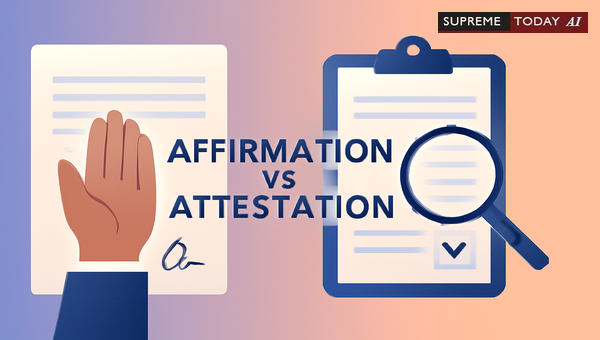
vs. : Understanding the Key Legal Differences
In legal proceedings, documents often require solemn commitments to their truthfulness or proper execution. A common question arises: what is the difference between an and an ? These terms are frequently confused, yet they serve distinct purposes with different formalities and implications. Whether you're drafting an , executing a , or verifying a statement in court, grasping this distinction can prevent costly errors and ensure your documents hold up under scrutiny.
This article breaks down the definitions, requirements, legal significance, and practical applications of affirmations and attestations. Drawing from legal precedents and statutory insights, we'll highlight how these mechanisms differ and when to use each. Note: This is general information and not specific legal advice. Consult a qualified attorney for your situation.
Definitions and Nature of and
An is fundamentally a solemn declaration made by an individual asserting their belief in the truth of a document or statement. It serves as an alternative to an , particularly for those with religious objections to swearing. As described in legal documents, an emphasizes the declarant's personal belief or truthfulness: a solemn declaration that a person believes a document or statement to be true
.
In contrast, is a formal act of witnessing. It involves an authorized person observing the signing or execution of a document and then certifying its authenticity by signing (and often sealing) it. Legal sources define it as bearing witness to a fact, certifying the genuineness of a document, and signing to attest proper execution
. The attestor's role is crucial: they verify that the signature occurred in their presence or confirm its genuineness
.
This core difference—personal declaration versus third-party certification—sets the stage for varying applications in affidavits, deeds, and testamentary proceedings.
Formalities and Procedural Requirements
The procedural hurdles for are more rigorous, designed to safeguard document integrity. Key requirements include:- The attestor must sign an clause.- If they have a seal, it must authenticate the signature.- The clause must follow a prescribed form (e.g., ) and appear immediately after the execution it attests
.
Failure to comply can invalidate the document. For instance, missing wording or signatures renders it insufficient for legal purposes
.
Affirmations, however, are less formal. They typically do not require a witness to observe the signature; instead, the declarant simply affirms the contents' truth. This aligns with its use in settings like court affirmations or oaths alternatives, without the witnessing mandate
.
Additional context from ordinances reinforces this. Under certain provisions, every commissioner administering an or must note the place in the or : Every Commissioner before whom any or is administered... shall state truly in the or at what place 2024 Supreme(SRI)(SC) 12836. This underscores 's procedural precision, even in contexts.
In , affidavits or affirmations are treated similarly for duties, with no distinction in charging: every or in a should be chargeable with duty
. Yet, elevates verification through witnessing.
Legal Significance and Evidentiary Weight
bolsters a document's evidentiary value by providing formal certification of proper execution. Courts emphasize strict adherence; non-compliance can lead to challenges or invalidation
. This is vital for deeds or instruments where authenticity is contested.
An , while admissible as evidence of belief, lacks this certification heft. Its weight depends on context and jurisdiction, often sufficing where oaths are inappropriate but not replacing witnessed execution
.
Notarial practices highlight authentication's depth: Authentication connotes made by an officer by which he certifies that a record is in due form of law 2017 Supreme(Online)(Cal) 24. Here, (or authentication) goes beyond mere witnessing, ensuring legal form.
Key Differences: A Side-by-Side Comparison
| Aspect | | ||---------------------|--------------------------------------------------|--------------------------------------------------|| Nature | Solemn declaration of belief in truth
| Witnessing and certifying execution
|| Witness Required| Generally no | Yes, by authorized person
|| Formalities | Minimal; no prescribed clause needed | Signing, sealing, specific wording
|| Purpose | Alternative to ; affirms contents | Verifies signature/authenticity || Consequences of Error | May reduce weight, but often still admissible | Can invalidate document entirely |
These distinctions are critical in affidavits or legal instruments, where procedural lapses affect validity
.
Contextual Applications and Exceptions
In practice, use for high-stakes documents like deeds requiring witnessed execution. Affirmations fit court testimonies or oaths alternatives. For international documents, notarial may suffice without full protocols 2017 Supreme(Online)(Cal) 24.
Exceptions exist: jurisdictional variations or specific statutes may blur lines, such as in inventory verifications under civil procedure: requires the inventory... to be verified on or
. Always check local rules.
Practical Recommendations for Legal Compliance
To avoid pitfalls:- For document execution, use authorized attestors and prescribed forms to certify authenticity.- Opt for affirmations when witnessing is impractical or religiously sensitive, but verify legal sufficiency.- Legal professionals: Scrutinize clauses for compliance to preserve evidentiary value.
Conclusion: Choose Wisely for Document Validity
In summary, an is a personal pledge of truth without witnessing
, while demands formal third-party verification with strict procedures
. Understanding these ensures documents withstand legal challenges.
Key Takeaways:- : Belief declaration, substitute.- : Witness certification, execution proof.- Prioritize formalities for enforceability.
This overview draws from established legal sources but is for informational purposes. Seek professional advice tailored to your needs.
References
: as witnessing and certifying.
: Requirements for attesting officers.
: Prescribed formats and invalidation risks.
: as solemn declaration.
, 2024 Supreme(SRI)(SC) 12836, 2017 Supreme(Online)(Cal) 24: Contextual insights on oaths, jurats, and authentication.















