


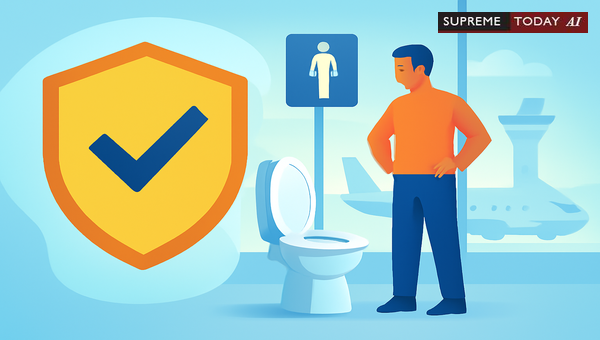
Is an Airport Toilet a in Insurance Policies?
Imagine slipping and falling in an airport toilet, leading to injury. You file an insurance claim, but the insurer denies it, arguing the location isn't a '.' Is this valid? Many policyholders face this dilemma when interpreting insurance terms, especially under policies tied to the or general liability coverage.
Is a toilet in an airport considered a in an insurance policy? This question arises frequently in claims involving accidents at transit hubs. In this post, we'll dive into legal principles, judicial precedents, and practical applications to clarify this issue. While this analysis provides general insights, consult a legal professional for advice specific to your situation.
Understanding '' in Insurance Contexts
The cornerstone of this debate is the definition of a '' under , which is broad: it encompasses any place to which the public has a right of access, whether a thoroughfare or not, including places where passengers are picked up or dropped off2003 0 Supreme(Ker) 308. Judicial interpretations expand this further, including private properties accessible to the public or where the public habitually resorts, even if access is by permission or license 2003 0 Supreme(Ker) 308 2003 0 Supreme(Ker) 308.
This definition is crucial for insurance policies, particularly those covering . Policies often limit coverage to incidents in 'public places,' excluding purely private areas. For instance, one source notes that if the property which is damaged was not in a at the time of the accident, if the act or omission which led to the accident occurred in a 2023 0 Supreme(Mad) 523. Similarly, thereof deals with liability which may be incurred by the owner of a vehicle against the death of or bodily injury to any passenger of a public service vehicle caused by or arising out of the use of the vehicle in a 2023 0 Supreme(Guj) 351.
Key factors determining a '' include:- : Does the general public have entry rights or habitual access?- : Even private premises like workshops or factories qualify if open to public interaction with vehicles 2003 0 Supreme(Ker) 308.- : Clauses must be read strictly, as the
.
Landmark Case Law on Public Places
Indian courts have consistently broadened the scope of 'public places' beyond streets and open roads. In , the ruled that places like workshops or factory premises with public access are 'public places' for insurance liability, despite being private property 2003 0 Supreme(Ker) 308.
The in emphasized the legislature's focus on places where members of the public and their property are likely to come into contact with vehicles, including workshops 2003 0 Supreme(Ker) 308.
Further, clarified that access need not be 'by right' but can be by permission or habit, with the test being whether the public can and does resort to the place 2003 0 Supreme(Ker) 308.
These precedents underscore a trend: functionality and public use trump strict ownership. A relevant example comes from criminal law contexts, where the toilet was a and accessible to the general public2025 0 Supreme(HP) 982, highlighting how courts view such facilities based on openness.
Applying the Law to Airport Toilets
Airports are quintessential public hubs, licensed for public use, often as public-private partnerships 2025 0 Supreme(Ker) 1282. Toilets within terminals are typically accessible to travelers, visitors, and staff—mirroring the 'habitual resort' test.
Consider a real incident at Labuan Airport, where a victim entered the public toilet near ST2 Café at level 2 of Labuan Airport
. The court's reference to it as a 'public toilet' reinforces its classification, as it was part of premises open to the public. Inside, events unfolded in this accessible space, supporting the view that airport facilities like toilets fall under public places.
In insurance disputes, if an accident occurs here—say, a slip due to poor maintenance—the accessibility aligns with case law. Policies covering liabilities would likely extend, provided the incident involves covered risks like vehicle-related injuries 2014 0 Supreme(Guj) 918. However, exclusions apply if the loss is 'in transit' at a 'different place' outside policy scope
.
Airports mandate insurance for public use: every motor vehicle owner has to take out an insurance policy before using the motor vehicle in a 2010 0 Supreme(P&H) 1602 2010 0 Supreme(Raj) 517. Thus, facilities integral to public transit, like toilets, are generally included.
Insurance Policy Implications and Best Practices
Coverage hinges on policy wording. Some exclude private areas, but courts interpret broadly for public-access spots. For example, medi-claim policies have exclusions, but incidents in transit hubs may qualify if tied to covered events 2024 Supreme(Online)(NCDRC) 860.
- For Policyholders: Document accessibility (e.g., photos of open doors, public signage) to strengthen claims.
- For Insurers: Explicitly define '' to include/exclude airport facilities, avoiding ambiguity.
- Claims Tip: Note that the accident should have taken place in a '' for applicability 2014 0 Supreme(Guj) 918.
Other contexts, like public toilets in community projects, further affirm their public status 2018 0 Supreme(Mad) 207.
Conclusion and Key Takeaways
Based on legal definitions and judicial trends, a toilet in an airport is likely considered a within insurance policies, given its 2003 0 Supreme(Ker) 308 2003 0 Supreme(Ker) 308. Courts prioritize where the public resorts, making airport toilets akin to workshops or cafes in terminals.
Key Takeaways:- Public access, not ownership, defines the term 2003 0 Supreme(Ker) 308.- Precedents like Kerala and cases support inclusion 2003 0 Supreme(Ker) 308.- Airport-specific incidents treat toilets as public
2025 0 Supreme(HP) 982.- Always review policy terms strictly
.
This is general information, not legal advice. For personalized guidance, contact an insurance lawyer or expert. Stay safe in transit and informed on your coverage!
#InsuranceLaw, #PublicPlace, #AirportLiability















