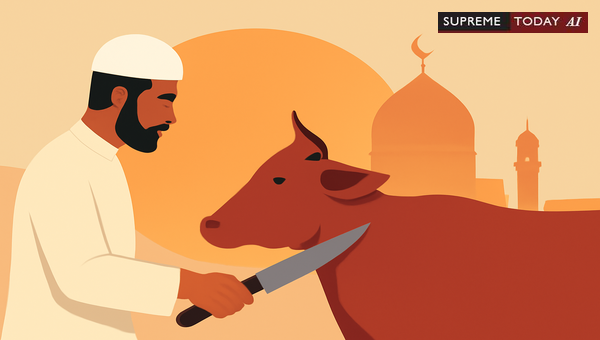
Animal sacrifice is generally not practiced in mosques or dargahs and, if observed at certain sites like Sikkandar Dargah, it is considered unauthorized and potentially violative of law unless explicitly recognized or protected as a religious practice S.Paramasivam vs The District Collector, Madurai District - Madras, M. Kannan @ Solai Kannan, S/o. R. Muthusamy vs District Collector, Madurai District, Madurai - Madras.
The Supreme Court has clarified that animal sacrifice is not an essential religious practice for Muslims; it is an optional act and not mandatory for religious fulfillment. The Court emphasized that only practices deemed essential or integral to a religion are protected under Article 25 of the Constitution Hifzur Rahman Choudhury VS Union Of India - Gauhati, RAVEENDRAN P. T. S/O THANKAPPAN VS STATE OF KERALA - Kerala.
The distinction between religious practices and essential religious tenets is significant. Offerings such as prayer or worship are generally not essential at every location unless a particular place holds special religious significance. The Court has held that animal sacrifice, unless proven to be an essential part of religious doctrine, can be regulated or restricted RAVEENDRAN P.T vs THE STATE OF KERALA - Kerala, RAVEENDRAN P. T. S/O THANKAPPAN VS STATE OF KERALA - Kerala.
There is no statutory prohibition against animal sacrifice at religious sites in Tamil Nadu, and such practices, if carried out in accordance with law, are not inherently unlawful. Unauthorized or unregulated sacrifices are considered illegal Mohamed Akbar VS Commissioner, Greater Chennai Corporation, Chennai - Madras, M. Kannan @ Solai Kannan, S/o. R. Muthusamy vs District Collector, Madurai District, Madurai - Madras.
Campaigns and protests against animal sacrifice, especially by groups claiming it as a constitutional right under Articles 25 and 26, have been noted. Historically, Muslim communities have practiced animal sacrifice peacefully at sites like Sikkandar Badusha Darga for decades without causing law and order issues, indicating that such practices are a matter of religious freedom and harmony Mi.Dha.Pandian @ Pandiarajan vs The Commissioner of Police - Madras, Mi.dha. Pandian @ Pandiarajan Vs Commissioner Of Police O/o.commissioner Of Police - Madras.
Analysis and Conclusion:Based on legal precedents and constitutional provisions, animal sacrifice is not an essential or mandatory religious practice in Islam. It is a permissible religious act but not a core requirement, and its practice can be regulated by law. The courts have recognized that prohibiting or restricting animal sacrifice, when not essential to religious doctrine, does not violate religious freedoms guaranteed under the Constitution. Therefore, animal sacrifice is not an indispensable religious practice of Islam, and restrictions or regulations on it are constitutionally permissible when justified.