


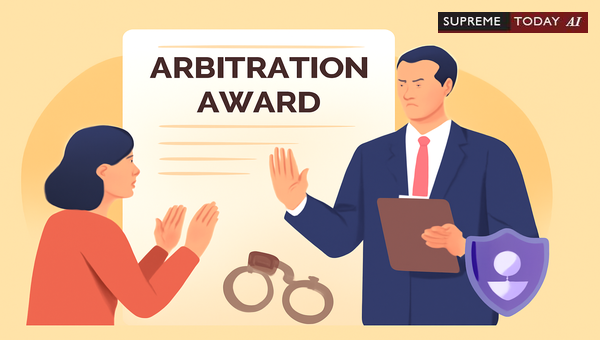
Can Arbitrator Award Damages for False FIR Mental Harassment?
In the realm of dispute resolution, arbitration offers a swift alternative to court litigation, but its boundaries are strictly defined. A pressing question for many is: Arbitrator can Award for Mental Harresment through False Fir? This issue arises when one party files a false First Information Report (FIR)—a police complaint—leading to alleged mental distress for the other. Can an arbitrator step in to award damages? Generally, the answer hinges on the 's scope, , and adherence to legal principles under the (the Act). This post breaks it down, drawing from key legal precedents and guidelines.
Overview of Arbitrator's Powers
Arbitrators derive their authority solely from the . They cannot venture beyond it, much like a referee confined to the rules of the game. Under the Act, awards for claims like mental harassment from a false FIR may be possible if explicitly covered, but challenges often arise on grounds of or procedural lapses. 1986 0 Supreme(Del) 202 1999 8 Supreme 295
Mental harassment claims, especially tied to criminal proceedings like false FIRs, blur civil-commercial lines. Courts scrutinize whether such fall within the arbitrator's purview, emphasizing that an arbitrator must operate within the confines of the . 1986 0 Supreme(Del) 202
Grounds for Challenging Arbitration Awards
limits challenges to specific grounds:- Corruption or fraud.- .- Exceeding jurisdiction or . 2022 0 Supreme(J&K) 35 2013 0 Supreme(Del) 2363
For instance, if an arbitrator awards damages for mental agony without the agreement covering such claims, it could be deemed beyond scope. In one case, an FIR led to claims where the award of the learned arbitrator on mental agony was upheld after review, but only because it aligned with the reference.
2022 Supreme(Online)(DEL) 5770
Speaking vs. Awards
Awards are either speaking (reasoned) or (unreasoned). Courts can probe reasoning in speaking awards but not the arbitrator's mental process in ones. 2003 8 Supreme 726 2001 0 Supreme(Jhk) 459
An award passed without reasons is set aside, especially in where under is the sole remedy. 2016 0 Supreme(Ori) 404 This underscores the need for transparency: If from the award, it can be inferred that the Arbitrator has applied his mind, taken into consideration the relevant material for arriving at the finding the Award cannot be interfered with. 2007 0 Supreme(Del) 1319
In a matter, an award for mental agony post-FIR was affirmed: Taking into all these factors, the learned arbitrator has awarded the damages for mental agony and harassment undergone by the respondent. 2022 Supreme(Online)(DEL) 5770
and False FIR Claims
A false FIR often triggers criminal probes, but ancillary civil damages for harassment may fall to arbitration if linked to the underlying contract. However, If the claim is outside the scope of the , the arbitrator cannot award damages for mental harassment resulting from a false FIR. 1986 0 Supreme(Del) 202
Precedents reinforce this: Arbitrators cannot rewrite agreements. In construction disputes, awards were set aside for jurisdictional overreach, like implying escalation clauses absent in contracts.
Similarly, for mental claims, the agreement must explicitly or impliedly encompass torts like harassment.
One source notes FIR-related distress: Also, his plea that an award on account of mental agony may for challenge are constricted... and also led to the registration of an FIR against the respondent. Courts rejected challenges, upholding the award as within bounds.
- Delhi_Delhi_FAO(OS)_(COMM)-8_2019 _DHC_5640-DB
Principles of
Arbitrators must uphold : fair hearings, evidence consideration, and unbiased decisions. Failure invites misconduct claims.
2009 0 Supreme(SC) 337
Arbitrators are not Judges, they have not to write judgments as Judges do, but must show mind application. Breaches, like ignoring evidence of false FIR intent, could vitiate awards. 2007 0 Supreme(Del) 1319
In error challenges, An award can only be set aside for error which is on its face. Courts won't delve into mental processes unless apparent. 2011 0 Supreme(Cal) 96 2006 0 Supreme(Cal) 388
Application to Mental Harassment from False FIR
- If Covered: Where agreements include broad dispute clauses (e.g., all contractual torts), arbitrators may award damages. Cases show awards for mental agony and harassment post-FIR upheld. 2022 Supreme(Online)(DEL) 5770
- If Not: Exclusive civil courts handle pure torts; arbitration fails.
- Evidence Role: Proving harassment requires cogent links, akin to dowry cases where the prosecution had failed to prove the proximate connection between the demand of dowry and the act of cruelty or harassment. 2025 Supreme(Online)(Guj) 12213
Practical example: A respondent claimed mental agony after an FIR; the arbitrator awarded, and courts affirmed, summarizing claims and findings.
Key Case Insights
- Unreasoned Awards: Statutory awards need reasons for review. 2016 0 Supreme(Ori) 404
- Plausible Views: If the arbitrator takes a plausible view, the award cannot be set aside. 2011 0 Supreme(Cal) 96
- No Mental Probing: Courts avoid speculating on reasoning unless facial errors exist. 2006 0 Supreme(Cal) 388
These align with challenges under the Act, now governing post- arbitrations.
Recommendations for Parties
- Review Agreement: Check for inclusive clauses on harassment/damages.
- Present Evidence: Submit FIR copies, witness statements on distress.
- Seek Reasoned Awards: Prefer speaking awards to withstand scrutiny.
- Post-Award Strategy: Challenge via if jurisdictional excess.
Consult professionals; this is general insight, not advice.
Conclusion and Key Takeaways
An arbitrator may award for mental harassment via false FIR only if the agreement permits, jurisdiction is respected, and prevails. Courts intervene narrowly, upholding plausible awards like those for mental agony post-FIR. 2022 Supreme(Online)(DEL) 5770
Takeaways:- Scope is king—broad clauses enable more claims.- Reasoned awards survive better.- False FIRs add complexity; link firmly to contract.
Stay informed on arbitration evolutions. For tailored guidance, engage a lawyer.
References:- 2022 0 Supreme(J&K) 35 2013 0 Supreme(Del) 2363 2003 8 Supreme 726 2001 0 Supreme(Jhk) 459 1986 0 Supreme(Del) 202 1999 8 Supreme 295
2016 0 Supreme(Ori) 404 2011 0 Supreme(Cal) 96 2007 0 Supreme(Del) 1319 2006 0 Supreme(Cal) 388 2025 Supreme(Online)(Guj) 12213
- Delhi_Delhi_FAO(OS)_(COMM)-8_2019 _DHC_5640-DB 2022 Supreme(Online)(DEL) 5770
#ArbitrationLaw #MentalHarassment #FalseFIR















