


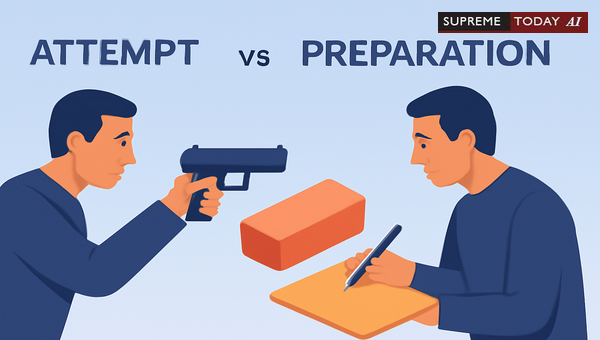
Attempt vs Preparation: Key Differences Under the
In criminal law, the line between planning a crime and actually trying to commit it can be razor-thin. A common question arises: What is the difference between attempt and preparation? This distinction is crucial under the (), as it determines whether an accused can be convicted of an attempt—which is punishable—or mere preparation, which generally is not. Understanding this helps demystify and highlights how courts assess intent and action.
This blog post breaks down the concepts, key elements, and judicial interpretations, drawing from established legal principles. Note that this is general information and not specific legal advice—consult a qualified lawyer for your situation.
What Constitutes Preparation to Commit an Offence?
Preparation is the initial stage where an individual devises or arranges the means or measures necessary for committing an offence. It stops short of any direct movement toward the crime itself. Typically, mere preparation is not punishable under the , except in specific statutes.
Key characteristics include:- Devising means: This involves setting up tools, plans, or arrangements needed for the offence. 2004 2 Supreme 358, 2007 5 Supreme 297- No required for liability: Mere intention to commit an offence, without any , does not constitute an offence. The will is not taken for the deed unless there is some external act showing progress towards the commission of the offence. 2004 2 Supreme 358, 2007 5 Supreme 297- Limited punishability: Preparation is only criminalized in rare cases, such as under (waging war against the Government of India) or (preparation to commit dacoity) of the . 2004 2 Supreme 358, 2007 5 Supreme 297
For instance, buying a weapon with intent to murder might be preparation, but it alone doesn't cross into punishable territory unless followed by further steps.
Defining Attempt to Commit an Offence
An attempt goes beyond preparation into direct action toward the crime. It involves intent coupled with overt acts that would lead to the offence if not interrupted.
Core elements of attempt:- Intent to commit: The accused must have a clear intention to perpetrate the offence. 1996 7 Supreme 556, 2007 5 Supreme 297- Beyond preparation: The accused has gone beyond the stage of mere preparation and taken deliberate overt steps towards the commission of the offence. 1996 7 Supreme 556, 2007 5 Supreme 297- Inevitable progression: An attempt to commit an offence is an act, or a series of acts, which leads inevitably to the commission of the offence, unless something unforeseen happens to prevent it. 2004 2 Supreme 358- : The act must be reasonably proximate to the consummation of the offence. 1980 0 Supreme(SC) 108, 1980 0 Supreme(SC) 109
Attempt is punishable under for offences not expressly provided otherwise, with penalties up to half the punishment for the completed crime.
The dividing line is often fact-specific: The dividing line between preparation and attempt is sometimes thin and depends on the facts of each case. Attempt shows a greater degree of determination compared to mere preparation. 2007 5 Supreme 297
Key Distinctions Between Attempt and Preparation
The primary differences boil down to proximity, determination, and action:
| Aspect | Preparation | Attempt ||---------------------|--------------------------------------|----------------------------------------------|| Stage | Arranging means (preliminary) | Direct overt acts toward commission || Proximity | Distant from completion | Reasonably close; would succeed if uninterrupted || Determination | Initial intent | High resolve, at all costs despite obstacles 1996 7 Supreme 556, 2006 4 Supreme 204 || Punishability | Generally not (exceptions apply) | Yes, under Section 511 || Example | Procuring poison for murder | Administering poison to victim |
Attempt is closer to the actual commission of the offence compared to mere preparation. Attempt involves a deliberate towards the commission of the offence, while preparation is limited to arranging the means to commit the offence. 1996 7 Supreme 556, 2007 5 Supreme 297
Insights from Indian Case Law
Courts have repeatedly clarified this boundary through precedents, emphasizing that facts dictate the categorization.
In a case involving an alleged attempt to rape, the court distinguished: For an offence of attempt to commit rape, prosecution is required to establish that the act of the accused went beyond the stage of preparation. The accused removed the victim's knicker but no further penetration was attempted, leading to conviction under (outraging modesty) rather than (attempted rape). There is a distinction between 'preparation' and 'attempt'. 2010 0 Supreme(Bom) 1673
Another ruling on a sexual assault noted: Appellant has crossed threshold of preparation as victim has been put down to earth and forcefully clothes has been removed which has resulted in tearing of blouse. This elevated it to attempt. 2020 0 Supreme(Jhk) 238
In animal cruelty contexts, transporting cows for slaughter was held as mere preparation: The act of transporting the cow, bull or bullock... would not travel beyond the stage of preparation of slaughtering... There is vast difference in the stages of ‘preparation’ and ‘attempt’. No offence under the was made out without actual slaughter attempts. 2008 0 Supreme(All) 2440
A -inspired observation reinforces: Attempt means that the appellant has taken all possible steps for commission of the crime, but has failed due to the circumstances beyond his control. There is thin line difference between preparation and attempt. 2020 0 Supreme(Jhk) 238
These cases illustrate how courts apply the '' or '' tests, often reducing charges if acts remain preparatory.
Why This Matters in Practice
Misclassifying preparation as attempt can lead to wrongful convictions, while undercharging attempts undermines justice. Prosecutors must prove beyond reasonable doubt that the accused crossed into attempt territory. Defenses often argue 'mere preparation' to seek acquittal.
Under , punishments for attempts are halved, reflecting incomplete harm but recognizing danger. This framework balances deterrence with fairness.
Conclusion: Key Takeaways
- Preparation is about setup and rarely punishable; attempt requires overt, proximate acts with firm intent.
- The test is factual: Has the accused moved decisively toward completion?
- Judicial precedents like those in rape and slaughter cases provide guidance on the 'thin line.'
Grasping these nuances empowers better navigation of criminal proceedings. For tailored advice, always seek professional legal counsel. Stay informed, stay lawful.
(Word count approx. 1050. References are to specific legal documents for verification.)
#AttemptVsPreparation #IPCDifferences #CriminalLawIndia

















