


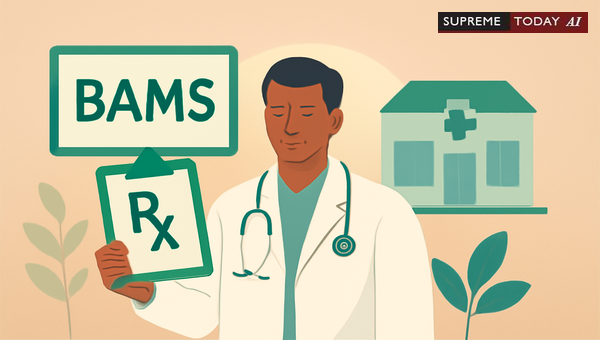
Can BAMS Doctors Legally Run Allopathy Clinics?
In the diverse landscape of India's medical systems, tensions often arise between traditional practices like Ayurveda and modern allopathy. A common question among practitioners is: Can a BAMS Doctor Practice by Starting an Allopathy Clinic? This query touches on critical legal boundaries designed to protect public health. While BAMS (Bachelor of Ayurvedic Medicine and Surgery) holders are well-trained in Ayurvedic medicine, venturing into allopathy without proper qualifications can lead to serious legal consequences.
This article breaks down the legal framework, key court rulings, exceptions, and risks involved. Note: This is general information based on legal precedents and not specific legal advice. Consult a qualified lawyer for personalized guidance.
Understanding BAMS Qualifications and Practice Limits
A BAMS degree qualifies practitioners to practice Indian systems of medicine, such as Ayurveda, but does not extend to modern scientific medicine (allopathy). The and clearly delineate these boundaries. states that only those enrolled in a can practice allopathy 2010 0 Supreme(Mad) 528.
Merely holding a BAMS degree does not confer the right to independently run an allopathy clinic. As highlighted in various judgments, A person qualified solely in Ayurveda (BAMS) is authorized to practice Ayurveda and not allopathy 2010 0 Supreme(Mad) 528. Courts have emphasized that practicing outside one's recognized qualification constitutes 2010 0 Supreme(Mad) 528.
From other cases, it's evident that BAMS is not a recognized qualification for allopathy under the IMC Act schedules. For instance, Qualification of BAMS is not a recognized qualification as per aforementioned Schedules to hence, Dr. Vinay being holder of BAMS, is neither qualified nor authorized to practice Allopathic system of medicine 2023 Supreme(Online)(Del) 18330.
Key Rulings and Legal Precedents
The has consistently upheld these restrictions. In Poonam Verma v. Ashwin Patel (AIR SC 2111), the court clarified that practitioners must hold recognized qualifications in the specific system they practice. A practitioner must possess a recognized qualification in the system of medicine they intend to practice. Practicing outside that qualification is illegal, constitutes negligence, and can be prosecuted 2010 0 Supreme(Mad) 528.
This principle extends to BAMS doctors attempting allopathy. Unauthorized practice is deemed , leading to and 2022 0 Supreme(MP) 1394. Additional sources reinforce this: BAMS doctors running clinics prescribing allopathic medicines face clinic seizures and charges 2023 0 Supreme(Kar) 562 2023 Supreme(Online)(KAR) 22858.
In one case, a BAMS practitioner was challenged for lacking regulatory oversight for allopathy: For the medical practitioners which fall under Alopathy Branch of Science, there is a regulatory body namely the Medical... 2023 0 Supreme(Kar) 482. Courts have ruled against such practices, stressing registration requirements.
Exceptions and Special Provisions
Are there any exceptions? Limited ones exist, but they don't permit general private practice:
Government Postings: Laws like the , allow Ayurvedic practitioners with specific allopathic training to practice modern medicine in government institutions
. This is restricted to official roles, not private clinics.
Integrated Training: Certain notifications recognize training for Indian system practitioners, but only under specific conditions. Certain laws recognize specific integrated courses or training in allopathic medicines for practitioners of Indian systems only under particular conditions, such as government postings or recognized courses
. Mere theoretical knowledge or short training doesn't suffice; recognized qualifications and registration are mandatory 2010 0 Supreme(Mad) 528.
Other Cases: Some BHMS practitioners with training were permitted under regulated conditions, but this is not general for BAMS 2018 0 Supreme(MP) 495. Private allopathy clinics by BAMS doctors remain unauthorized.
Risks of Unauthorized Practice
Attempting to start an allopathy clinic without qualifications invites severe repercussions:
Criminal Penalties: Practicing without a license is illegal, akin to 2022 0 Supreme(MP) 1394. Cases show clinic seizures and prosecutions 2023 0 Supreme(Kar) 562 2025 Supreme(RAJ) 1045 2022 Supreme(Online)(Mad) 86184.
: Negligence claims can arise, endangering patients and practitioners.
Regulatory Action: can deregister or bar practice. Examples include BAMS doctors accused of allopathic prescriptions leading to legal battles 2023 Supreme(Online)(KAR) 22858.
One snippet notes: Practice of profession in a consulting room as part of service will not satisfy the requirements of starting a clinic... highlighting that even setup doesn't legitimize unauthorized practice 2014 0 Supreme(Ker) 267.
Registration and Compliance Essentials
To legally practice:
- Obtain recognized allopathic qualifications (e.g., MBBS) and register with the State Medical Council.
- Adhere strictly to BAMS limits for Ayurveda.
- For cross-practice, pursue authorized bridge courses or government approvals—rare for private setups.
Sources stress: To legally practice as a medical practitioner, one must obtain registration under the relevant medical act. Para-medical practitioners or those with alternative medicine qualifications like BAMS cannot practice Allopathy unless they acquire specific registration 2023 0 Supreme(Kar) 562.
Real-World Examples from Case Law
A BAMS doctor running Jyoti Clinic was noted in income assessments, but practice limits were implicit 2024 Supreme(Online)(KAR) 21891.
Advertisements calling BAMS holders renowned doctors in allopathy contexts led to disputes 2023 0 Supreme(P&H) 157.
Forgery probes into BAMS certificates underscore scrutiny: The degree 'BAMS' which would qualify a person to practice medicine is the degree known as 'Bachelor of Ayurvedic Medicine and Surgery' 2015 0 Supreme(Bom) 2523 2015 0 Supreme(Bom) 2562.
These illustrate enforcement against overreach.
Conclusion and Key Takeaways
Generally, a BAMS doctor cannot legally start and operate an allopathy clinic without recognized allopathic qualifications or specific legal authorization. Doing so risks penalties, clinic closure, and professional ruin. The law prioritizes patient safety through regulated practice.
Key Takeaways:- Stick to Ayurveda with your BAMS degree.- Seek MBBS or equivalent for allopathy.- Limited government exceptions don't apply to private clinics.- Enforcement is active—avoid charges.
Recommendations: BAMS practitioners eyeing allopathy should pursue proper education and registration. Authorities must continue curbing unauthorized practice for public health 2010 0 Supreme(Mad) 528.
For more on medical laws, explore our resources. Stay compliant!
References:- 2010 0 Supreme(Mad) 528 Legal restrictions on allopathy by Indian medicine practitioners.-
Government training recognitions.- 2022 0 Supreme(MP) 1394 and negligence.- 2023 Supreme(Online)(Del) 18330 BAMS not recognized for allopathy.- 2023 0 Supreme(Kar) 482 Regulatory bodies.- And others as cited. #BAMSLaw #AllopathyPractice #MedicalRegulations
















