Searching Case Laws & Precedent on Legal Query.....!
Analysing the retrieved Case Laws
Scanned Judgements…!



Searching Case Laws & Precedent on Legal Query.....!
Analysing the retrieved Case Laws
Scanned Judgements…!
Grounds for Advocate to Withdraw - An advocate may withdraw from a case on several grounds, including if they are or would be embarrassed, if they have a pecuniary interest, or if maintaining independence is difficult. Courts recognize that advocates have duties beyond client instructions, and public policy presumes good faith unless malice is proven. Withdrawal is also permissible when continuing proceedings would constitute an abuse of process or when the advocate’s conduct breaches professional standards. ["SALUTICA ALLIED SOLUTIONS SDN BHD vs APPLE MALAYSIA SDN BHD - High Court Malaya Kuala Lumpur"], ["Surendra Bir Singh Maurya VS State of U. P. - Allahabad"], ["Nemchand S/o Dulichand Jain VS Vipinkumar S/o Manubhai Patel - Bombay"], ["Bar Council of Maharashtra and Goa VS Rajiv Nareshchandra Narula - Supreme Court"]
Professional and Ethical Grounds - Advocates are expected to act in good faith, maintain independence, and avoid conflicts of interest such as pecuniary interests or contingent fees. They can withdraw if their continued involvement jeopardizes their professional integrity or independence. ["SALUTICA ALLIED SOLUTIONS SDN BHD vs APPLE MALAYSIA SDN BHD - High Court Malaya Kuala Lumpur"], ["Peruru Pavan Kumar VS State Of Andhra Pradesh - Andhra Pradesh"]
Procedural and Disciplinary Grounds - Advocates may also withdraw or be disqualified if disciplinary proceedings are initiated against them, or if they breach rules of conduct established by the Bar Council. Grounds include misconduct, breach of confidentiality, or failure to adhere to procedural norms. ["Bar Council of Maharashtra and Goa VS Rajiv Nareshchandra Narula - Supreme Court"], ["FAIJAL S/O MAHAMADRAFIQ BANKAPUR vs THE STATE OF KARNATAKA - Karnataka"]
Specific Circumstances - Withdrawal can be justified if the advocate is involved in misconduct, such as making defamatory statements without reasonable grounds, or if continuing representation would violate legal or ethical standards. Courts will require that the advocate's good faith and adherence to duties are presumed unless proven otherwise. ["Nemchand S/o Dulichand Jain VS Vipinkumar S/o Manubhai Patel - Bombay"], ["Shyam Babu Sah VS State of Bihar - Patna"]
Conclusion - An advocate’s grounds for withdrawal include conflicts of interest, ethical breaches, professional misconduct, or circumstances where continuing would compromise independence or violate legal standards. The courts generally favor allowing withdrawal to uphold professional integrity, provided the advocate acts in good faith and adheres to procedural norms. ["SALUTICA ALLIED SOLUTIONS SDN BHD vs APPLE MALAYSIA SDN BHD - High Court Malaya Kuala Lumpur"], ["Peruru Pavan Kumar VS State Of Andhra Pradesh - Andhra Pradesh"], ["Bar Council of Maharashtra and Goa VS Rajiv Nareshchandra Narula - Supreme Court"], ["FAIJAL S/O MAHAMADRAFIQ BANKAPUR vs THE STATE OF KARNATAKA - Karnataka"]
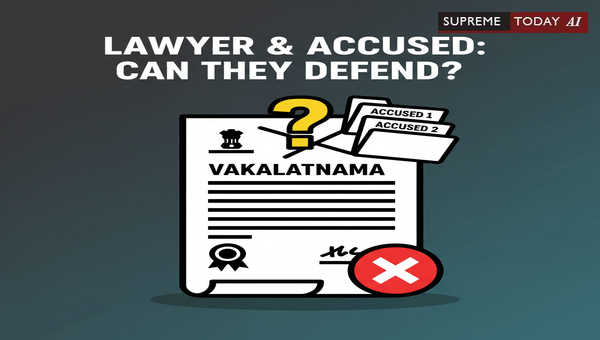
In the complex world of legal representation in India, the vakalatnama serves as a critical power of attorney, authorizing an advocate to act on behalf of a client in court proceedings. But what happens when the lines blur? Specifically, whether an Advocate can accept the Vakalatnama for Accused if he is also Accused in this case raises profound questions about conflicts of interest, ethical duties, and procedural validity. This scenario could arise in multi-accused cases involving family, colleagues, or related parties, potentially compromising impartiality.
While direct precedents on an advocate accepting vakalatnama while being co-accused are limited, related principles from case law emphasize ethical boundaries and grounds for disengagement. Courts generally prioritize the advocate's role as an officer of the court over client loyalty, as noted in common law contexts where advocates are, first, officers of the court; their fealty compels them to assist the court, rather than remain mere mouthpieces to their clients Navinchandra Khimchand Shah VS PUTCO Pvt Ltd. - 2019 Supreme(Bom) 1277. This post explores the issue, drawing on key grounds for vakalatnama withdrawal and insights from judicial decisions.
A vakalatnama is not merely a formality; it binds the advocate to represent the client diligently under the Advocates Act, 1961, and rules of professional conduct. Accepting one while being an accused in the same case typically triggers a conflict of interest. An advocate's personal stake could influence strategy, testimony, or advocacy, undermining justice.
For instance, in cases with familial ties among accused—like two real brothers and a nephew alongside an employee in a nursing home operated by an accused doctor—it is deemed quite unnatural for overlapping roles, highlighting ethical red flags Surendra Bir Singh Maurya VS State of U. P. - 2023 Supreme(All) 2461. Courts may view such acceptance as defective from inception, akin to a flawed instrument lacking essential elements.
Even if initially accepted, advocates may seek withdrawal under specific circumstances. These grounds provide insight into when representation becomes untenable, including potential conflicts:
An advocate may withdraw if they haven't received a brief or documents from the client. In Sri Arvind Kumar Sharma's case, the court allowed withdrawal noting he never received any brief from the opposite party and did not appear or argue on their behalf. Without engagement, the vakalatnama isn't binding Shivanshu Mugdal VS State of U. P. - Allahabad.
Clients can demand withdrawal. In Hiyat Khan, the client's wish to argue personally led to permitted disengagement DIRECTOR, INDIAN INSTITUTE OF TECHNOLOGY, KANPUR VS HIYAT KHAN - Allahabad. Clear communication prevents disputes.
A vakalatnama missing requirements, like an Advocate Welfare Ticket, is invalid. The court in Sri Arvind Kumar Sharma deemed it defective, facilitating withdrawal Shivanshu Mugdal VS State of U. P. - Allahabad.
Non-appearance justifies exit, as substantive engagement is absent Shivanshu Mugdal VS State of U. P. - Allahabad.
These grounds underscore that vakalatnama isn't irrevocable; courts balance client rights with judicial integrity.
Judicial precedents reinforce caution in advocate-client dynamics, especially with conflicts:
Withdrawal from Prosecution: Under CrPC Section 321, public prosecutors' withdrawal applications require independent satisfaction and public interest justification. In one case, the trial court erred by dismissing on technical grounds without proper review, remitting for reconsideration Surendra Bir Singh Maurya VS State of U. P. - 2023 Supreme(All) 2461. This supervisory role extends analogously to private advocates.
Advocates' Welfare and Practice Rights: Voluntary sanad surrender doesn't bar resuming practice, a fundamental right. However, benefits availed must be refunded Channabasappa Lingappa Mokhashi, S/o. Late Lingappa Mokhashi VS Karnataka State Bar Council, Bengaluru - 2024 Supreme(Kar) 434. This affirms advocates' protections but doesn't override conflict rules.
Plaint Rejection and Advocate Liability: Allegations of fraud against advocates don't warrant plaint rejection pre-trial; issues like misjoinder go to merits Supriya Basu VS Monika Sengupta - 2023 Supreme(Cal) 1549. Relevant for co-accused scenarios involving advocate-defendants.
Advocate Clerks and Natural Justice: Refusal to register clerks must follow natural justice; mechanical denials are quashed R. Mahendiran VS Principal District Judge, Namakkal - 2020 Supreme(Mad) 329. Parallels advocate registration/withdrawal fairness.
Procedural Duties: Advocates must file vakalatnamas promptly, as delays in revisions aren't condoned without diligence Sant Sagar Builders & Developers Pvt. Ltd. VS Sagar Heights Co-Operative Housing Society Ltd..
Evidence Production: Late evidence requires valid reasons; routine allowances are discretionary abuses Navinchandra Khimchand Shah VS PUTCO Pvt Ltd. - 2019 Supreme(Bom) 1277. Ties to ensuring clean representation.
Review Petitions: Imposed advocates or procedural irregularities don't vitiate trials absent errors apparent on record MUKESH VS STATE OF NCT OF DELHI - 2018 Supreme(SC) 704.
These cases illustrate courts' vigilance against irregularities in representation.
Bar Council rules prohibit advocates from appearing in cases against close relations or with personal interests without disclosure. If an advocate is co-accused:- Disclosure is Mandatory: Courts may reject or recall vakalatnama.- Withdrawal Recommended: To avoid ethics violations.
Recommendations:- Advocates: Verify no conflicts; secure clear instructions and valid documents before acceptance.- Clients: Disclose all facts; communicate intentions early.- Verify compliance (e.g., welfare stamps) to avert defects.
This analysis is for informational purposes and reflects general principles; outcomes vary by facts. Consult a qualified advocate for case-specific advice. Stay informed on evolving legal ethics to navigate India's courts effectively.
References: Shivanshu Mugdal VS State of U. P. - AllahabadDIRECTOR, INDIAN INSTITUTE OF TECHNOLOGY, KANPUR VS HIYAT KHAN - AllahabadSurendra Bir Singh Maurya VS State of U. P. - 2023 Supreme(All) 2461Channabasappa Lingappa Mokhashi, S/o. Late Lingappa Mokhashi VS Karnataka State Bar Council, Bengaluru - 2024 Supreme(Kar) 434Supriya Basu VS Monika Sengupta - 2023 Supreme(Cal) 1549R. Mahendiran VS Principal District Judge, Namakkal - 2020 Supreme(Mad) 329Sant Sagar Builders & Developers Pvt. Ltd. VS Sagar Heights Co-Operative Housing Society Ltd.Navinchandra Khimchand Shah VS PUTCO Pvt Ltd. - 2019 Supreme(Bom) 1277MUKESH VS STATE OF NCT OF DELHI - 2018 Supreme(SC) 704
#Vakalatnama #LegalEthics #AdvocateRights



[23] In Perbadanan Pengurusan 3 Two Square (supra), when Gunalan Muniandy J (as he then was) dismissed the defendant's application to disqualify the Advocate & Solicitor from representing the plaintiffs he said: "On the aforesaid grounds, having ... Advocate and solicitor not to accept brief if embarrassed. (a) An advocate and solicitor shall not accept a brief if he is or would be embarrassed. ... The Defendant has count....

Grounds Sought for Quashment 4. Aggrieved by the registration of the case against them, Petitioners/ Accused Nos.1 and 2 filed the present petition on the following grounds: a. ... There are no grounds for quashment of the case and prays for dismissal of the petition. Point for Determination 8. ... An advocate shall not stipulate for a fee contingent on the results of litigation or agree to share the proceeds thereof. 31.....

But in practice the Courts have held on grounds of public policy that an advocate is entitled to special protection and that if an advocate is called in question in respect of defamatory statements made by him in the course of his duties as an advocate, the Court ought to presume that he acted in good ... It was held by the Full Bench that - although an advocate has his duty towards his client, he has oth....

Khurshid Alam learned Additional Advocate General for the respondents. 8. ... With the passage of time, the law developed and the grounds for unconstitutionality also widened. D.D. ... and one of the grounds mentioned therein under Section 11(1)(c) is eviction on the ground of personal necessity of the landlord. ... Basu in Shorter Constitution of India (14th Edn., 2009) has detailed, with reference to various judgments of this Court, the #....

On these grounds, learned counsel representing the respondent-advocate implored the court to quash the entire proceedings of the DC pending before the Bar Council and to dismiss the appeal. 27. ... It was submitted that at the stage of taking cognizance of a complaint, detailed reasons are not required, and a prima facie finding in the reference order that there are grounds to proceed against the advocate for misconduct wo....

AMONGST THE OTHER GROUNDS AT THE TIME OF HEARING AND GROUNDS RELIED IN THE AVERMENT MAY BE CONSIDERED AS THE PART OF THIS PETITION. ... B. amongst the other grounds at the time of hearing and grounds relied in the averment may be considered as the part of this petition. C. Grant such other relief as this Hon’ble court deems fit and necessary, in the interest of justice.” ... ANWARALI D NADAF, ADVOCATE) A....

The learned trial court has rejected the withdrawal application filed by the Public Prosecutor without considering the grounds taken therein in proper prospective. The withdrawal application has been dismissed by learned trial judge on technical grounds. ... Surendra Bir Singh Maurya is an Advocate in the High Court. It is quite unnatural that two real brothers and one nephew alongwith an employee of nursing home operated by accused Dr. R.R....

The learned trial court has rejected the withdrawal application filed by the Public Prosecutor without considering the grounds taken therein in proper prospective. The withdrawal application has been dismissed by learned trial judge on technical grounds. ... Surendra Bir Singh Maurya is an Advocate in the High Court. It is quite unnatural that two real brothers and one nephew alongwith an employee of nursing home operated by accused Dr. R.R....

This comes to be rejected by the Council holding that the petitioner was not entitled to resume practice as he has availed all the benefits of retirement and fresh enrollment cannot be considered on several grounds. The impugned endorsement is issued pursuant to the resolution of the Council. ... Surgeon of the District where the advocate is practicing. ... Navya Shekhar, learned Additional Government Advocate appearing for respondent No.2.....

Chakrabarty, learned advocate appearing on behalf of the plaintiff, submits that the plaint case was based on misrepresentation of facts by all the defendants including the defendant nos. 3 and 4. ... Mukherjee, learned advocate for the petitioners, this court is of the view that the plaint, read as a whole, indicates that the plaintiff alleged misrepresentation, fraud, cheating etc. against all the defendants jointly and severally. ... In this case, the pra....

5. Having regard to the aforesaid rival submissions, the question arises as to whether the refusal of the Respondent by the impugned order to register the Petitioner as Advocate Clerk of Thiru. N.R.Ranganathan, Advocate, requires any interference, and if so, in what manner?
Order is only about statutory obligations to execute conveyance under the provisions of MOFA. Advocate for respondent undertakes to file his vakalatnam.

In the common law context and in the legislative perspective, advocates are, first, officers of the court; their fealty compels them to assist the court, rather than remain mere mouthpieces to their clients. But from the client’s perspective, an advocate is his special power of attorney agent—that is what vakalatnama is all about—to plead on his behalf. The advocate represents the client, and that representation binds the client.

He submits that the petitioner has given his vakalatnama in favour of Shri M.L. Sharma advocate in January 2013 and April 2013 but police imposed Advocate V.K. Anand as his advocate and compelled to give his confession statement under Section 313 Cr.P.C.

3. Even though several grounds are taken, Mr. A.K. Parija, learned Senior Advocate appearing for the Appellant-Company confined his argument on two grounds. The first limb of his argument is that the Referral Court has not assigned any justifiable reason for determining the actual market value of the acquired land at Rs. 30 lakhs per acre, which is contrary to the mandates of Sections 23 & 24 of the Act. The amount of compensation determined in respect of the land in question....


An indispensable Tool for Legal Professionals, Endorsed by Various High Court and Judicial Officers
Please visit our Training & Support
Center or Contact Us for assistance

Scan Me!
India’s Legal research and Law Firm App, Download now!


For Daily Legal Updates, Join us on :

 Back to top


