


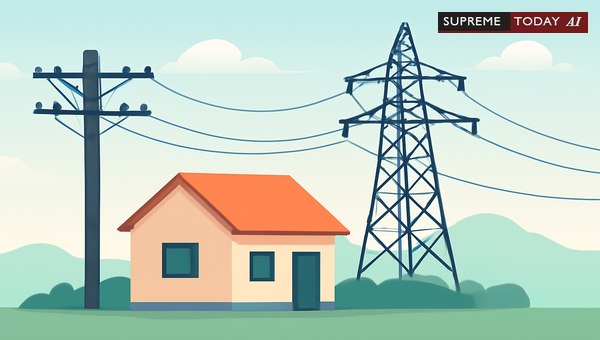
Is Electricity in India? A Comprehensive Legal Analysis
In the realm of property law, questions about classification can have significant implications for transactions, registrations, and disputes. One intriguing issue is: Is Electricity a ? This question often arises in contexts involving electric lines, connections, and infrastructure attached to land or buildings. Under Indian law, the answer leans toward yes—particularly when electricity manifests in fixed forms like lines and poles—but with important nuances.
This blog post breaks down the legal reasoning, drawing from jurisprudence, statutes, and key judgments. We'll explore why courts treat electricity infrastructure as , exceptions to consider, and practical implications for property owners. Note: This is general information based on legal precedents and not specific legal advice. Consult a qualified lawyer for your situation.
Understanding Under Indian Law
Indian law defines broadly. , states: shall include land, benefits to arise out of land, and , or . (emphasis added) It is in fact not a definition of but specify things which are not included within the term .2018 0 Supreme(All) 769 2016 0 Supreme(All) 1507
The , reinforces this by requiring registration for documents affecting , including permanently attached to land.2022 0 Supreme(P&H) 1076
Electricity as a 'Thing' and Property in Jurisprudence
Electricity isn't a tangible good like land, yet jurisprudence recognizes it as a thing or property. As elaborated in key legal analysis, electricity must be held to be a ''thing'' and, therefore, a ''property'' based on authoritative sources like Salmond and Paton. This broad legal conception extends to intangible rights and immaterial things that have a proprietary value.1963 0 Supreme(MP) 108
Courts have consistently viewed electricity in its delivered form—through fixed lines and connections—as falling within property laws. For instance, electric lines and connections are under the , because they are attached to land or structures and involve a physical, fixed presence, as held in H. Hard Municipality v H. Electric Supply Co.1963 0 Supreme(MP) 108
Key Judicial Recognitions
Several judgments explicitly categorize electric infrastructure as immovable:- Electric lines, poles, and connections permanently affixed to land or structures are akin to , thus .2011 0 Supreme(Guj) 387 1972 0 Supreme(Ker) 20- Courts interpret fixed electric lines as part of the immovable estate, subject to registration.2022 0 Supreme(P&H) 1076
In one case, electricity dues were recoverable from where the buyer had applied for a connection, but it was refused due to outstanding dues—highlighting electricity's tie to the property's status.2025 0 Supreme(All) 3095
Statutory Frameworks Supporting Classification
Authorities like electricity boards can place lines along or across under , and . These powers allow posts in or upon any , but emphasize the underlying land as immovable while granting limited rights for infrastructure.2023 0 Supreme(Cal) 1510
No document required by section 17 or by any provision of the , to be registered shall— (a) affect any comprised therein.2011 0 Supreme(Raj) 426 2000 0 Supreme(Ker) 330
This underscores that transactions involving fixed electric setups must comply with rules.
Exceptions and Counterarguments
Not all electricity-related elements qualify as immovable:- Temporary or movable equipment: Lines or devices not permanently attached may be movable property.- Mere contractual rights: to electricity supply, without fixed installations, aren't inherently immovable.- : Placing high-tension lines over property (e.g., at 14.2 meters height) grants utilities rights of user, not ownership transfer. Landowners retain title and can claim compensation for damages.2023 0 Supreme(Cal) 1510
In disputes, electricity service is a basic amenity akin to a property right. Disconnection requires due process, especially with existing connections.2023 0 Supreme(Mad) 1557
Practical Implications and Rights of Landowners
For property transactions:- Document electric connections as in records to avoid disputes.2022 0 Supreme(P&H) 1076- Electricity dues can attach to , affecting new owners.2025 0 Supreme(All) 3095
Landowners facing utility installations:- Entitled to compensation under .- Can challenge arbitrary disconnections; courts protect lawful connections.2023 0 Supreme(Mad) 1557
Ownership issues, like encroachments via infrastructure, require legal remedies—mere poles don't confer land title.1972 0 Supreme(Ker) 20
Recommendations for Stakeholders
- Property buyers/sellers: Verify and register fixed electric infrastructure to clarify title.
- Electricity boards: Explicitly note limited rights in agreements to prevent ownership claims.
- Policymakers: Consider statutes defining electric lines as immovable for streamlined processes.
Key Takeaways
- Electricity, via fixed lines and connections, is generally classified as under Indian law due to its attachment to land.1963 0 Supreme(MP) 108 2022 0 Supreme(P&H) 1076
- Judicial precedents and statutes like the Registration Act and Telegraph Act support this, treating it as .2011 0 Supreme(Guj) 387 1972 0 Supreme(Ker) 20
- Exceptions apply to temporary setups or pure service rights.
- Always prioritize registration and compensation claims in disputes.
In summary, while electricity as energy flow is intangible, its infrastructure integration makes it immovable in legal eyes. This classification ensures proper handling in sales, dues recovery, and infrastructure projects. For tailored advice, reach out to a legal expert.
References
- 1963 0 Supreme(MP) 108: Core jurisprudence on electricity as property.
- 2022 0 Supreme(P&H) 1076: Registration Act application to electric connections.
- 2011 0 Supreme(Guj) 387, 1972 0 Supreme(Ker) 20: Judicial views on fixed lines.
- 2025 0 Supreme(All) 3095, 2023 0 Supreme(Cal) 1510, etc.: Additional statutory contexts.












