


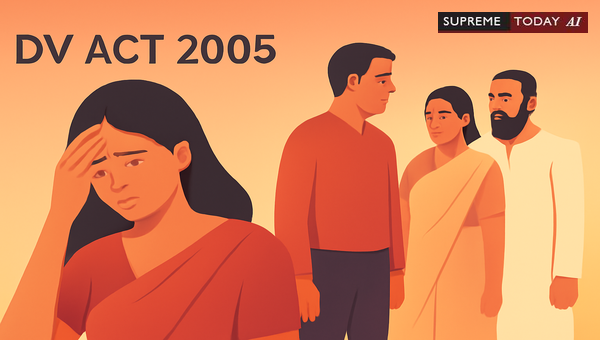
Husband Not Made a Party in DV Case: Legal Insights Under DV Act
In cases in India, a common dilemma arises: Dv me Husband Ko Party Nahi Banaya Gya – or, The husband was not made a party in the DV case. This often happens when a wife files proceedings against her in-laws for abuse, but hesitates or omits naming her husband directly. Is this permissible under the ? Does the husband's absence invalidate the case? This blog post dives deep into the legal framework, judicial precedents, and strategic considerations to clarify this issue.
We'll explore key principles, the role of the husband's , real-world case insights, and recommendations. Note: This is general information based on legal precedents and not specific legal advice. Consult a qualified lawyer for your situation.
Background on DV Proceedings
The DV Act, , is a landmark legislation aimed at protecting women from various forms of domestic abuse, including physical, emotional, verbal, sexual, and economic violence. It applies to women in domestic relationships, such as wives, and extends to relatives of the husband like in-laws. 2006 8 Supreme 1002
A frequent scenario involves wives seeking relief primarily against in-laws, especially if the husband is uninvolved directly or absent (e.g., due to work abroad). The question is whether proceedings can proceed without arraying the husband as a . Generally, the Act allows flexibility, but nuances exist regarding the husband's indirect role. 2015 0 Supreme(Ker) 867
Key Legal Principles: Must the Husband Be a Party?
1. Definition and Scope of
under includes any act, omission, or conduct by the causing harm. This broad definition covers not just direct perpetrators but also those whose enables abuse. For instance, The DV Act defines to include any act, omission, or conduct of the that results in harm or injury to the . This encompasses not only physical violence but also emotional and economic abuse. 2006 8 Supreme 1002
2. Husband's Inclusion Not Strictly Mandatory
Courts have held that the husband's presence is not strictly necessary when allegations target relatives. Proceedings can continue against in-laws alone, particularly if the husband is not directly accused. The presence of the husband in the is not strictly necessary for the proceedings to continue against his relatives. The Act allows for the possibility that a wife may seek relief against in-laws without the husband being a party, especially in cases where the husband may be absent due to work or other reasons. 2015 0 Supreme(Ker) 867
This is echoed in cases where prior FIRs or disputes exist without naming the husband initially. For example, in one matter, Yeh Baat Sahi hai Ki Manoj Sharma Ki Durghatna Wale Prakaran Mein Police ne mujhe Abhiyukt bhi nahi banaya. 2024 Supreme(Online)(MP) 23937 This highlights scenarios where parties proceed without the primary family member.
3. or as
Even without direct allegations, the husband's – like neglect or failure to intervene – can qualify as abuse. Courts may scrutinize this, potentially justifying his inclusion later. The husband's or , which may expose the wife to harassment or abuse by in-laws, can also be construed as . 2015 0 Supreme(Ker) 867
Supporting evidence from cases shows neglect's impact: suspecting the role of her husband Deepak Bhandari on the ground that her husband would not give time to the deceased, had neglected her.
Similarly, complaints note, Ki mere pati muje time nahi dete the... indicating emotional neglect contributing to distress.
In domestic disputes, such often ties to broader cruelty: Family Court noted the husband's behavior was not cordial, and allegations of were proved. This pattern underscores how neglect exacerbates in-law abuse. 2024 Supreme(Online)(MP) 43935
4. Judicial Precedents
Key rulings affirm flexibility:- : The clarified that proceedings under the DV Act focus on the 's nature, not strict formalities like marriage validity. This supports initiating cases against relatives without the husband if the context fits. 2017 0 Supreme(Bom) 2223
Other cases reinforce:- Bail applications where petitioners (relatives) were accused without the husband: Third Bail Application No. 16632/ Deeta @ Deetraj S/o Vala... against the petitioner is absolutely false because earlier the petitioner and in relation to that an FIR was lodged... land dispute with the husband.
- Charge sheets dropping co-accused but proceeding against husband/mother-in-law: Ultimately name of five co-accused has been dropped by the police and charge sheet was submitted against husband and mother-in-law.
These illustrate courts' pragmatic approach, allowing cases to proceed based on evidence against specific parties.
Integrating Husband's Role: Evidence from Related Cases
often involves layered family dynamics. Sources reveal:- Neglect and Emotional Distress: Husbands' failure to support, like not spending time, leads to suspicion of complicity. But bhagwan .... Ki mere pati muje time nahi dete the.
- Quarrels and : Frequent fights, economic pressure (e.g., demands to vacate home), and cruelty claims. Mere mana karne par mera pati... ko use lekar chala gya... mera pati ne ghar ka koi kharcha nahi uthaya aur mujh par dabav daalta raha. 2018 0 Supreme(Del) 1123- Suicide and Agony Contexts: In tragic cases, neglect contributes to mental breakdown, with FIRs under () and 498A. The deceased reportedly poured kerosene on herself... after a quarrel. 2024 Supreme(Online)(MP) 43935
These elements highlight why documenting the husband's strengthens claims, even if he's not initially named.
Recommendations for Victims
To build a strong case:- Include Husband if Feasible: It is advisable to include the husband in the if possible, as this may strengthen the case and provide a clearer context. 2015 0 Supreme(Ker) 867- Gather Evidence: Collect proof of neglect, like messages, witness statements, or medical records showing emotional harm. Focus on patterns: Gather substantial evidence of the husband's or .- Strategic Framing: Highlight family dynamics for comprehensive relief (, , ). Consider linking to cruelty under if applicable.- Seek Counseling: Address psychological impacts early, as health issues amplify vulnerability.
Conclusion and Key Takeaways
Under the DV Act, , proceedings against in-laws can generally proceed without naming the husband as a party, especially sans direct allegations against him. However, his passive role – neglect or enabling abuse – may warrant inclusion for a fuller picture. 2015 0 Supreme(Ker) 867
Key Takeaways:- Husband's inclusion is not mandatory but advisable for robustness.- Evidence of is crucial; courts recognize it as violence.- Precedents like D. Velusamy emphasize relational context over formalities. 2017 0 Supreme(Bom) 2223- Always prioritize safety and consult legal experts.
This framework empowers victims to navigate complex family disputes effectively. For personalized guidance, reach out to a family law specialist.
#DVActIndia, #DomesticViolenceLaw, #FamilyLaw















