Searching Case Laws & Precedent on Legal Query.....!
Analysing the retrieved Case Laws
Scanned Judgements…!



Searching Case Laws & Precedent on Legal Query.....!
Analysing the retrieved Case Laws
Scanned Judgements…!
False Cases Filed to Avoid Repayment - Several judgments indicate that false cases, including POCSO and other criminal charges, have been filed by parents or relatives to escape repayment of borrowed money. For example, ["2025 Supreme(Online)(Guj) 8372"] states that the case is foisted against him because the victim's parents borrowed money and then turned hostile, possibly to avoid repayment. Similarly, ["2022 Supreme(Online)(MAD) 29126"] and ["2025 Supreme(Online)(Mad) 76262"] highlight that false complaints were lodged due to previous monetary disputes, with evidence suggesting motives rooted in non-repayment of loans and previous financial conflicts.
Motive of Borrowers and Hostile Witnesses - Courts have noted that witnesses, including victims and their parents, sometimes turn hostile, especially when there is a financial dispute. For instance, ["2025 Supreme(Online)(Guj) 8372"] mentions witnesses turning hostile after a compromise, and ["2022 Supreme(Online)(MAD) 29126"] states that the victim girl and her parents did not support the case of the prosecution due to previous motives related to non-payment of borrowed money.
Lack of Supporting Evidence and Material - Courts have observed that allegations based solely on false complaints lack substantive evidence. ["2025 Supreme(Online)(Guj) 8372"] emphasizes the absence of support from the victim and her parents, and ["2022 Supreme(Online)(MAD) 29126"] notes that there is no material to support the case of the prosecution, suggesting falsehood.
Specific Cases of Borrowing and Non-Repayment - Multiple judgments detail that the accused had lent money, often supported by promissory notes or demand notices, and that the accused demanded repayment, which was not fulfilled. For example, ["2024 Supreme(Online)(KER) 19269"] and ["2024 Supreme(Online)(Ker) 79039"] describe cases where amounts like Rs.1 lakh or Rs.2.5 lakh were borrowed, with the accused issuing notices and filing suits, indicating genuine financial transactions rather than false accusations.
Courts’ Approach to False Accession and Repercussions - Some judgments suggest that when a false case is proven, courts should take strict action under relevant laws. ["2024 0 Supreme(Ker) 824"] states that if the POCSO Court found after trial that there is substance in the case of the accused that it is a false accusation, the Court should direct the Police to register a case under Section 22 of the POCSO Act.
No Evidence of Sexual Offense or Criminal Intent - In cases involving sexual allegations, courts have dismissed charges when evidence of falsehood or motive to escape financial liability was established. For example, ["SASIKUMAR CHELLAPPAN Vs STATE OF KERALA - Kerala"] dismisses anticipatory bail, citing false allegations linked to monetary disputes.
Analysis and Conclusion:The collected judgments predominantly reveal that in several POCSO and criminal cases, false accusations have been lodged by parents or guardians to evade repayment of loans or settle civil disputes. Courts have recognized motives such as previous financial conflicts, threats, and attempts to escape liability. They emphasize the importance of supporting evidence and have often found that witnesses either turned hostile or lacked credibility. When false allegations are proven, courts advocate strict legal action, including penal provisions under the POCSO Act or other relevant laws. Overall, these judgments underscore the need for careful scrutiny of allegations, especially when financial motives are evident, and highlight judicial caution in cases where false complaints are suspected.
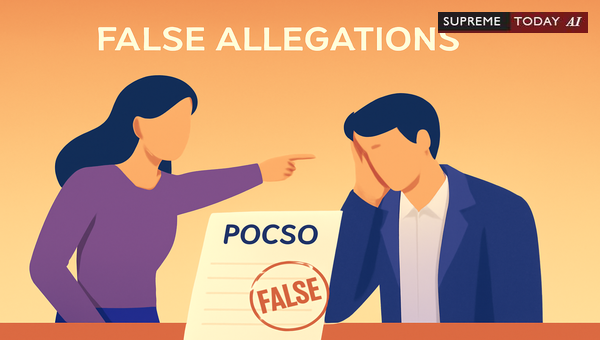
In the realm of child protection laws, the , stands as a robust shield against heinous crimes. However, like any powerful legislation, it can sometimes be misused for ulterior motives, such as settling personal scores or evading financial obligations. A common query arises: In POCSO cases, are there favorable judgments for the accused where the parents borrowed money from the accused and, to avoid repayment, filed a false case against them?
This blog delves into judicial precedents, legal provisions, and real-world examples highlighting how courts scrutinize such claims. While the POCSO Act presumes certain protections for victims, it also incorporates safeguards against false complaints. Note: This is general information based on precedents and not specific legal advice. Consult a qualified lawyer for your situation.
Courts, including the , have repeatedly cautioned against the misuse of POCSO for false or malicious allegations, particularly in cases tied to family disputes or financial motives. 2025 0 Supreme(Mad) 2588 The law presumes guilt under Sections 29 and 30 of the POCSO Act once the prosecution establishes the offense, but it equally recognizes false accusations. Section 22 explicitly punishes false complaints or information, empowering courts to direct investigations if arises. 2025 0 Supreme(Mad) 2588
For instance, judgments emphasize diligent scrutiny in cases involving extraneous motives. The and have warned against vengeful filings in custody battles or personal vendettas. In , concerns were raised about false cases against biological parents for custody manipulation. 2024 0 Supreme(Ker) 824 Similarly, the in stressed cautious handling where allegations arise amid disputes. 2024 0 Supreme(Ker) 824
A recurring theme in defenses is financial disputes, where complainants allegedly file false POCSO cases to dodge debts. Courts have acknowledged this pattern, though proof is crucial.
In one case, it was argued that to escape from the clutches of law and also to swallow the borrowed money, they have foisted the false case. 2022 Supreme(Online)(Mad) 72966 Here, the wife of the appellant had lent money, leading to quarrels and threats, after which a false POCSO complaint emerged.
Another precedent notes: As they have failed to repay Rs.3000/- borrowed from the petitioner, he has asked them to repay the amount. In order to avoid payment, they had filed the complaint against the petitioner.
SASIKUMAR CHELLAPPAN Vs STATE OF KERALA - Supreme(Online)(KER) 55811
The petitioner claimed innocence, asserting the complaint was instigated to evade the debt.Even in cases where convictions were upheld, defenses highlighted similar motives. For example, On behalf of the accused, it was suggested that the father of the child victims had borrowed Rs. 5,000/- from the accused, and to avoid the repayment a false case has been filed. 2020 0 Supreme(Bom) 999 2020 0 Supreme(Bom) 1223 Though the court found child testimony reliable, such suggestions underscore how financial grudges factor into defenses.
These examples illustrate that courts consider ulterior motives like unpaid loans but demand concrete evidence to discredit prosecution claims.
This provision is a cornerstone: The court shall consider the evidence and may direct the police to investigate if there is of false allegations. 2025 0 Supreme(Mad) 2588 It deters misuse and allows counteraction against malicious filers.
Sections 29 and 30 create , but the accused can prove lack of intent or involvement.
The prosecution bears the burden of , factoring in witness credibility and motives. 2014 6 Supreme 449
In Prem Singh, the absence of motive or evidence of ulterior factors was pivotal, urging thorough scrutiny. 2002 4 Supreme 53
While not all defenses succeed, several judgments favor accused when financial motives are substantiated:
Debt Evasion as Motive: In scenarios mirroring the query, courts have noted quarrels over unpaid loans leading to false filings. One case involved a defacto complainant borrowing for business but citing COVID losses to avoid repayment, prompting a counter-claim of false complaint.
Provocation and Context: In a related IPC matter, refusal to repay borrowed money fueled disputes, influencing the court's reduction from murder to . 2015 0 Supreme(Mad) 3441
Investigation Flaws: Courts acquit when probes reveal manipulation, as in a murder case tied to debt where evidence failed to form a complete chain. 2018 0 Supreme(Del) 2734
have granted bail or quashed proceedings when prima facie evidence points to falsehoods motivated by money. However, in educator-minor cases, bail is often denied due to gravity, emphasizing protection. 2021 0 Supreme(Ker) 468
Not every financial dispute claim succeeds. Courts prioritize child testimony reliability, medical evidence, and investigation fairness. In one conviction under (analogous to POCSO), a Rs.5,000 loan defense was dismissed for lacking corroboration. 2020 0 Supreme(Bom) 999
Key Limitations:- holds; prosecution must prove guilt.- Motives alone don't suffice—evidence of collusion is needed.- Child witnesses' credibility often trumps suggestions without proof.
Favorable and High Court judgments exist for POCSO accused when false allegations stem from parents' unpaid debts, provided robust evidence disproves claims. Provisions like Section 22 and judicial precedents 2025 0 Supreme(Mad) 2588
offer recourse, but success hinges on facts. Innocents deserve protection from malicious misuse, yet child safety remains paramount.
Takeaways:- Courts caution against POCSO misuse in financial/family feuds. 2024 0 Supreme(Ker) 824- Prove motives with evidence for acquittal or bail.- Always consult professionals—outcomes vary.
References (Solely from provided documents):1. 2025 0 Supreme(Mad) 2588 - False complaints and Section 22.2.
- Motivated falsehoods.3. 2024 0 Supreme(Ker) 824 - Custody misuse warnings.4. 2022 Supreme(Online)(Mad) 72966,
SASIKUMAR CHELLAPPAN Vs STATE OF KERALA - Supreme(Online)(KER) 55811
, etc., for debt-related defenses.Stay informed, stay protected.
#POCSOFalsesCases, #SCJudgmentsPOCSO, #LegalSafeguards


PW-1 also admitted that the accused came to his house to demand money borrowed by him. Therefore, it is evident that PW-1 borrowed money from the accused and as the accused demanded to repay the said debt, that the present case is foisted against him. ... Further, the very defence set up by the accused in the trial Court is that as PW-1, who is the father of the victim girl, borrowed mon....

The learned counsel submitted that actually Rs.2,50,000/- was borrowed after executing a promissory note on 10.01.2021. When the defacto complainant failed to repay the amount as agreed, the accused demanded the same and at this juncture, the defacto complainant filed Annexure 1 complaint. ... As per Annexure 5 demand notice and Annexure 6 copy of plaint, it is discernible that the petitioner issued notice and filed a suit alleging that the defacto complainant borrowed Rs.1 lakh on 27.....

In the meanwhile, in order to escape from the clutches of law and also to swallow the borrowed money, they have foisted the false case against the appellant. ... Further, due to fear of parents and society and also the threat made by the accused, they would not immediately come forward to reveal the same to others. ... 15.The contention of the learned counsel for the appellant is that the mother of the victim had borrowed money fro....

The learned counsel submitted that actually Rs.2,50,000/- was borrowed after executing a promissory note on 10.01.2021. When the defacto complainant failed to repay the amount as agreed, the accused demanded the same and at this juncture, the defacto complainant filed Annexure 1 complaint. ... The sum and substance of the case centered on borrowing of money by the defacto complainant from the accused, demand of the same by the accused by issuing suit....

In the meanwhile, in order to escape from the clutches of law and also to swallow the borrowed money, they have foisted the false case pleaded not guilty. ... money from the wife of the appellant and did not repay the amount and therefore, there was a quarrel threat made by the accused, they would not immediately come forward to ... of the victim and foisted the false case#HL....
In fact, the victim girl in her evidence states that her parents borrowed loan from the Finance Company owned by the said Ramesh, since they were unable to repay the loan along with interest and there was some dispute, suppressing this fact a complaint was lodged against him. ... 7.The learned Additional Public Prosecutor submitted that in this case, the accused belongs to a dominant community in the area with considerable money, muscle and political power. ... The victim's ....
Moreover, it is not sufficient enough to show that the money has been retained by the accused, and the prosecution has to show that the accused dishonestly disposed of the same in some way or dishonestly retained the same. ... Hence the petitioners filed a suit in O.S. No.87 of 2019 on the file of the District Munsif Court, Padmanabhapuram and the same is pending. Whileso the second respondent came forward with the false complaint stating that the petitioners borrowed....

He would also submit that defacto complainant borrowed money for his business during the month of June and July 2020 and promised to repay the same within four months. ... The learned counsel for the intervenor/defacto complainant would submit that he had availed hand loan from the accused persons and could not repay the same due to covid-19 restrictions and there is loss of business and income. ... He would also submit that the defacto complainant inorder#HL_E....

As they have failed to repay Rs.3000/- borrowed from the petitioner, he has asked them to repay the amount. In order to avoid payment, they had filed the complaint against the petitioner. The statement under Section 164 Cr.P.C has been given by the victim stating the alleged sexual assault. ... The learned counsel for the petitioner contends that the petitioner is innocent of the allegations levelled against the petitioner and a false complaint was lodged by the de facto complainant at the instance of h....
Subsequently, he did not repay the amount nor be took any care register a case against the accused person in respect of the complaint dated 24.02.2015. ... The petitioner also found that the said Sekar lodged a false complaint on 30.04.2013 Rs.3,00,000/- for which he executed a promisory note dated p style="position:absolute;white-space
There used to be frequent quarrels between them by reason of refusal to repay money borrowed by the deceased and for not assisting the accused in preparing food. At about 3.45 p.m accused came to the workshop to fetch a wooden piece. Both of them belong to Matelli Panchayath, Jalpaiguri District in West Bengal and came to Kerala in search of work for their livelihood. On 18.06.2014 both of them were seen together at 3 p.m proceeding to the hall with vegetables purchased, situated at a lower level to the workshop.

On behalf of the accused, it was suggested that the father of the child victims had borrowed Rs. 5,000/- from the accused, and to avoid the repayment a false case has been filed. Other than this suggestion, nothing was elicited from PW1 to doubt her clear testimony. In the course of the cross-examination, absolutely no dent has been made to the clear testimony of PW1.
In the course of the cross-examination, absolutely no dent has been made to the clear testimony of PW-1. On behalf of the accused, it was suggested that the father of the child victims had borrowed Rs. 5,000/- from the accused, and to avoid the repayment a false case has been filed. Other than this suggestion, nothing was elicited from PW-1 to doubt her clear testimony.

It is not the case that the four accused sought to steal from the deceased and therefore, the recovery of the wallet from the possession from one of the accused is hardly of any help to the prosecution case. The prosecution has sought to argue that the motive for the commission of this murder was for the four accused to avoid having to repay the sum of money which they had borrowed from the deceased.
This resulted in a quarrel between them one year before the occurrence. It is alleged that the deceased stabbed the accused with a knife and in this regard, a case had been registered on the file of the Manavalankurichi Police Station in Crime No. 105/2003 under Section 307 of I.P.C against the deceased. It is alleged that the deceased had borrowed money from the accused and he did not repay the same.


An indispensable Tool for Legal Professionals, Endorsed by Various High Court and Judicial Officers
Please visit our Training & Support
Center or Contact Us for assistance

Scan Me!
India’s Legal research and Law Firm App, Download now!


For Daily Legal Updates, Join us on :



 Back to top


